
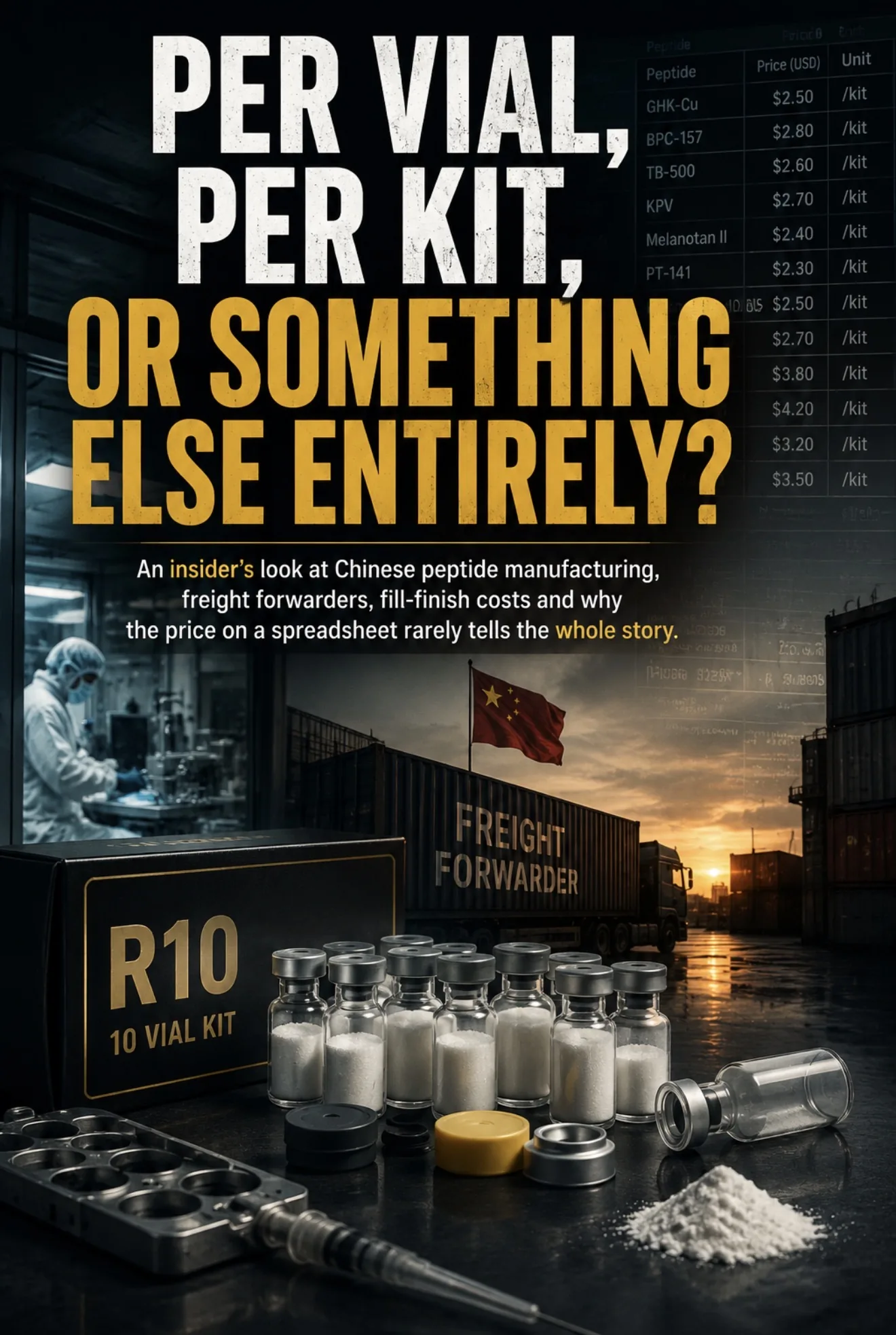
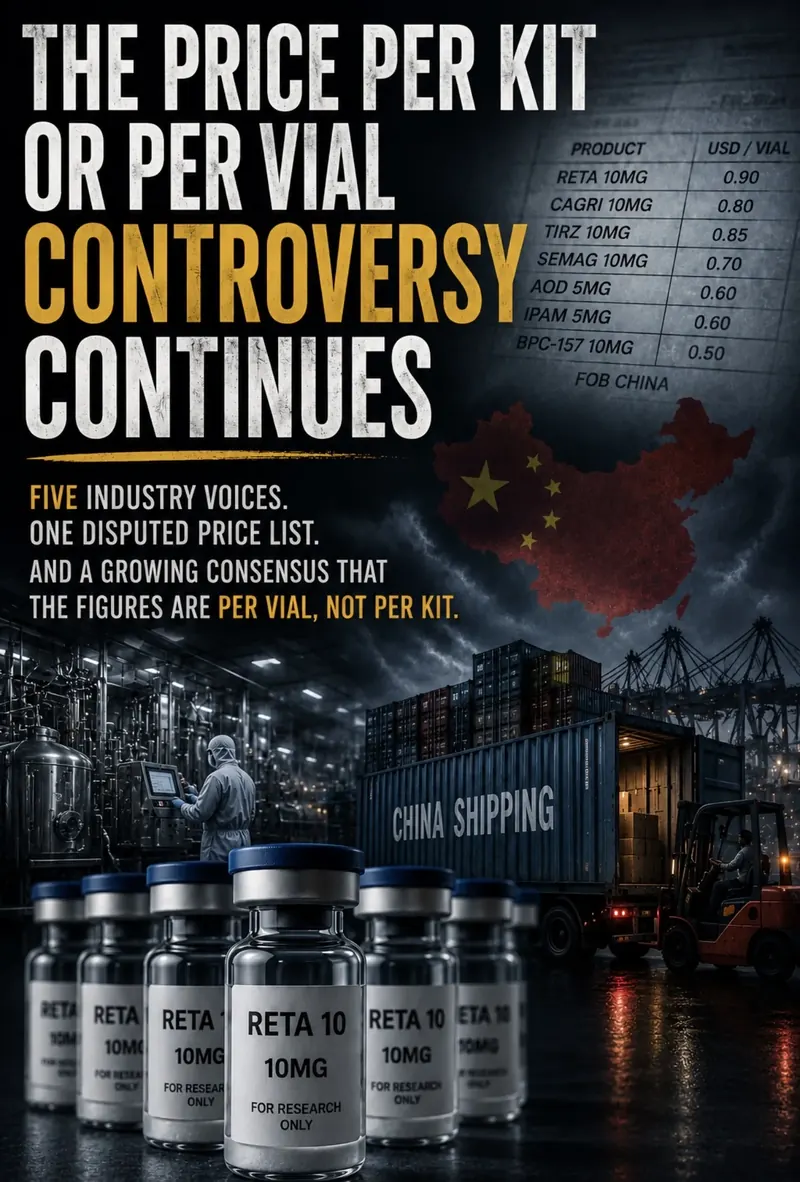
Regarding the recent price list I posted, and the debate over whether those figures are per kit or per vial, I asked someone with direct experience buying peptide raws and doing his own lyophilisation for his view.
His first reaction was that the prices looked more likely to be per kit, not per vial. In his own example, he said his all-in cost for an R10 kit is around 12.56 CAD, which converts to roughly $9 USD for a 10-vial kit. That includes the vial, stopper, cap, case, water, excipients, label and buffer.
He also made the point that, at scale, many peptide raws are not priced as differently as people often assume. There are obvious exceptions. He named Cagrilintide, Tesamorelin, TB4 and FOXO4 as expensive examples, and later said he had paid $120 per gram for MOTS-c. But for many common peptides, he said the raw-material cost can sit within a surprisingly close range once you are buying in bulk.
Where the pricing becomes more complicated is the difference between domestic Chinese pricingand international export pricing.
According to him, Chinese domestic raws can be significantly cheaper when there is no middleman involved. He estimated that some domestic pricing may be around 40% of what he pays internationally. He also gave KPV as an example, saying it cost him around $52/g with a forwarder or $85/g without one, and that kilo-level buying would likely bring the cost down further.
The use of a forwarder is an important part of this. In that setup, the manufacturer is not providing a full export service. They simply ship domestically within China to a freight forwarder. Once the package reaches the forwarder, the risk shifts to the buyer.
As he put it: “forwarder = no reship.”
That matters because it strips out a lot of the costs people associate with international vendors: customs risk, seizure losses, replacement shipments, customer support, warehousing, and the added expense of getting product safely into another country. A domestic China quote and a fully delivered international price are not the same thing.
The biggest qualification he made was that the list may not include the raw peptide at all. It may instead represent fill-finish or manufacturing costs, where the buyer supplies the raw material separately.
In that model, the buyer sources the raws, sends them to a factory, and pays the factory to vial, lyophilise, package and label the product. He said some factories charge per vial for that work, sometimes as low as $0.15 per vial depending on volume.
That would explain why some of the numbers look extremely low without automatically making them impossible. They may not be finished-product costs. They may be processing costs.
He also pointed out that not every peptide costs the same to manufacture after the raw stage. Some compounds need additional buffers, more formulation work, or longer lyophilisation cycles. Others, such as GHK or PT-141, may be faster and simpler to freeze-dry.
So the useful takeaway is a price can mean very different things depending on whether it includes:
the raw peptide,
domestic Chinese delivery only,
fill-finish work,
lyophilisation,
packaging,
international shipping,
seizure risk,
reship guarantees,
warehousing,
and reseller markup.
Without knowing which of those are included, it is very easy to compare two completely different types of pricing and draw the wrong conclusion.
The real question is not just “is this per kit or per vial?” The better question is:
Comments