
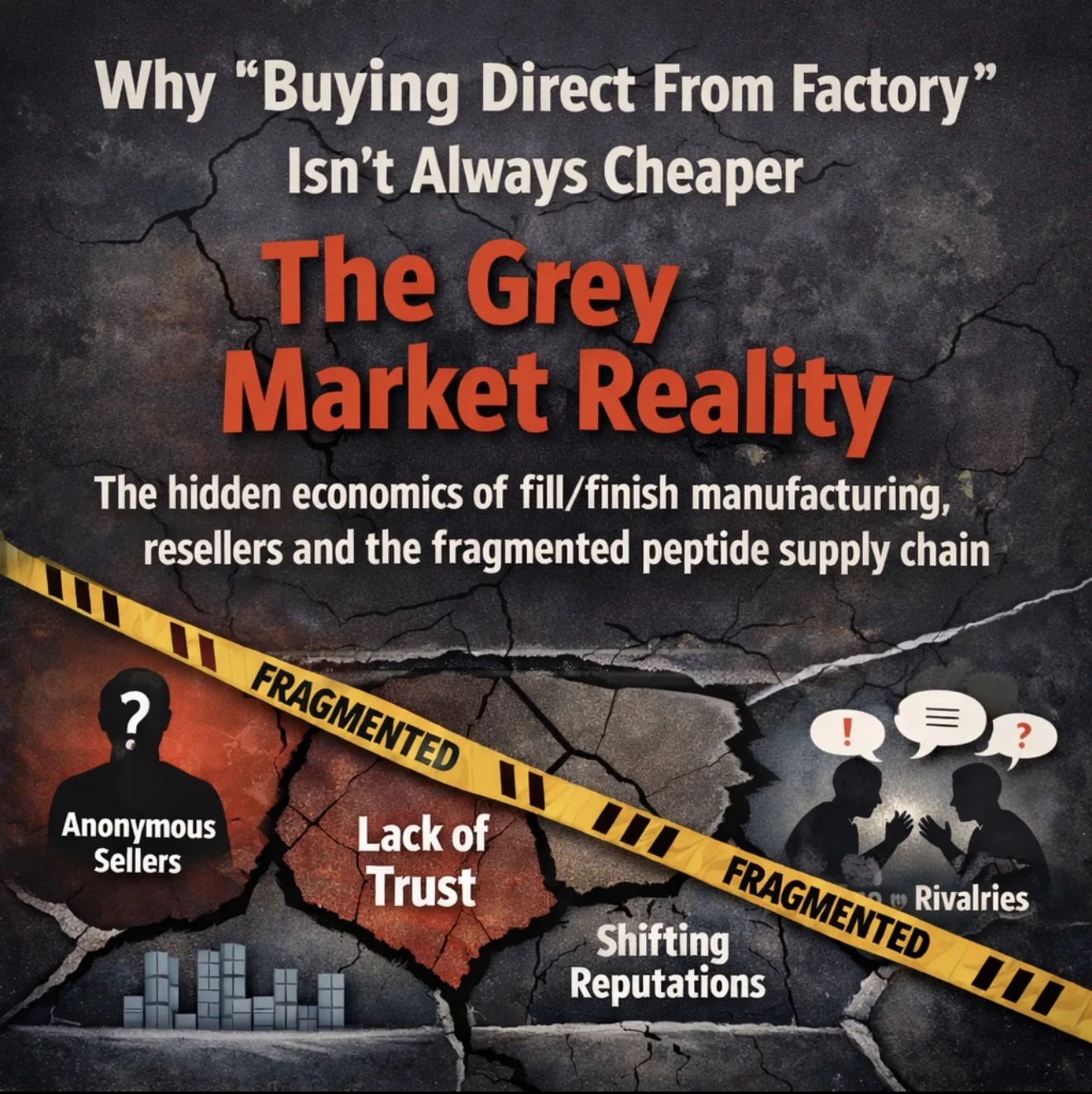
Something that gets asked repeatedly in the grey market peptide community is this:
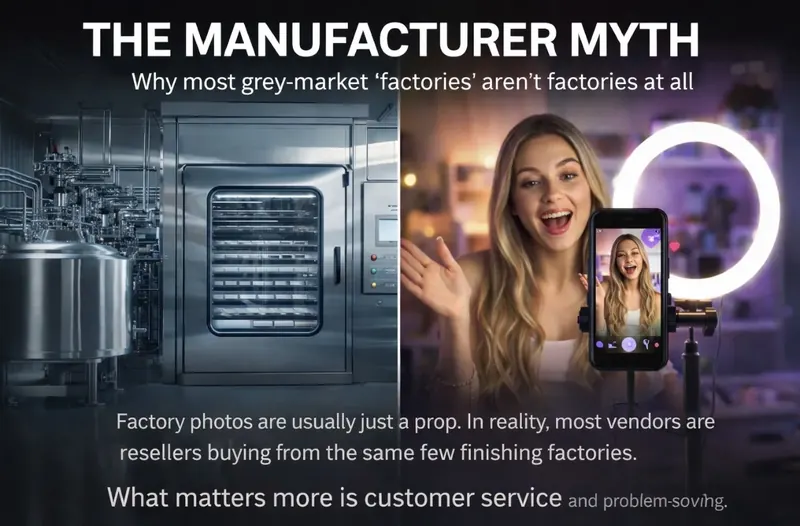
Given X vendor is supposed to be a manufacturer, why are their products more expensive than from resellers.
Yet we all know the likes of Uther, Nexaph, TCI are significantly more expensive than the others.
The assumption seems obvious.
Remove the middleman and the price should go down.
But when it comes to peptides, that logic often breaks down.
In many cases, buying directly from a fill/finish laboratory can actually cost more than buying from a reseller.
At first this feels backwards. But once you understand how peptide production and distribution actually work, the pricing difference starts to make sense.
Understanding the Peptide Supply Chain
I covered this entire structure in a previous post, breaking down how each layer works and why buyers rarely interact with the original manufacturer.
If you want a deeper explanation of that supply chain, you can read it here:
API Manufacturers
The upstream manufacturers produce bulk peptide powder (the API).
These companies operate as wholesale chemical producers.
They generally do not sell directly to the public.
Fill/Finish Laboratories
The fill finish factories are where the powder is made into finished vials.
This process usually involves
dissolving the peptide
sterile filtration
filling vials
freeze drying (lyophilisation
sealing and packaging
This stage requires expensive infrastructure:
cleanrooms
sterile filtration systems
vial filling equipment
lyophilisers
environmental monitoring
trained staff and quality control processes
Even outside the fully regulated pharmaceutical world, sterile manufacturing still requires specialised equipment and expertise.
Because of this, fill/finish facilities are designed to operate like production plants, not retail stores.
They make money by running large production batches, often thousands of vials at a time.
Why Small Orders Become Expensive
This is where the pricing paradox begins.
Fill/finish manufacturing behaves economically like a production campaign, not a retail transaction.
When a production line runs, the major costs include:
line setup
equipment sterilisation
cleaning and changeover
quality control
documentation
lyophilisation cycles
staff time
facility utilities
Many of these costs are fixed per batch, not per vial.
Whether the line fills 500 vials or 30,000 vials, the setup process still has to happen.
So if a buyer approaches a fill/finisher asking for a small order, perhaps a few kits or a few dozen vials, those fixed costs must be spread across far fewer units.
The result is a much higher price per vial.
This is often called the small order penalty.
To avoid this inefficiency, many finishers introduce:
minimum order quantities
minimum spend requirements
refusal of retail scale order
From their perspective, handling hundreds of small buyers is operationally inefficient and disruptive to production.
Lyophilisation and Equipment Capacity
Lyophilisation makes this dynamic even more pronounced.
Freeze drying cycles can take many hours or even days, meaning the equipment is occupied for long periods.
In large pharmaceutical operations, the cost of occupying a fill/finish production slot can run into hundreds of thousands of dollars per production campaign.
This illustrates how the real cost driver in sterile manufacturing is often equipment time and capacity, not the peptide powder itself.
So when a buyer thinks they are paying for “just a vial”, the manufacturer is actually pricing around production capacity and operational overhead.
Why Resellers Can Sometimes Be Cheaper
Resellers operate under a completely different business model.
Instead of manufacturing peptides themselves, they typically:
purchase large quantities of finished vials
hold inventory
split the inventory into smaller retail units
sell them to individual buyer
Because they bought the product in large bulk quantities, they often receive a much lower unit price from the finisher.
Once they have the inventory, they can break it down into:
kits
small vial quantities
group buy allocations
They can then sell these pieces individually while still remaining competitive on price.
In other words:
The reseller purchases large batches at wholesale pricing and then splits that inventory into many smaller retail sales.
This is why a reseller can sometimes add a margin and still appear cheaper than buying “direct.”
The Retail Advantage
Resellers are also built to handle things manufacturers often avoid:
small payments
customer support
shipping logistics
order splitting
communication with hundreds of buyer
Fill/finish labs are usually production focused operations.
Resellers are distribution businesses.
Those two roles have completely different cost structures.
The Layered Grey Market
Another important factor is how the grey market ecosystem has evolved.
The peptide supply chain is often deliberately fragmented.
Instead of one clean pipeline from factory to buyer, the market often looks like a layered system with;
brokers
distributors
resellers
group buy organiser
domestic depots
These layers exist because they solve practical problems:
minimum order sizes
international shipping
payment barriers
communication barriers
customs risks
The result is a market where many sellers compete at the retail interface, even though the actual production sources may be far fewer.
Uther as a Real Example
A recent message from Uther illustrates the issue clearly.
Uther explained that due to restructuring, inventory issues, and production pressure, it could no longer:
offer discounts
manage small orders directly
handle group buys
They introduced a minimum order of $800 and stated they could not afford to waste time on small purchases.
This response makes perfect sense when viewed from a production perspective.
A fill/finish operation managing production schedules, inventory, and equipment capacity simply isn’t designed to handle hundreds of small retail buyers.
The closer a company is to the manufacturing stage, the less suitable it often becomes for retail scale distribution.
Why the Market Remains Fragmented
The grey market peptide market could potentially operate far more efficiently if different roles in the supply chain worked together.
The basic structure already exists, manufacturing, finishing, distribution and retail, but in the grey market these roles usually operate independently rather than as a coordinated system.
A more efficient model might look like this;
one group focuses on manufacturing and processing
another handles retail distribution
another organises group buys and logistics.
Under a coordinated system, the supply chain could be far more stable and efficient.
But the grey market rarely works this way.
The environment is fragmented.
Many participants operate anonymously.
Reputations shift quickly.
Trust between sellers is limited.
And, as is often the case in small competitive ecosystems, egos tend to get in the way of cooperation.
Everyone is protecting their own margins.
So rather than a coordinated industry, the market often behaves more like multiple vendors fighting over the same space.
The Real Takeaway
The assumption that “factory direct should always be cheaper” doesn’t always apply in the peptide world.
Fill/finish laboratories are designed to manufacture large batches efficiently, not to serve retail buyers.
Resellers specialise in breaking those batches down and distributing them to smaller buyers.
Because of this difference, the reseller, not the manufacturer, can sometimes offer the lower price.
It may seem counterintuitive, but it’s simply the economics of how peptide production and distribution actually work.
The grey market loves the phrase “buy direct from the factory.”
It sounds like the smartest move.
But in practice, the factories are built to run production lines, not to manage hundreds of small retail buyers.
So the real irony is this:
The closer you get to the factory, the less interested they often are in selling to you.
And that’s exactly why the reseller exists
Comments