
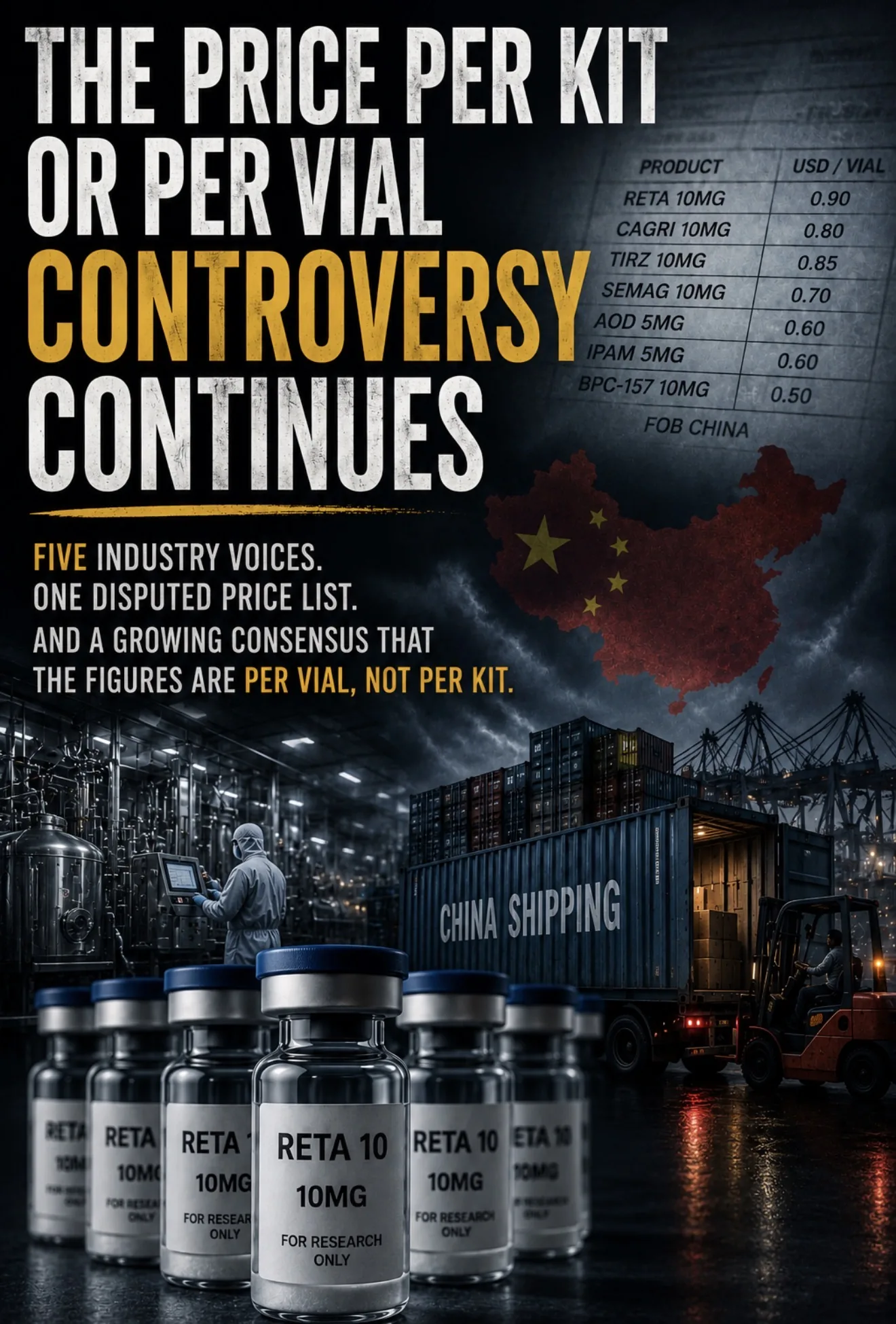
After publishing the original post, I received additional feedback from several people with different positions in the production chain
Sales Representative for a China based lyophilising factory
He explained that they offer contract lyophilisation services, where the customer supplies the API (raw peptide) and the company handles the freeze-drying and vialing process.
According to them, the processing cost is typically around RMB 80 to 100 ($12 to 15 USD) per box. However, based on that figure, they personally do not believe the pricing list in question represents a per-box cost.
They also noted that the peptide industry is highly competitive and suggested that some companies may be using unused manufacturing capacity to aggressively compete on price, potentially offering lower rates than would normally be expected.
In short, they confirmed that contract manufacturing with customer-supplied raws is common, but expressed skepticism that the disputed prices represent a complete boxed product at those levels.
Another China based contact
They broke peptide pricing down into several components rather than treating it as a single cost.
Using Retatrutide as an example, they claimed raw material costs can range from $100 to $200 per gram, with higher-quality raws costing more but offering better purity. They also stated that manufacturers typically use 10 to 20% more raw material than the theoretical amount to account for losses during production and transport.
According to them, 1 gram of RT10 can produce roughly 80 vials, and the finished product may test slightly above label claim due to overfilling and production allowances.
They estimated:
Lyophilisation/production costs: under $1 per vial
Packaging costs: under $0.50 per vial
They added that transportation, storage, labour, regulatory compliance and profit margins all contribute to the final selling price.
The overall message was that peptide pricing is made up of multiple layers, raw materials, manufacturing, packaging, logistics and profit, not just the cost of the peptide itself.
Lawrence from Clear Batch
Lawrence strongly rejected the idea that the disputed figures could represent properly manufactured finished peptide kits. He argued that anyone believing complete kits could be produced for a few dollars each was ignoring the realities of manufacturing and distribution.
According to Lawrence, normal production costs are around $1.50 per vial, with exceptionally efficient, high-volume operations potentially reducing that to around $1 per vial. He also noted that suppliers typically apply significant markups to those costs, particularly for single-compound products.
However, he stressed that manufacturing itself is not the biggest issue. In his view, the real costs come from regulation, compliance requirements, shipping challenges, licensing risk, operational overhead and the general complexity of operating in the industry. These factors create a premium that cannot be ignored when assessing realistic pricing.
Lawrence argued that if the industry operated in a fully legal, low-risk environment, the economics would look very different. He suggested that a product like this could potentially retail for around $20 per box, but said the reality of regulation, risk and logistics makes it impossible to compete at the lowest prices being discussed.
While he acknowledged that retail prices can be heavily marked up, he maintained that claims of properly manufactured finished kits at the very lowest quoted prices were not credible. His overall position was that the disputed figures, if quoted per kit, don’t reflect the true costs involved in producing and supplying a quality peptide product.
Peptide Critic
Peptide Critic took a firm position that the disputed figures are per vial, not per kit.
Using Retatrutide as an example, he said that a Reta 10 kit at around $40 when buying 25+ kits is not unusual, and that he had seen prices as low as $30 per kit before the disruption caused by Chinese New Year.
Based on his experience, he believes anyone interpreting the disputed figures as kit pricing is mistaken. His view is grounded in what he sees in the wholesale peptide market, where bulk-purchase pricing is already well established.
In short, his position is that the numbers make sense as per-vial pricing, but not as complete kit pricing.
Previous RUO Website Owner
He believes the disputed figures are per vial, not per kit.
He disagreed with the costings in my previous article saying that around $2 per vial for Reta 10 sounded more realistic. He added that he had not seen raw peptide prices low enough to support properly manufactured finished products costing under $1 per vial.
He also pointed out that manufacturing costs extend beyond the peptide itself. In his view, producers either need to purchase sterile vials or wash and sterilise them in-house, both of which add significant cost. He specifically noted that sterile vials are a major expense that is often overlooked when people attempt to calculate manufacturing costs.
Overall, his position was that the figures make more sense as per-vial pricing, and that raw material costs, sterile packaging and production requirements make extremely low finished-product costs difficult to justify.
Conclusion
After speaking to five people from different parts of the peptide supply chain, it looks like the original price list I posted is per vial not per kit.
Taken together, their comments suggest a rough manufacturing or wholesale cost of around $1 to $4 per vial, with approximately $2 to $2.50 per vial emerging as the centre of gravity.
For a 10-vial Reta 10 kit, that would imply something in the region of $20 to $25 per kit before additional costs such as testing, shipping, warehousing, payment processing, customer support, seizure risk and profit margins are added.
Perhaps the most surprising outcome of this exercise is that, while there was disagreement over whether the disputed list represented kit pricing, vial pricing or manufacturing costs, most of the people consulted ultimately converged on a similar ballpark figure.
The responses suggest that the true answer is probably far closer to a few dollars per vial than a few dollars per kit.
But regardless of whether the original list turns out to be per vial or per kit, one thing became clear throughout these discussions, the underlying costs being quoted are still remarkably low compared to the prices many end users ultimately pay. The disagreement isn’t over whether there is a mark up between manufacturing and retail. The disagreement is over how large that gap really is, what costs sit in the middle, and how much of the final price reflects production versus logistics, regulation, risk and profit.
Comments