
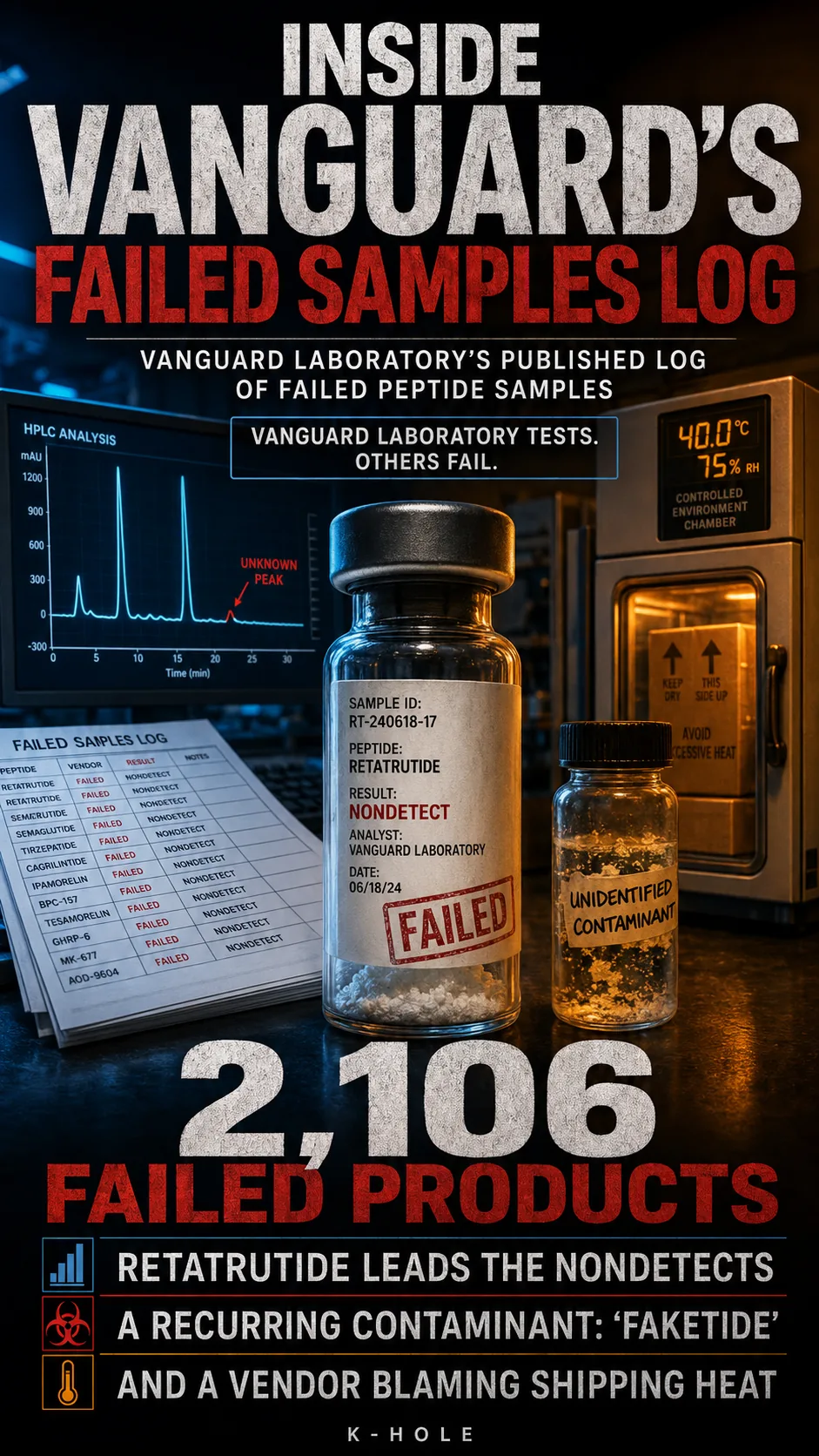
https://docs.google.com/spreadsheets/d/1VxKLbWqLiZG_T01AqxoQIXmbEgtQpIQMS0vNWWFIqQM/edit?usp=sharing
Vanguard Lab’s failed-samples log contains 2,106 entries recorded between 17 February and 27 July 2026.
The monthly totals are:
February: 48
March: 337
April: 276
May: 325
June: 594
July: 526 by 27 July
Retatrutide was the product most commonly listed with a non detect result. There were 27 entries labelled Retatrutide, two labelled GLP-Reta and one labelled Retatrutide 60mg, giving a total of 30.
However, Vanguard has clarified that “non detect” doesn’t automatically mean the vial contained no peptide. According to Dustin from Vanguard Laboratory, non detect could mean there was no peptide, the wrong peptide was present or, in the case of a blend, one of the expected compounds wasn’t detected.
Dustin initially said that where a purity figure appeared alongside a non detect result, the vial had most likely been mislabelled by the client. He later clarified that only a few entries resulted from customer mislabelling and that these cases were normally easy to identify.
One example would be a customer submitting samples marked Retatrutide and Tirzepatide, only for the vial labelled Tirzepatide to test as Retatrutide and the vial labelled Retatrutide to test as Tirzepatide.
The google spreadsheet contains a notes column intended to make the different types of failure clearer.
Dustin also said that many of the apparent zero-peptide samples contain the same unidentified peak, which doesn’t match any peptide in Vanguard’s library. This has led him to believe that many may have come from the same supplier. When asked whether a vial containing only pure mannitol would produce that unidentified peak, Dustin said no. The peak Vanguard is repeatedly seeing isn’t mannitol.
Vanguard internally refers to the recurring unknown contaminant as “faketide.”
The discovery raises another question about what may be happening at the kit level. One possibility raised in the lab discussion was that a seller could replace one good vial in each kit with a fake or zero-peptide vial. If only one vial from a ten-vial kit is selected for testing, the substituted vial would have only a one-in-ten chance of being chosen. That “kit cutting” theory hasn’t been confirmed by Vanguard, and Dustin didn’t say it was common practice. It remains a worst-case possibility raised during the discussion, not a conclusion established by the data.
MOTS-C was comfortably the most common product failing on purity. The google sheet contains 142 standalone MOTS-C entries below Vanguard’s 98.9% threshold, rising to 148 when blends containing MOTS-C are included.
The next most common standalone products failing Vanguard’s 98.9% purity threshold were:
Retatrutide: 86
NAD+: 82
Tesamorelin: 78
SS-31: 72
BPC-157: 71
The overall number of recorded failures has risen sharply. March recorded 337, while June recorded 594. July had already reached 526 by the 27th.
There may be a slight levelling off after June, but the number remains far higher than it was earlier in the year. Non detect results peaked at 92 in May, dropped to 67 in June and had already climbed to 77 by 27 July.
There is an important limitation.
This is Vanguard’s failure log, not its complete testing record. Without knowing how many samples Vanguard tested each month, it cannot tell us whether the percentage failing has increased. It only shows that the number of recorded failures has risen.
The clarification changes how the non detect figures should be described. Retatrutide is the product most frequently listed as non detect, but those entries cannot all be treated as confirmed zero-peptide vials.
What the data does show is a dramatic increase in the number of failures recorded by Vanguard, MOTS-C dominating the substandard-purity results and a recurring unidentified contaminant across multiple non detect samples.
That contaminant is not mannitol, does not match any peptide in Vanguard’s library and appears frequently enough that the lab has given it its own name: faketide.
Bella Zhang Blames Shipping Heat
Bella Zhang has now offered an explanation for the zero-peptide white-cap tirzepatide she sent me. Bella said zero-peptide readings are mainly caused by high temperatures because peptides have poor heat resistance. According to her, heat generated during trans shipment and temporary warehousing for cross-border air freight can completely deactivate the active ingredient, leaving nothing detectable when the vial is tested.
She maintained that all raw materials and finished products from her factory are manufactured according to official standards and that certification reports are issued for every batch before shipment. On that basis, she said the white-cap products had passed all quality checks when they left the factory.
Bella also repeated that my original shipment had been held by customs for a random inspection and that new replacement products had subsequently been sent. She said the factory could not control or trace unforeseen incidents occurring while products were in transit.
Dustin from Vanguard Laboratory directly challenged that explanation. He offered to place tirzepatide in a controlled heated stability chamber for several days and said he could guarantee that the tirzepatide would still be detectable afterwards. Dustin said Vanguard regularly conducts degradation studies for FDA-regulated clients. In his view, unless a sample was placed in a furnace or subjected to residue-on-ignition conditions, traces of it would remain detectable. He said there was no realistic way for ordinary transport temperatures to make the active ingredient completely disappear.
Heat exposure during shipping can cause degradation and reduce potency, particularly where moisture or damaged seals are involved. However, that is very different from the peptide vanishing entirely and leaving no detectable trace.
Hopefully as more labs post their results we’ll get a better picture. And thanks to Dustin for being so quick of the mark to produce this. He even managed to produce the first copy while at the gym!

Comments