
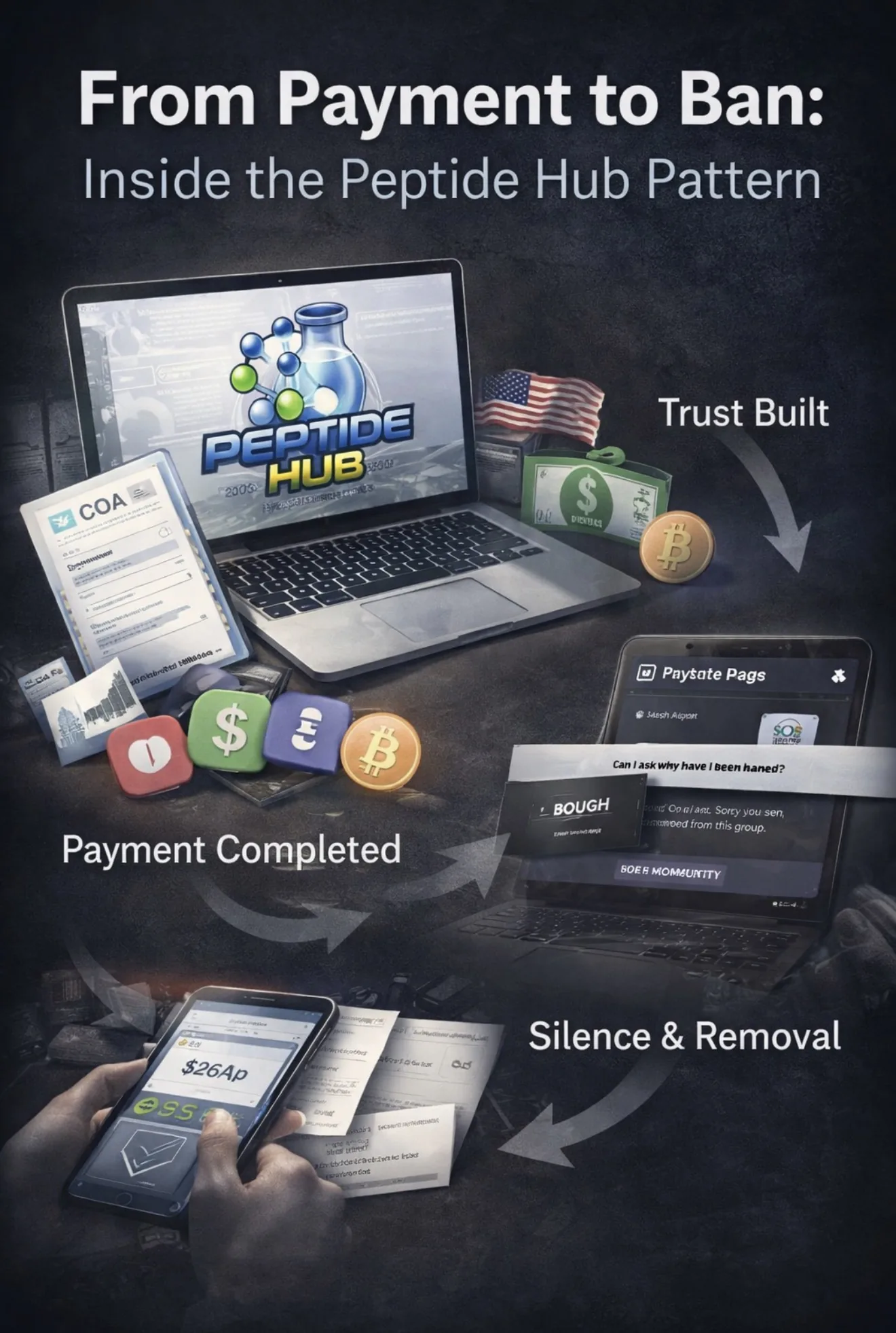
This is the case of a vendor operating under the name Peptide Hub, who runs a Skool group with around 320 members and promotes himself as a peptide seller through a closed, tightly controlled community structure.
Concerns began to build early.
He was said to be using COAs that appeared to come from other clients, rather than providing clear, batch specific proof tied directly to the products being sold. At the same time, he claimed to have a fully stocked USA warehouse, presenting the operation as established and ready to ship quickly.
That combination of borrowed credibility and strong warehouse claims helped make the operation appear legitimate.
The structure of the community itself also raised red flags.
The associated Discord server appeared to function mainly as an announcement only space, with little or no real discussion allowed. Buyers had limited room to compare experiences or raise concerns publicly.
Attention then shifted to the Skool community, where a handful of positive order updates helped build confidence, even as deeper questions remained unanswered.
What followed, according to multiple accounts, was not a single dispute but a repeated pattern involving:
crypto payments → missing tracking → removal from community spaces → abuse toward those who questioned or warned others
How Trust Is Built
If you’ve been following my previous articles, this structure will feel familiar.
Buyers are brought into a closed environment, where:
discussion is limited
visibility is controlled
and early impressions carry disproportionate weight
The Discord server (now gone) limited interaction and reduced scrutiny
Inside the Skool group, trust is reinforced through:
positive order posts
confident replies
visible activity
Posts create a steady stream of reassurance:
buyers stating they placed large orders and were “not worried”
others claiming multiple successful deliveries
some calling the their “go to”
encouragement posts telling others not to be “scared”
In one example, a buyer posted a large order and promised updates.
Weeks later, others are still asking:
“Any update, did you receive your order?”
“Did you receive your order?”
No clear follow-up is visible.
One particularly influential post showed a video of a single delivered kit, paired with a strong endorsement claiming better service than top vendors.
After that post, more buyers placed orders.
According to multiple accounts:
those later buyers did not receive orders
and were removed from the group
Another early reviewer who initially received product was also later banned after calling out the scam.
That kind of early success content carries weight, especially in a closed group.
It lowers hesitation for everyone who follows.
The COA Issue
When buyers asked for COAs, they were directed to a Dropbox folder framed as:
“Our manufacturing facility posts all current tests here”
On the surface, this looks like transparency.
In reality:
COAs appear heavily redacted (client names, batch numbers removed)
many are clearly WWB related reports
some contain references to EGB (a WWB associated group buy)
several are outdated, in some cases nearly a year old
This breaks traceability between:
product ↔ batch ↔ test result
According to the EGB organiser:
some COAs shown are hers
many are outdated
some are not even for the products being sold
At the same time, Peptide Hub had previously presented themselves in a way that resembled a WWB sales rep, before later rebranding.
Whether any product ever came from WWB is uncertain.
But the issue is not origin, it is presentation.
The account appeared to borrow WWB credibility:
COAs
branding style
warehouse claims
…in a way that makes the operation look more legitimate than could be verified.
When Challenged: Immediate Escalation
When the EGB organiser directly challenged the use of her COAs, the response did not address the issue.
It escalated into abuse:
“You might be the stupidest bitch I’ve ever met”
“Btw your not cute you look like you do meth”
“Gain some weight”
“Life’s great you ugly bitch”
“I’m white you stupid meth head whore”
He also dismissed independent testing entirely:
“I don’t need to do that”
“I make 30 to 60 sales a day”
“I make over $15,000 every 2 days”
At that point, the response shifted from verification → hostility.
The Payment Funnel (Victim Account)
Initial contact was friendly and low pressure:
“Hey! Thanks for joining 😊 We’re currently offering free U.S. shipping…”
When asked for COAs:
no batch specific proof was provided
instead → Dropbox link
Conversation then shifted toward product recommendation:
“HGH is far superior…”
Payment Stage Shift
Initially, multiple payment methods appeared available:
Afterpay
Klarma / Affirm
card payments
But at the point of purchase:
“Our Afterpay is having trouble…”
“We can only accept CashApp, Apple Pay, Zelle or BTC right now”
This is the key shift:
from protected → to non reversible payments
At the same time:
urgency introduced
incentives added
“Were you wanting to put an order in today?”
“I’ll throw in a free kit…”
The Move to Crypto
Crypto was not forced initially, but became the only workable option.
“Any USDC or USDT?”
“Yes mam, let’s do USDC”
Transaction Breakdown
Once crypto was agreed:
“Here’s USDC through ETH”
Payment was broken into steps:
small test (~$5)
When the first didn’t show
“The minimum amount is seven dollars”
second slightly larger payment (~$8)
Then:
“Got it!”
That confirmation builds trust.
The buyer then sends the full amount.
After Payment: The Pattern Changes
Instead of moving into fulfilment:
communication slows
responses become vague or stop
tracking is not provided
When the buyer asks for updates:
no response
Then:
Discord disappears
buyer goes to Skool
buyer is banned
No product is delivered.
The Ban Pattern
Across multiple accounts:
1.payment completed
2.questions asked
3.access removed
Important detail:
bans occur before resolution, not after
This changes the meaning of the ban.
It stops looking like moderation
and starts looking like:
removal of paying customers asking questions
Escalation: Abuse & Intimidation (Second Case)
When someone entered the group to warn others, the response escalated immediately:
“Hey what’s up dumbass”
“Stop messaging my members saying false shit”
“Who the f*** are you”
“You have no idea what you’re talking about”
Then:
“Are you a male or a fat dyke”
“Go f*** yourself”
“God you’re retarded”
“You’re gonna lose your job”
And:
“I have your address now I’ll ruin your life”
At this point, the interaction is no longer about:
resolving issues
providing proof
fulfilling orders
It becomes:
deflection → intimidation → personal attack
Wider Corroboration
As more members compared notes:
“Yea I was removed and he cussed me out”
Another account:
friend who paid in crypto was banned before tracking
The reason given by Peptide Hub is that they “cancelled” the transaction despite it being a crypto transaction
Reports of similar experiences continued to emerge.
My Interaction with Peptide Hub
After one of my members posted about Peptide Hub, I received a DM from him;
calling the member “not credible”
calling them “a dumbass”
His defence:
many reviews show deliveries
criticism comes from people asking questions
I requested access to the Skool group.
Nearly a month later, it’s still pending
During our conversation, he claimed:
large HGH order from WWB
possibly organising Janoshik testing
Again, credibility framing.
The Gap Between Public and Private Outcomes
Inside the group, the visible story is positive: confident posts, successful order claims, and reassuring replies. Outside that public view, some buyers described something very different bans after payment, removal after questions, missing tracking, and orders that never arrived.
Because the Skool group is private and moderated, buyers have limited ability to compare experiences in real time, question problems openly, or hear from people who had already been removed. That meant the visible narrative could stay positive even while complaints were disappearing.
For new buyers, that matters. Trust is built from what they can see. If negative accounts are removed along with the people making them, the group stops reflecting the full reality of what buyers are experiencing. At that point, the community is not just hosting trust, it is helping shape it.
Conclusion
This does not read like a one off dispute. It reads like a repeatable setup.
Multiple accounts describe the same shift: trust is built through reviews, COAs, branding, and shipping claims, then once payment is made, questions are met with silence, bans, missing tracking, or abuse.
The issue is not just whether some people received product. It is whether visible success was used to build confidence for later buyers who were then cut off from answers, delivery, and the community itself.
Since posting this in K-Hole, more people have come forward alleging similar experiences.

Comments