
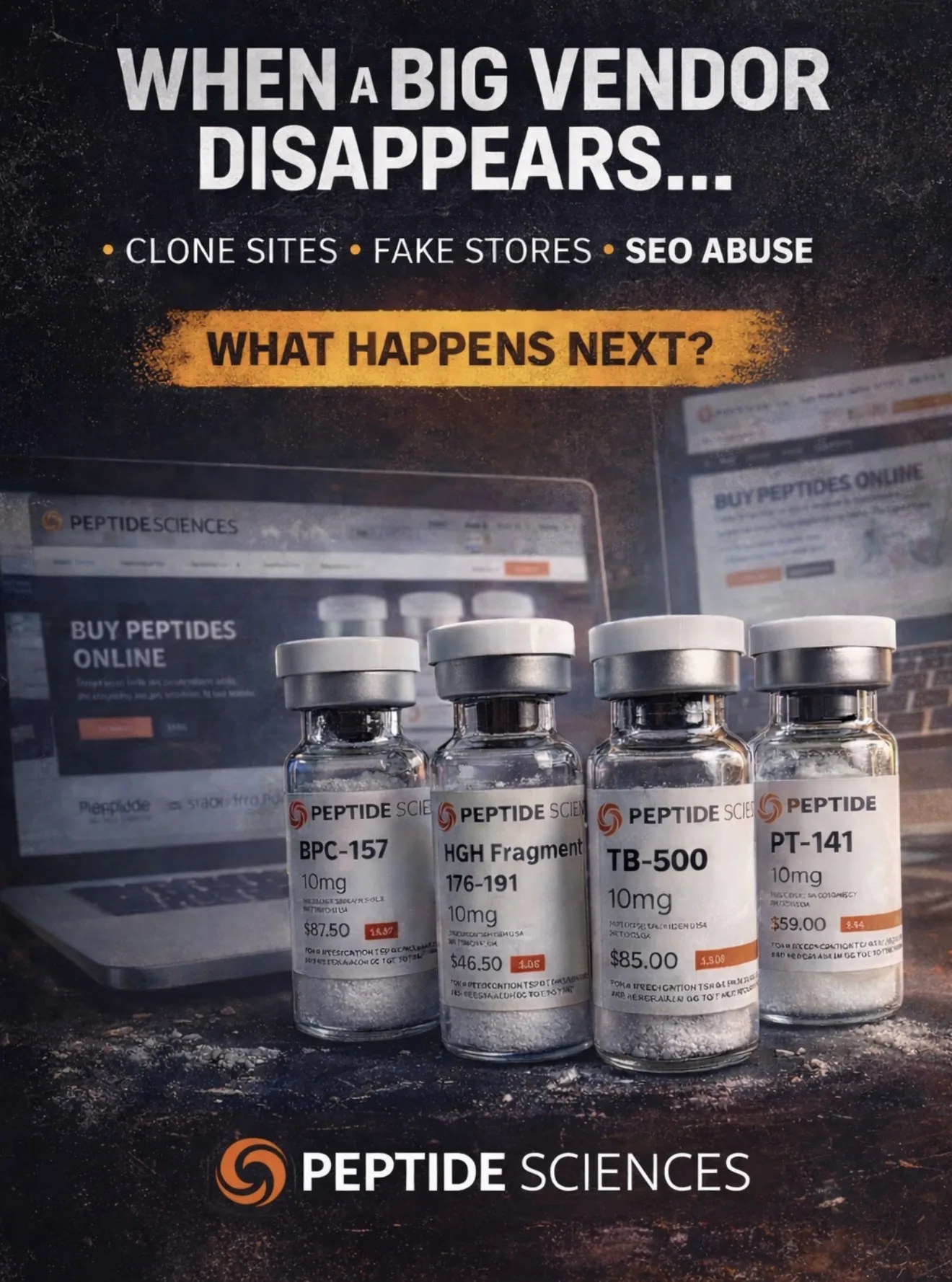
Peptide Sciences shut down in early March 2026, ending operations after years as one of the most widely recognised peptide vendors online.
But the name didn’t disappear.
It stayed searchable, familiar, and trusted, making it the perfect target.
But within weeks, clone domains and fake storefronts moved in to take its place.
The company disappeared. The brand didn’t.
What Happens Next
The original website remains online with a clear notice:
“Any website claiming affiliation… or claiming to sell our products is unauthorized and fraudulent.”
The message is unambiguous.
The company is gone.
Anything still selling under that name isn’t legitimate.
What Follows
What follows is predictable.
When a known vendor disappears:
Similar domains are registered
Clone sites are built using the same branding, products, and layout
Payments are pushed toward irreversible methods
SEO pushes these sites into visibility
This is a textbook dead brand hijack.
Search results don’t verify legitimacy. They replace it.
Searchable Doesn’t Mean Legitimate
When I searched “Peptide Sciences,” the first result wasn’t the original company.
It was a UK-branded clone domain, likely surfaced first because I’m searching from the UK.
The real site still appeared immediately below, but only as a closure notice warning users about fraud.
Further down were additional domains:
“store” variations
typo domains
and even a site claiming to be the new “official” Peptide Sciences
One of those sites states:
“We are proud to welcome researchers to our new official website…”
Which directly contradicts the original company’s warning.
The Domain Pattern
Not all domains lead to different sites.
Some lead to the same one.
For example:
peptidesciencesstore.com
peptidesciencestore.com
Both resolve to the same storefront.
This is typo squatting, capturing users who mistype or click quickly.
Other domains appear separate:
UK-branded versions
“official” rebrand claims
But the storefronts themselves tell a different story.
Same branding.
Same product cards.
Same catalogue structure.
Same pricing.
Even the supposed UK version lists products in US dollars rather than pounds.
Different domains. Same store.
WHOIS: What the Domains Show
The WHOIS lookup shows these domains were not all set up the same way.
peptidesciencesstore.com was registered on 12 January 2026, and
officialpeptidesciences.com followed on 18 March 2026.
Both use:
Cosmo town
the same support@cosmotown.com contact email
similar parking-style DNS infrastructure
By contrast, peptidesciencesuk.com:
was registered earlier (27 November 2025)
uses Cloudflare
has privacy-shielded registrant details
Timeline
UK domain: 27 November 2025
Store domain: 12 January 2026
Official domain: 18 March 2026
Two sites existed before the shutdown became public.
The others appeared later, once the opportunity was obvious.
So the registration details varied.
The storefronts did not.
How the SEO Gap Gets Filled
Google doesn’t verify legitimacy.
It ranks relevance.
These sites exploit that by:
using exact match brand domains
cloning product pages and categories
generating large volumes of keyword-rich content
benefiting from the absence of the original site
When the real vendor disappears, it leaves a gap.
Search results don’t disappear with it.
They get replaced.
The Payment Funnel
The shift becomes obvious at checkout.
Instead of standard payment processors, these sites rely on:
Zelle
Cash App
crypto (often discounted)
manual bank transfers
“contact us after ordering” instructions
At that point, it’s no longer an online store.
It’s a direct transfer to an unknown recipient, with no protection or recourse.
The moment the checkout changes, the risk begins.
The UK Mismatch
The UK-branded site reveals a simple but critical flaw.
Despite presenting itself as UK-facing, its checkout includes:
Zelle (US-only)
manual Apple Pay transfers
generic bank transfer instructions
These are not standard UK payment methods.
A legitimate UK storefront would typically support:
card payments
PayPal
proper Apple Pay integration
Instead, the payment flow doesn’t match the region it claims to serve.
The domain says UK.
The checkout says otherwise.
Why This Works
This model relies on something simple:
People don’t search for new vendors.
They search for the ones they already trust.
So the sequence becomes:
A trusted vendor shuts down
Users continue searching the same name
Clone domains appear
Traffic is captured before users realise anything has changed
This works particularly well in peptides because of:
repeat buyers
brand loyalty
urgency and scarcity behaviour
The Takeaway
This isn’t just a fake website.
It’s what happens when a trusted name disappears but demand doesn’t.
The company shut down.
The brand stayed visible.
And within that gap, new sites moved in to take its place.
Searchable doesn’t mean legitimate.
Comments