
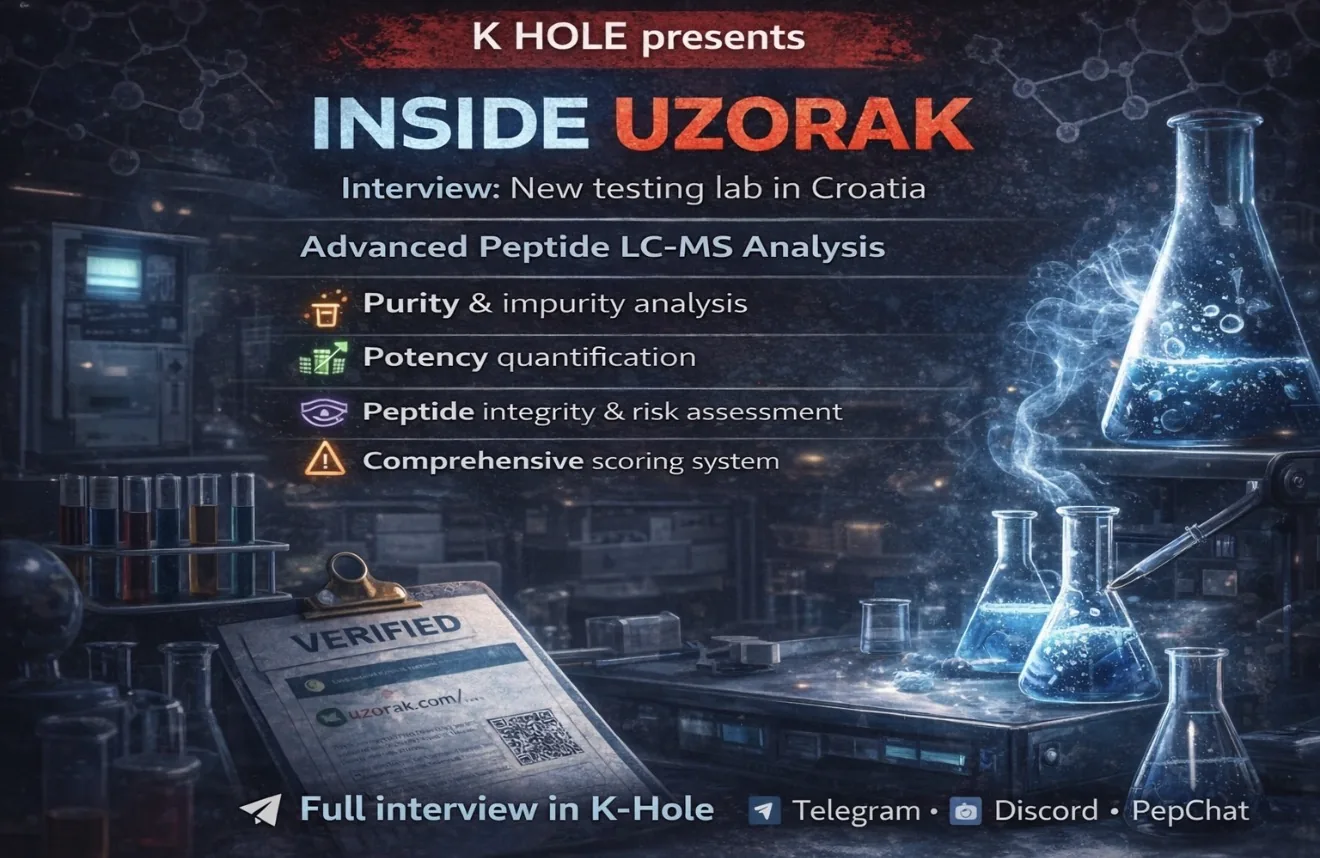
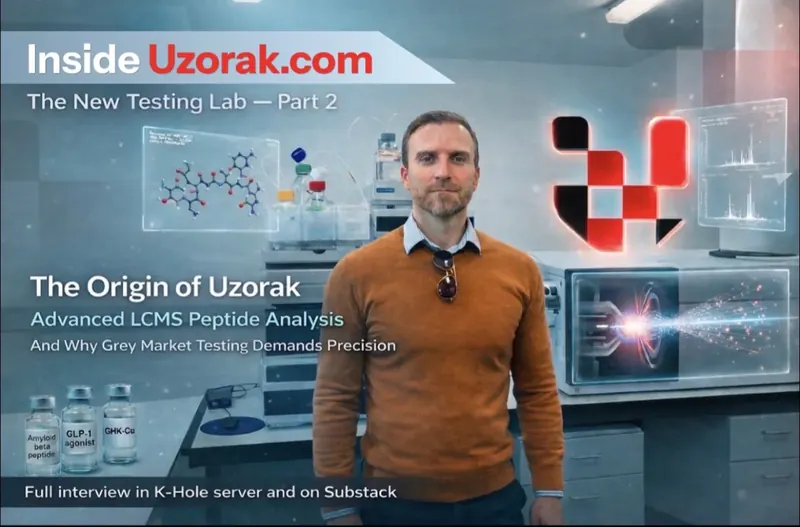
Over the past few days, I’ve been speaking with Alex, co-founder of Uzorak, a new peptide testing lab based in Zagreb, Croatia.
Uzorak positions itself as bringing “pharmaceutical level analysis” into the research-only grey market.
That’s a big claim.
They are not simply offering standard HPLC-UV purity reports. Their flagship package includes:
High-resolution LC-MS
Impurity identification and quantification
Sequence confirmation (MS/MS)
Tandem MS structural fingerprinting
Weighted scoring systems
Risk triggers
Blind testing options
Upcoming heavy metal screening aligned with ICH Q3D
Their argument is simple:
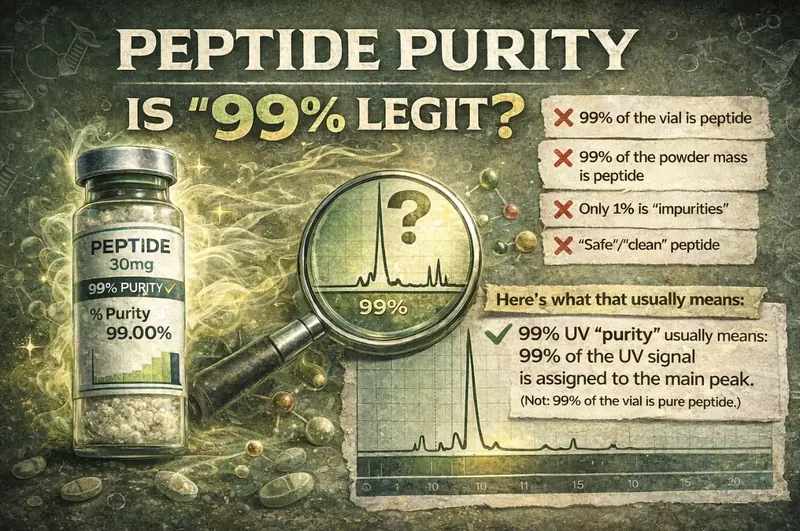
“99% UV purity” is a low bar in an unregulated environment.
What matters is not just how big the main peak is, but what’s inside it.
The Core Claim: UV is a Low Bar
Uzorak argues that standard Mass/Purity testing is insufficient in the grey market because:
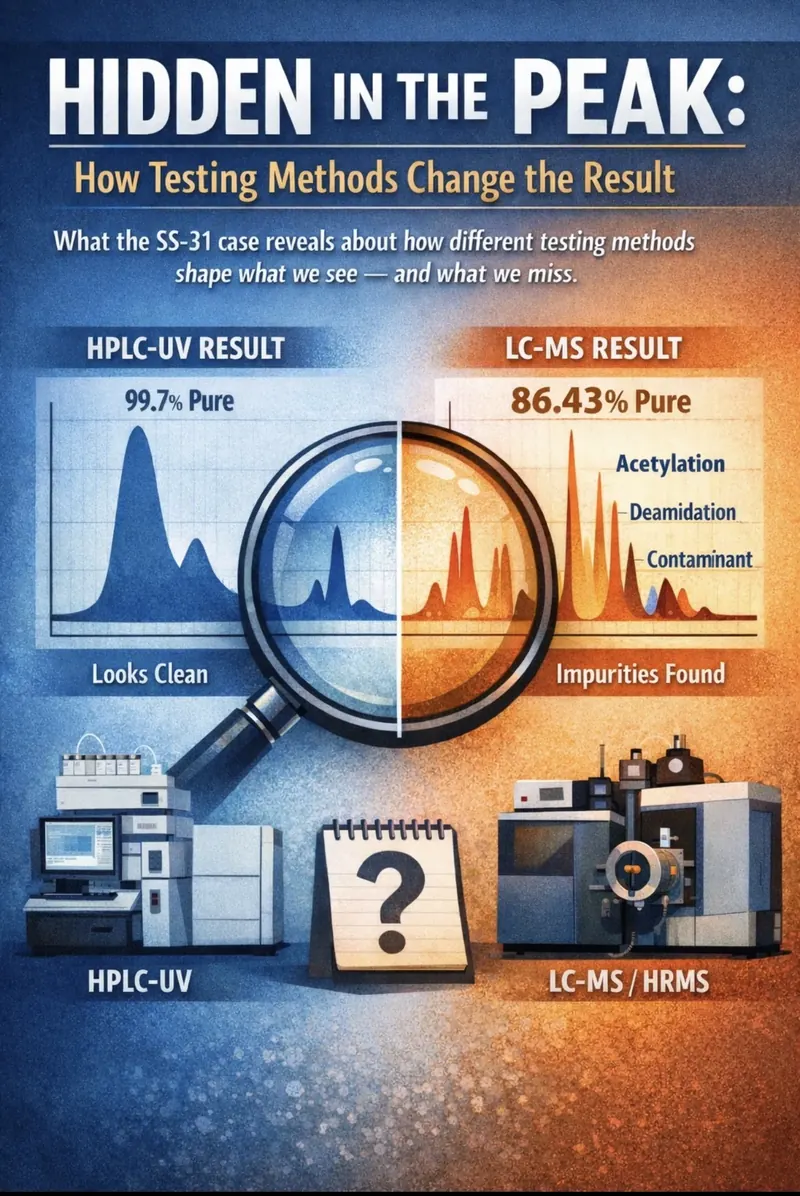
UV cannot detect impurities co-eluting in the main peak
UV cannot identify what those impurities are
Degraded peptides can still show 99% under UV
Process residues and contaminants may go unnoticed
Their position is that third party testing standards should be higher, not lower, in unregulated environments.
That’s a fair stance.
But the entire value proposition lives in the details.
So I asked specifics.
What Actually Differentiates Them?
I put it to Alex directly:
From what I can tell, your differentiation isn’t that other labs can’t perform these analyses, but that you’ve bundled advanced testing into one package and presented the results in a decision friendly way.
He agreed that packaging and interpretation is a core part of it.
Their differentiation, as he frames it, is not just the equipment, but the structured interpretation:
Impurity identity and quantity
Separation between “altered peptide” vs “hazard impurity”
Risk triggers
An overall scoring model
He also emphasised high resolution MS capability, down to very tight mass precision.
That matters, because when you’re claiming you can “see what UV can’t,” precision is the whole point.
The Scoring System
Uzorak’s reports distill results into:
Overall Score (1 to 10)
Rating (Excellent / Good / Warning / Poor)
Risk flags
Weights:
Purity: 35
Potency: 20
Integrity: 45
A key detail: potency does not affect grade classification.
When asked why, the answer was pragmatic:
You can have a pharmaceutical-grade peptide… but simply not have much of it.
In other words:
Purity + structural integrity determine quality
Potency determines how much active material is present
It’s a coherent distinction, but it also confirms the grading system is interpretive, not regulatory.
“Higher Resolution” Higher in What Sense?
When I asked what “higher resolution” means (mass accuracy? resolving power? MS/MS coverage? chromatography? processing?), Alex was blunt:
High-resolution refers to the quality of the equipment.
He points to equipment specs on their site, and says the visible difference shows up in their reports: the precision with which they can detect and quantify variants and process impurities.
Two important takeaways:
High resolution isn’t a buzzword
It’s instrument performance, and whether that performance shows up in the data you receive
If Someone Already Has a Report From Another Lab, What’s Missed?
His answer depends on which service you mean, but the core point is consistent:
Anything hiding inside the main peak can’t be detected by UV
Anything outside it may appear as an unidentified peak without a clear assignment
He also acknowledged something refreshingly honest: until they’ve built a larger dataset of real grey-market testing, they can’t confidently say which “misses” are most common.
That’s a good answer, it shows they understand the difference between theory and the actual market at scale.
Alteration Risk vs Impurities Hazard
Uzorak splits risk into two buckets:
Alteration Risk: oxidation / methylation / deamidation
Impurities Hazard: hydrolysis / cleavage / TFA / Fmoc / tBu
When asked to explain the practical difference, Alex added a caveat worth keeping:
Their warnings and thresholds should be treated as guidelines and rules-of-thumb, because it’s impossible to predict how a given impurity level affects every person.
However, he also states that impurities classified as “hazard” generally imply:
heavier degradation, or
the presence of genuinely hazardous compounds
…and therefore “generally not safe.”
That’s strong language, and it’s exactly where labs need disciplined phrasing so analytical flags don’t become implied clinical claims.
Score Weights, Proprietary, With Hard Fails
Uzorak’s scoring model uses published weights:
Purity: 35
Potency: 20
Integrity: 45
When I asked why those specific weights, Alex said they are based on proprietary calculations developed through their experimentation.
But the important detail is this: the system is not a simple weighted average.
If purity or integrity crosses a severe warning threshold, the rating can collapse to zero.
So this isn’t a “compensate your way to a pass” model.
You cannot offset structural compromise with good potency.
You cannot average your way out of a red flag.
That design choice matters.
Warning Triggers, Where Do The Numbers Come From?
Their warning thresholds include:
Oxidation > 3%
Methylation > 1.5%
Deamidation > 0.2%
When asked about the evidence base behind these specific cutoffs, Alex stated that:
They are based on scientific and clinical research
Refined by long term pharmaceutical testing experience
Intended as guidelines rather than absolute limits
Open to refinement as more data emerges
So these thresholds are not arbitrary.
But they are also not fixed regulatory standards.
They are part of an interpretive framework layered on top of analytical measurement.
That distinction matters.
However, when discussing red level warnings, Alex went further.
He stated that high levels of certain hazard-class impurities could correlate with increased probability of adverse outcomes, including organ stress, metabolic dysfunction, and potentially long term hormonal impact.
That is strong language.
There’s an important line here: analytical testing can identify degradation and hazardous compounds, but translating impurity levels directly into physiological outcomes is where labs must tread carefully.
Risk flags are analytical signals. They are not clinical diagnoses.
That distinction will matter if this model is to gain long-term credibility.
Do Thresholds Vary by Peptide Class?
Interestingly, he says no, thresholds should remain the same.
His reasoning is that oxidation and deamidation are easy to detect across GLP peptides and usually appear near the main peak (and sometimes inside it). With appropriate detection + MS, they can be detected and quantified.
That’s a simplifying decision, and it’s something worth watching as they accumulate more real world data across different peptide classes.
“Pharmaceutical Grade” What Does That Mean?
Uzorak uses the term “Pharmaceutical Grade.”
When asked how they prevent readers interpreting this as regulatory-grade material, the answer was that:
It reflects comprehensive testing
It aligns with pharma analytical logic
It does not imply FDA/EMA approval
This is an area where language must remain precise, because “pharmaceutical grade” has different meanings depending on context.
Alex also made a provocative claim: if Ozempic came in a vial, it would likely test around the 99% purity mark with slight degradation and no other warnings.
Interesting, but again, this is why definitions need to be nailed down. “Pharmaceutical grade” in a report is not the same as regulatory classification.
Blind Testing
They offer a BLIND-GLP-1 option.
In that scenario:
The peptide identity is not disclosed
They determine identity, sequence, and structure themselves
A completely blind test is theoretically possible (method TBD).
Blind testing is not more expensive.
ISO / IEC 17025
They are not currently accredited.
They state they follow most ISO/IEC 17025 guidelines where applicable, but acknowledge full accreditation is complex for research-only laboratories, particularly when dealing with unknown peptides or standardising new ones.
Public Verified Report: Is It Really Required?
Their checkout appears to show “Public Verified Report = required.”
Alex clarified:
A verification link is created for all reports (sample ID / order number), but customers can choose whether to share it, unless it’s a specific free or discounted offer initiated by Uzorak.
That’s a meaningful clarification.
What’s Not Included (Yet)
Endotoxin, sterility, and heavy metals are not included by default at the moment.
However, they plan to introduce an 18 heavy metal screen aligned with FDA/EMA ICH Q3D standards (Class 1, 2A, PGEs, select Class 3).
Significant if implemented rigorously.
When UV Looks Fine But MS Doesn’t
They confirm:
UV can look clean while MS reveals degradation
Causes may include storage, heat, handling
But degradation can also originate in manufacturing
Which aligns with what most experienced buyers already suspect: a pretty COA doesn’t guarantee clean production.
The Real Question
Is Uzorak revolutionary?
Not in the sense of inventing new analytical science. The core methods, high-resolution LC-MS, MS/MS sequencing, structural fingerprinting are well established in pharmaceutical laboratories.
What’s different is the context.
In the regulated pharma world, this level of analysis is normal. In the grey, research only market, it isn’t.
So the better question isn’t whether the science is new.
It’s whether bringing pharma level analytical depth into an unregulated space meaningfully changes the baseline, compared to a basic COA that relies primarily on UV purity and mass confirmation.
Because most grey market COAs still rely on:
HPLC-UV purity
Mass confirmation
and little else
Uzorak’s model attempts to:
Identify and quantify impurities
Separate alteration vs hazard
Provide structured interpretation
Raise third-party testing expectations
Whether it becomes the new standard depends on adoption, and how well it holds up over time.
Community Questions: The Next Layer
After the first part of this interview circulated, the technical questions started coming in, the kind that separate surface level testing from meaningful scrutiny.
Here’s what the community wants to know next:
1) Functional Bioassays, Does It Actually Work?
Chemical identity is one thing. Biological activity is another.
A peptide can test high purity and still have reduced biological activity.
So:
Do you offer (or plan to offer) functional bioassays to confirm biological activity, not just chemical identity?
How do you address the limitation that a peptide can test “clean” analytically yet still underperform biologically?
2) 3D Form, Aggregation & Dimers
For most GLP peptides, complex folding isn’t the issue, but aggregation can be.
So:
What can your workflow realistically assess regarding aggregation or structural damage?
Can you detect and quantify dimers or oligomers (SEC or LC-MS)?
Is this on your roadmap?
3) UV Purity (214 nm) & Excipients
Many COAs rely on UV detection at 214 nm.
Can excipients or additives overlap at 214 nm and skew purity results?
Do you use multiple UV wavelengths or PDA scans to reduce misinterpretation?
Can your workflow detect surfactants or unintended formulation additives?
4) Salt Form & Potency Interpretation
Many peptides are supplied as acetate or TFA salts.
Do you determine the salt form?
Do you quantify its contribution to vial mass?
If acetate can dissipate/shift over time, how do you account for that in potency calculations?
Because “10mg” doesn’t always mean 10mg of free peptide base.
Final Thoughts
This isn’t about hype.
It’s about whether the grey market should continue accepting “99% UV purity” as sufficient, or whether the baseline should move toward:
Identification
Quantification
Structural confirmation
Transparent thresholds
Clear separation between analytical findings and clinical claims
Time will tell how this evolves. But the conversation is shifting, and that alone is worth documenting.
Many thanks to Alex for taking the time to answer my questions in such detail. The full verbatim interview is available in K-Hole / Room 101.
https://www.uzorak.com/
Comments