
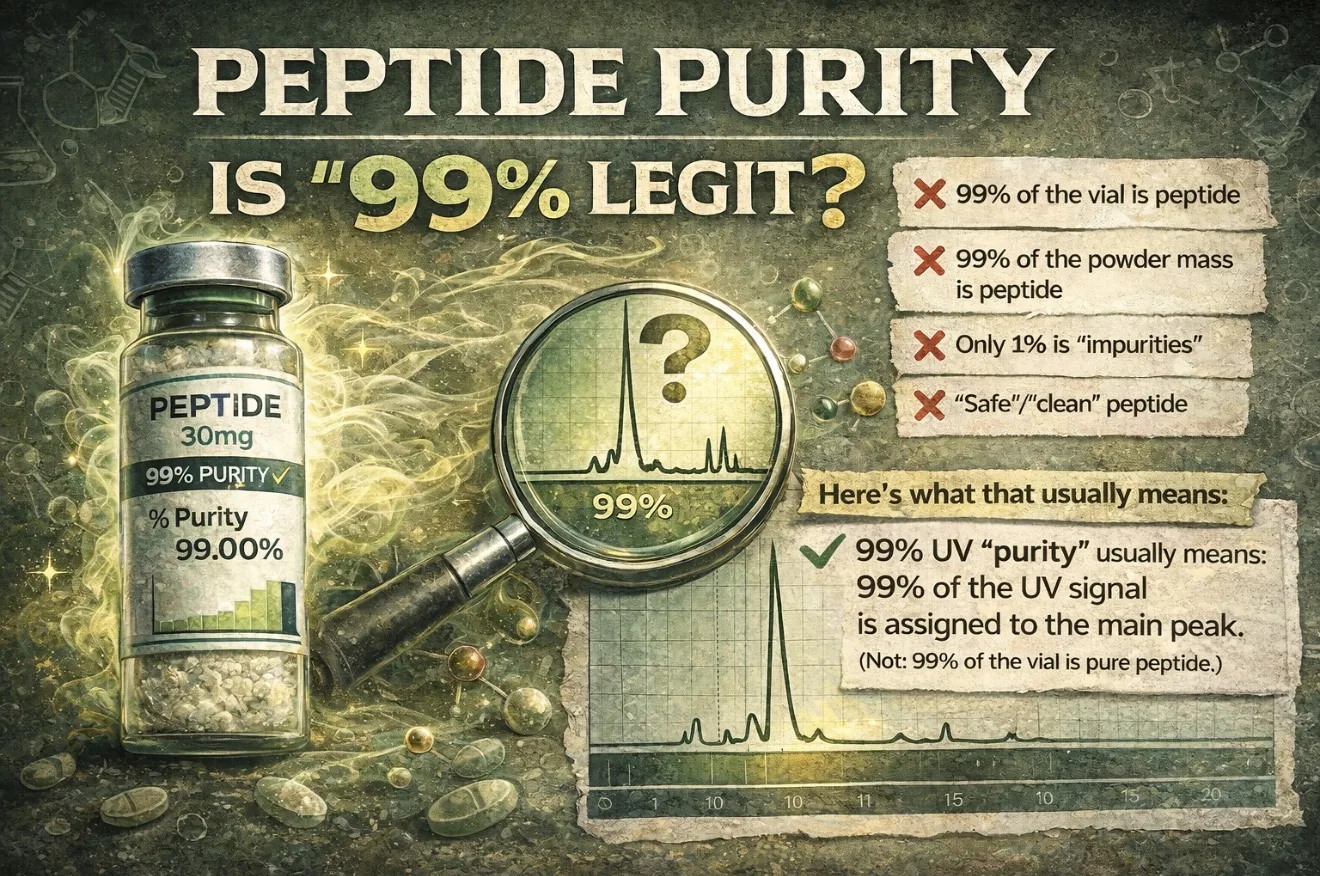
This post aims to cover Peptide purity: what it is, what it isn’t, why people misread it, and why the grey market changes everything
So you’ve just received a test report for your peptide. Let’s say it’s tirzepatide 30mg. The report says:
Purity: 99.765%
Measured content: 32mg
You feel a wave of relief. That’s the moment most people live for: “It’s legit.”
But before you celebrate by pinning your first dose, you need to understand what that 99.765% actually means, because most people read it wrong.
What “99.765% purity” does not mean
It does not mean:
99.765% of the vial contents are your peptide
99.765% of the powder mass is peptide
only 0.235% of the vial is “impurities”
or that the product is “safe,” “clean,” or “pharmaceutical grade” in any regulatory sense
The most common misconception is this:
People assume purity is a statement about the whole vial. It usually isn’t.
It’s a statement about what the test can “see” under that method, and anything that hides inside the main peak (co-elutes) can still be counted as “pure” by UV.
What that number usually does mean in the real world
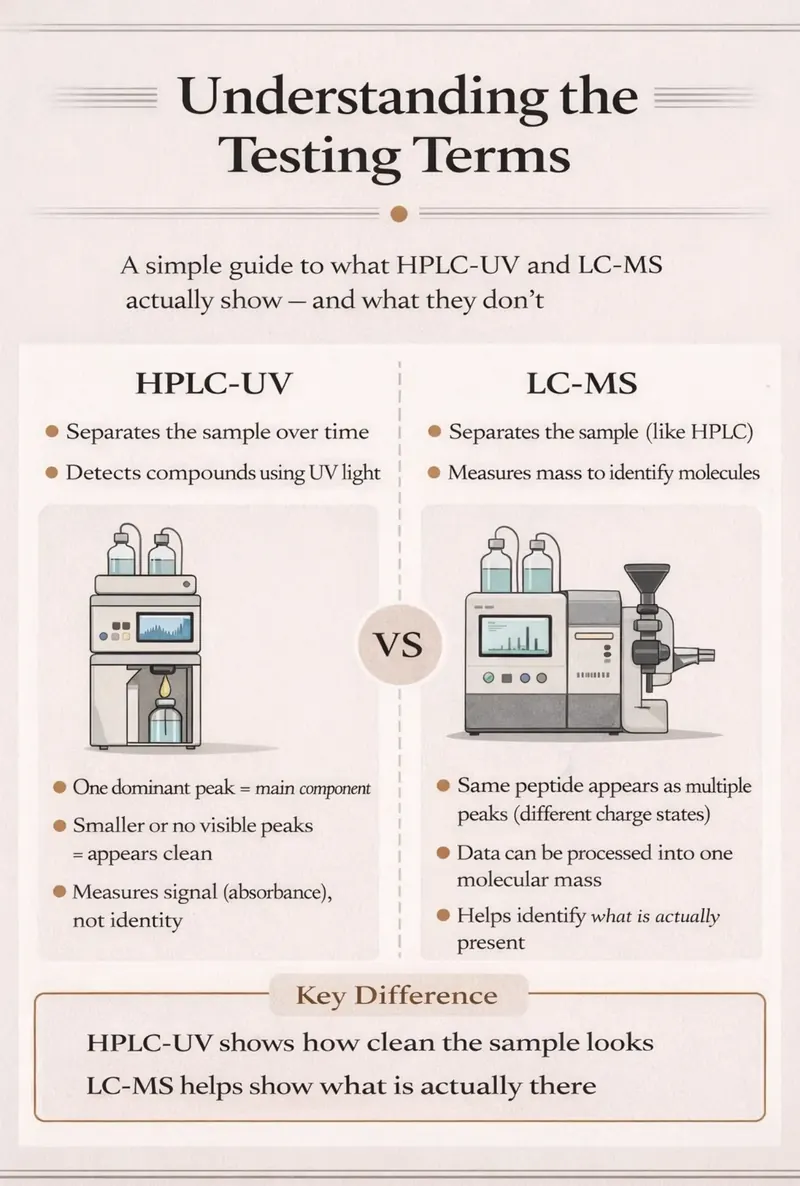
If your report is based on a standard COA format, the purity number is usually HPLC-UV purity.
A more accurate translation of “99.765% purity” is:
“99.765% of the UV-detectable signal in the chromatogram is assigned to the main peak.”
That’s not a small distinction. It’s the entire issue.
Because HPLC-UV detects absorbance, not molecular identity.
So the purity number is closer to:
“Of the things we can ‘see’ with UV light under these conditions, most of it looks like one clean peak.”
Why HPLC-UV became the standard (and why most labs still use it)
This is the part people skip, but it explains everything.
HPLC-UV didn’t become the default because labs were lazy. It became the default because it fits modern quality systems:
replicable (one lab to another)
scalable (high throughput)
standardisable (methods can be validated and transferred)
cost-effective
easy to compare across batches and suppliers
That’s why, from the mid-1990s onward, as pharmaceutical regulation and validation culture matured, HPLC-UV became a backbone method in regulated manufacturing. It’s dependable, auditable, and easy to operationalise at scale.
And that’s also why most peptide testing labs today still provide HPLC-UV purity/mass as the baseline. It’s the industry’s common language.
So no: UV testing isn’t “bad.”
It’s the standard for a reason.
Why UV purity is “fine” for pharma, and much less reassuring for grey market
This is where people keep making the wrong comparison.
In regulated pharma (think Lilly, Novo, Pfizer), the purity number sits inside a larger control system:
validated raw materials
controlled synthesis and purification
documented batch records
validated cleaning
in-process controls
stability programs
GMP release specifications
So UV purity is not being asked to do the entire job. It’s one metric inside a tightly controlled environment.
In the grey market, that surrounding system is absent or unknown.
You often don’t know:
what purification was actually done
whether steps were repeated or rushed
whether storage conditions were controlled
what was used during synthesis and cleanup
what the fill/finish environment looked like
whether equipment was shared and cleaned properly
what else might be present that wasn’t meant to be there
So the exact same “99% purity” line carries far less meaning, and can create false confidence.
Why HPLC-UV can miss impurities (the blind spots)
HPLC separates. UV detects. Purity is calculated from peak areas. That sounds solid, until you look at what UV can’t reliably distinguish.
Co-elution: impurities hiding inside the main peak
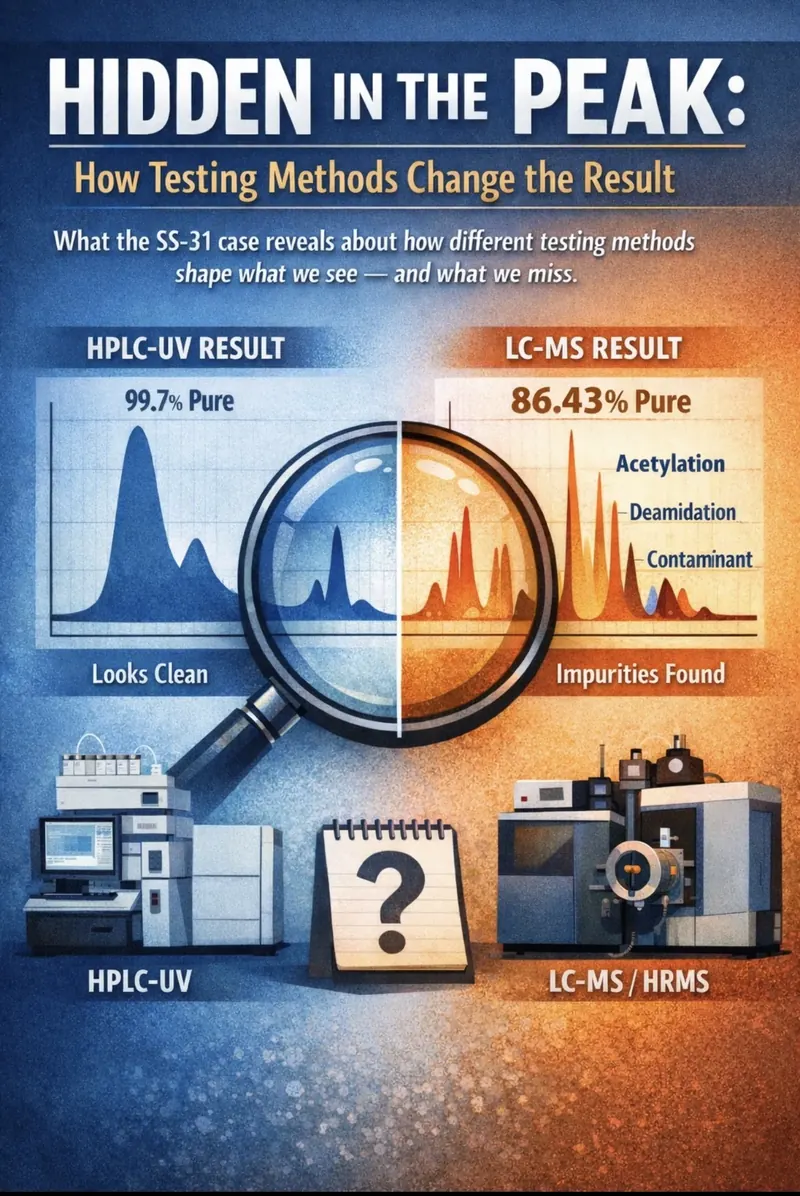
If an impurity elutes at the same time as the target peptide, UV may display one “clean” peak and count it as pure.
You can have multiple molecules inside one peak.
Variants can still “look like peptide” under UV
Oxidation, deamidation, methylation, isomerization, many peptide variants absorb UV very similarly. The chromatogram can look beautiful while variants exist at meaningful levels.
Some things don’t absorb strongly at the monitored wavelength
UV detection (often around ~214 to 220 nm for peptides) doesn’t guarantee visibility for every contaminant or additive. If something absorbs weakly, it may be under represented or not clearly visible.
Fragments and degradation products can be dismissed or washed out early
If degradation creates very small fragments, they may elute near the “void volume” at the beginning of the run, get treated as baseline/system noise, or simply not be integrated into the purity calculation.
So a “great” UV purity number can coexist with degradation and unwanted species, depending on what the method can separate and what the detector can see.
The part people misunderstand most: purity ≠ “how much peptide is in the vial”
Even if the peptide peak looks very “pure,” the vial can still contain substantial non-peptide mass:
counter-ions / salts (TFA, acetate, etc.)
water content
residual synthesis materials
other non peptide contaminants
formulation excipients (in some cases)
This is where “purity” gets confused with content.
A UV purity number is not automatically a statement about net peptide content.
Net Peptide Content (NPC)
A concept that matters here is:
NPC = the actual fraction of the powder that is peptide.
In grey-market material, NPC is often meaningfully lower than people assume because salts and water can be a real fraction of the mass.
And crucially:
The “missing percentage” isn’t automatically just counter-ion.
To quantify that missing mass properly, you need additional measurements such as:
Karl Fischer titration (exact water content)
quantification of counter-ion / salt content (e.g., TFA salt content)
and sometimes targeted screens for specific contaminant classes
Preservatives and add ins: what shouldn’t happen, and what can happen anyway
In theory, fill/finish should not be introducing preservatives into simple lyophilised peptide vials as a default.
Preservatives are more commonly introduced at reconstitution (for example, bacteriostatic water contains benzyl alcohol).
Fill/finish can involve excipients (buffers/stabilizers/bulking agents), but those aren’t the same thing as antimicrobial preservatives.
However, and this is the whole point in the grey market:
Preservative class compounds or unexpected add ins can appear anyway:
deliberately (undocumented formulation choices), or
inadvertently (cross contamination, poor cleaning, shared equipment, wrong diluent, handling errors)
And this is exactly the kind of thing that can fall outside the comfort zone of a basic UV purity readout.
If something doesn’t absorb strongly in UV, or isn’t separated cleanly from the main peak, it may not show up clearly, even if it’s present.
The SRY style example: when “purity” isn’t the issue at all
A good illustration of why this matters is the type of controversy the community has seen around certain batches where preservative class compounds were alleged, for example methylparaben and cresol/chlorocresol type preservatives being discussed in relation to SRY products several months ago.
Whether such findings come from:
intentional formulation,
cross-contamination,
incomplete cleaning,
or handling/diluent error,
the key point is this:
That isn’t a “99% purity” problem. It’s a process control / contamination problem.
And it’s exactly why “a perfect-looking UV purity number” cannot be treated as a blanket reassurance.
Some contaminants are more than a quality nuisance, depending on what they are and what levels they’re present at, they can be irritating, biologically active, or risky (and certain classes of contaminants are not what you want accumulating in the body, kidneys and endocrine active exposures are obvious concerns people raise, even if the exact risk depends on dose and identity).
The sober truth is:
In the grey market, we don’t yet have enough routine, standardised data to confidently say what contaminants are most common, because grey market products are not routinely characterised beyond basic COA style testing.
Even pharma doesn’t produce “perfect peptides”
Another myth that feeds COA worship is the fantasy that “true” peptides are perfect.
Peptide synthesis naturally generates side products:
incomplete couplings
truncations
sequence variants
oxidation/deamidation
reaction by products
Even in pharma, the goal isn’t “perfect.” The goal is controlled manufacturing within defined limits.
That matters because it changes the question from:
“Are there any impurities?” to “Which ones are present, and are they within acceptable limits?”
Which impurities are harmless vs harmful, and why levels matter
Not all impurities are equal.
Some variants are common and may be relatively benign at low levels (depending on the peptide and use case). Others point to manufacturing discipline problems. Others can be genuinely concerning.
That’s why the important questions become:
Which impurities and contaminants are common in grey market material?
Which ones are harmless vs harmful?
At what levels do they become a meaningful concern?
Are those thresholds universal, or peptide specific?
And that’s also why one purity number can never be “the whole answer.”
Degradation progression: when it turns into hydrolysis/cleavage
One of the practical insights people miss is that degradation isn’t just “a slightly worse peptide.”
Higher degradation can progress into:
hydrolysis
cleavage fragments
loss of structural integrity
At that point you’re no longer debating tiny variants, you’re dealing with a molecule that is breaking down into other species.
The missing tests purity doesn’t cover
Even the best LC-MS purity report doesn’t automatically answer:
heavy metals needs ICP-MS
sterility needs culture
endotoxin needs LAL / endotoxin testing
exact moisture content Karl Fischer
counter-ion/salt load targeted quantification
So when people treat “99% purity” as a proxy for safety, they’re using the wrong tool for the wrong job.
Bottom line
HPLC-UV became standard because it’s validated, replicable, and scalable, and in regulated pharma it sits inside a full GMP quality system that prevents surprises.
In the grey market, the same number can be misleading because:
UV has known blind spots
and the surrounding control system is unknown and some of the most important issues (unexpected add ins, preservative class compounds, metals, sterility/endotoxin, salt/water load) can sit outside that purity number
So the honest way to read a typical COA purity line is:
“This is the percentage of UV detectable signal assigned to the main peak under this method.
Not: “This vial is 99% what you think it is.”
That’s the gap newer “advanced” reports are trying to fill, not because UV is useless, but because in the grey market, UV alone is not enough to carry the meaning people want it to carry.
Disclosure
This article was written with input from Alex at Uzorak Lab, a newly established peptide testing laboratory based in Croatia that plans to operate globally.
An in depth interview with Uzorak will be published shortly in the K-Hole server, where their methodology, scoring framework, and analytical approach will be discussed in more detail.
As always, this piece reflects independent analysis and does not constitute endorsement.
Comments