
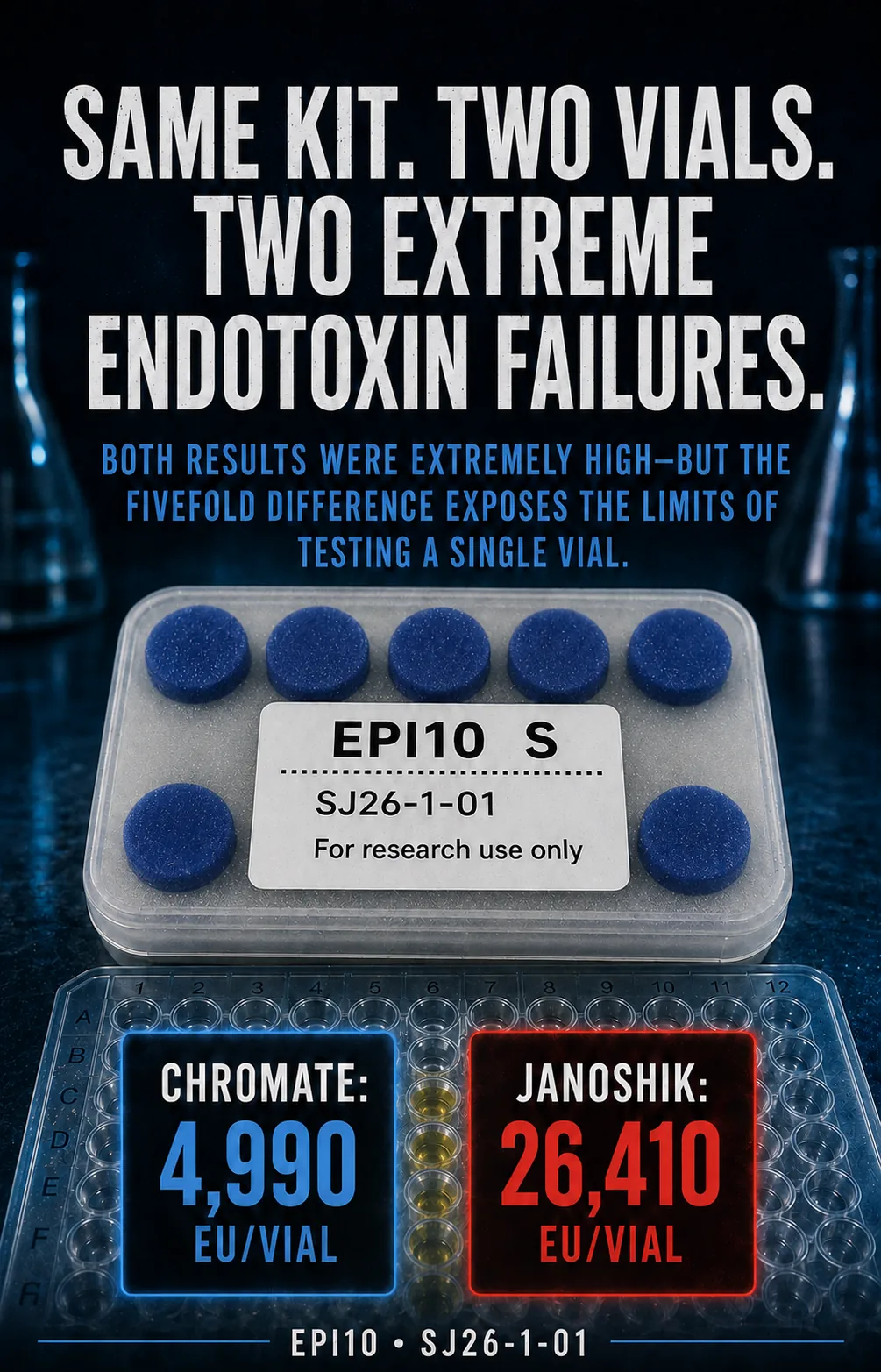
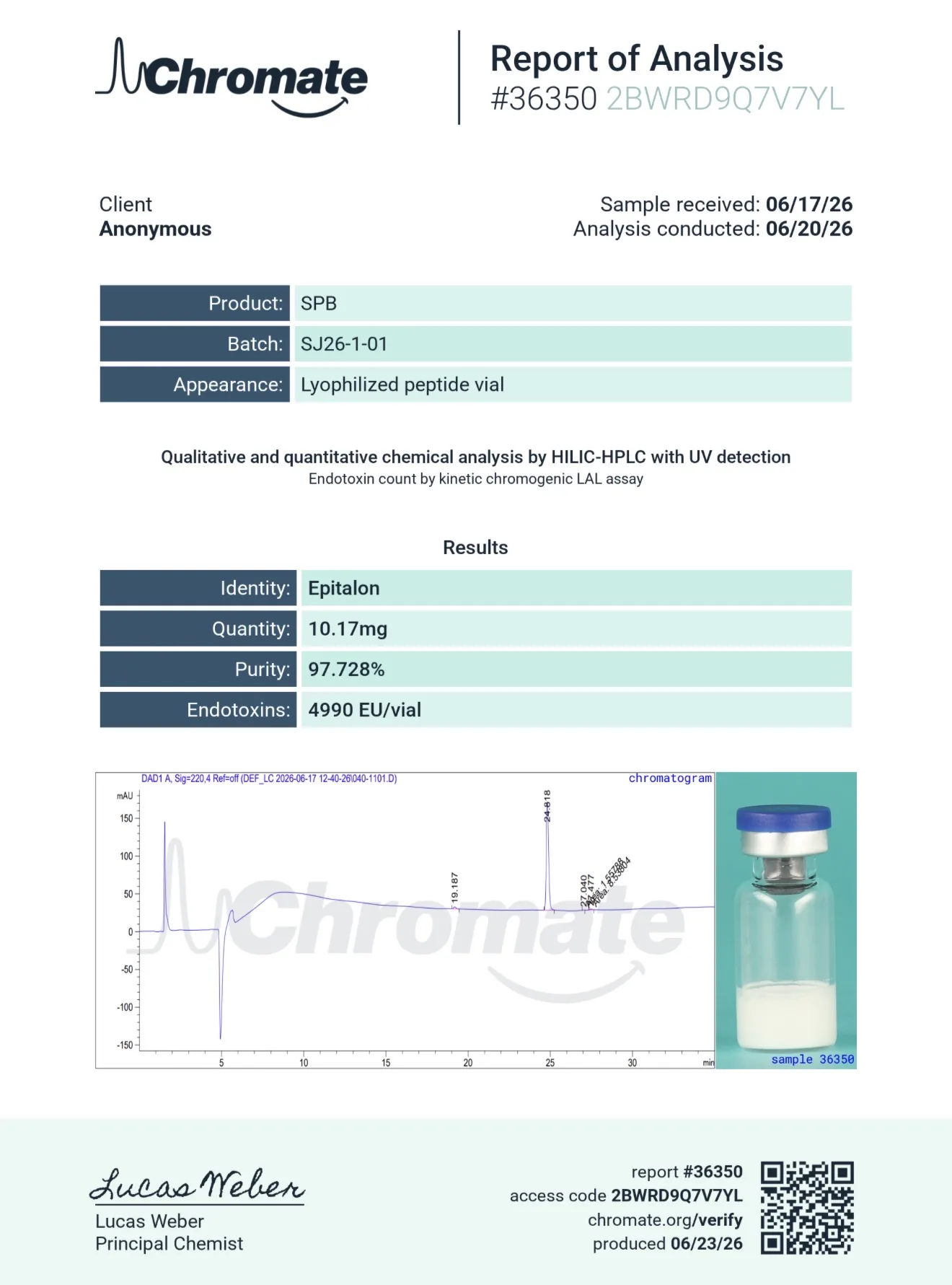
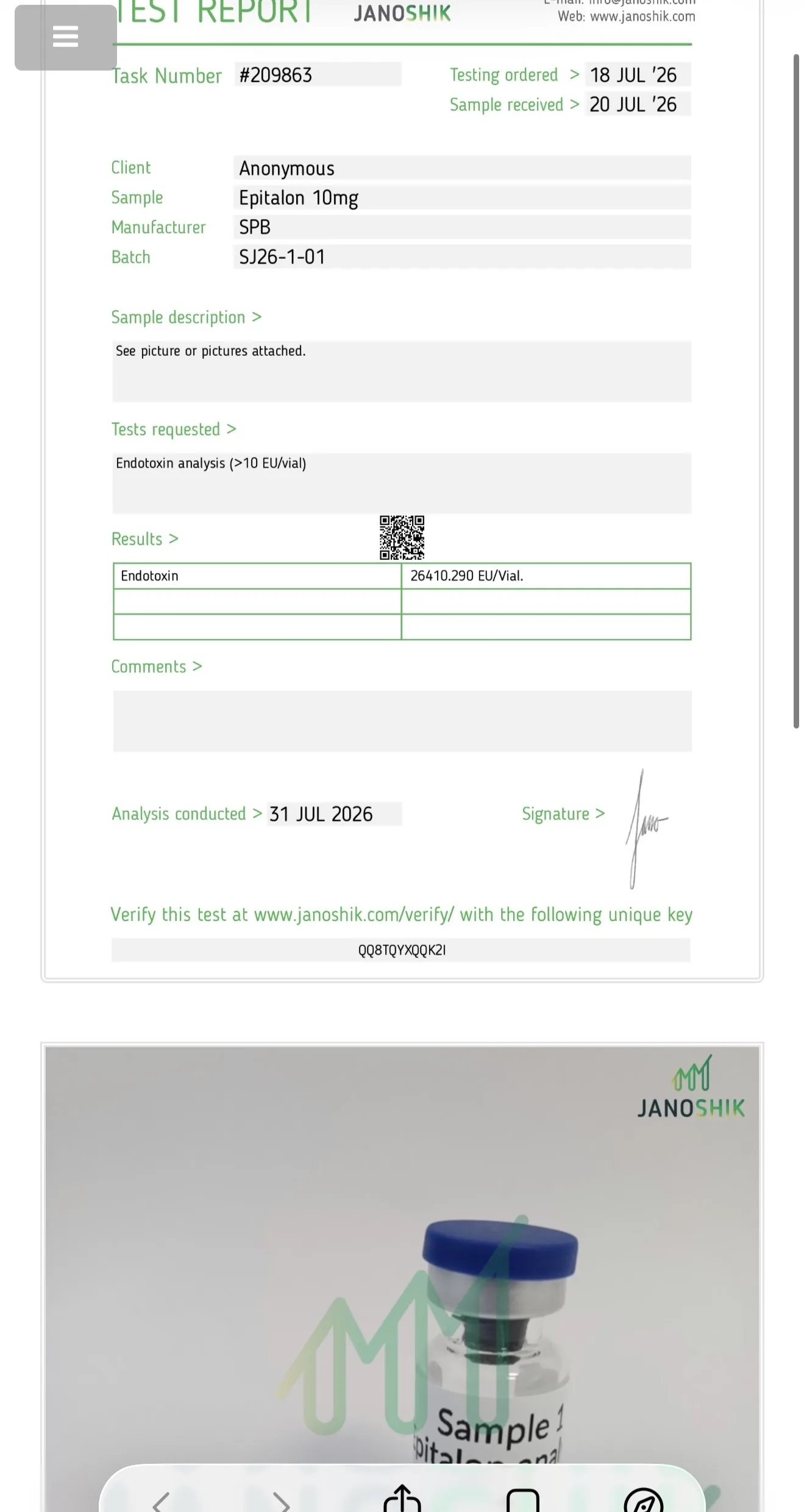
Two Epitalon vials from the same SPB kit have now produced extremely high endotoxin results at two independent laboratories. Chromate tested one vial in June and reported 4,990 EU/vial. Janoshik later tested another vial from the same kit and found 26,410 EU/vial, more than five times Chromate’s result.
The difference prompted questions about whether one laboratory’s measurement was inaccurate. The discussion in K-Hole’s Lab Chat channel offered another possibility: the endotoxin may not have been evenly distributed between the vials.
Dustin from Vanguard Laboratory explained that endotoxin contamination isn’t necessarily homogeneous. Endotoxins are associated with bacterial cell walls and may exist as aggregates or remain attached to particles. Even after purification and lyophilisation, they may not be evenly distributed throughout the bulk material.
A small sample taken from one part of a production lot therefore may not represent the whole batch. Contamination can also be introduced later through containers, closures, water, equipment or handling during filling. Without access to the manufacturing process, it’s impossible to know whether this originated in the active ingredient, during processing or at the vial-filling stage. There is also no confirmation that every vial was filled from a single API lot.
Dustin said that, from his experience investigating contamination, clean and heavily contaminated samples can exist within the same lot. He’s worked on national and global recalls in which some samples were clear while others contained high levels of organisms such as Listeria or Salmonella.
That’s why pharmaceutical, food and environmental testing relies on statistically based sampling rather than assuming one unit represents an entire batch.
He gave the example of a client supplying Walmart. The client sends 25 samples from one lot, which Vanguard combines into five composite samples. Those five composites are then tested as a more representative picture of the lot while the client pays for five tests rather than 25. For peptide sellers, Dustin said Vanguard will test between one and 20 vials from the same lot for the price of one sterility test. He said many sellers already submit more than ten vials from a lot for third-party testing.
Pacific Coast Biologics added that endotoxin control during freeze-drying requires all glassware to be sterilised before the finished material is introduced and everything to be rinsed with Type 1 water at 18.2 megaohm resistivity. They also described a real incident involving recombinant protein. A single drop of tap water from the outside of a flask entered a sterile filtration unit. The material subsequently failed endotoxin testing and the entire purification process had to be repeated. It shows how easily contamination can be introduced, even where the bulk product itself may previously have been clean.
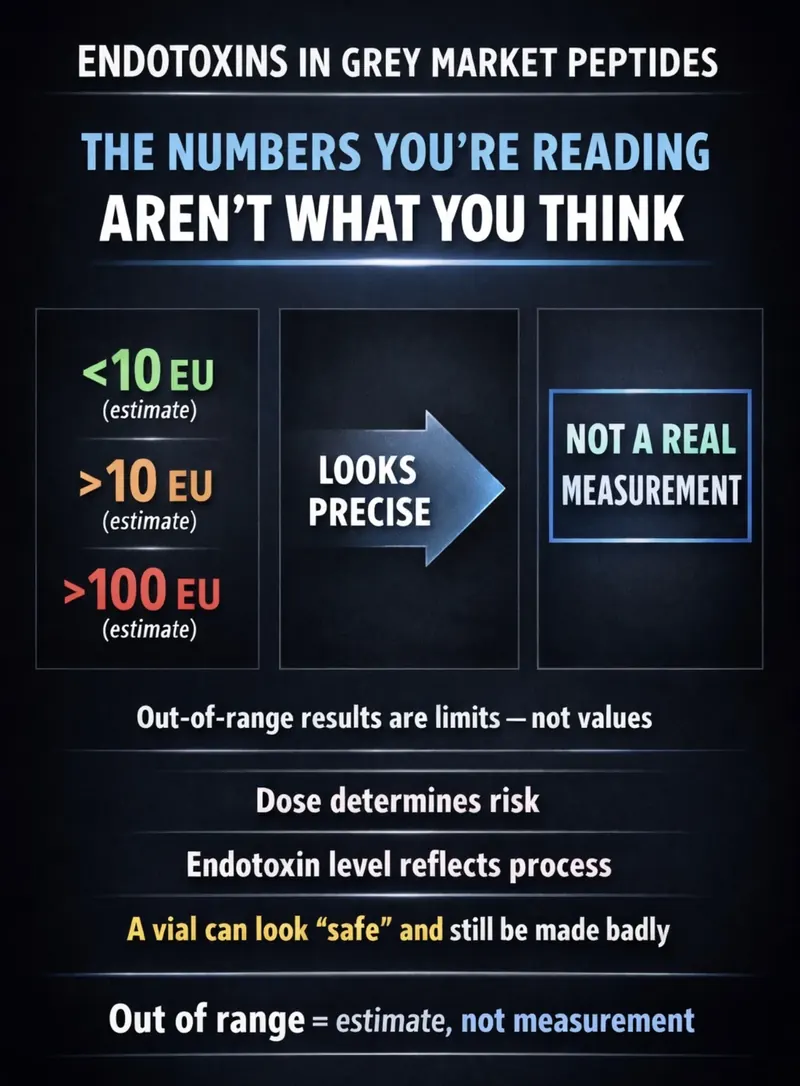
Chromate also responded to clarify their initial result. He said endotoxin testing is a bit tricky. The kinetic LAL assay itself has a validated recovery range that effectively spans 4 -fold (50 10 200%). Numerous different factors may affect the final measurement. Chromate uses an automated Endosafe system to reduce operator error but acknowledged that every testing method has advantages and limitations.
Chromate also reported recently finding approximately threefold variation, around 5 and 15 EU/vial, between two presumed vials from the same batch. The difference was confirmed through multiple retests. However, he said there is insufficient data to establish how common this degree of intra-batch variation is.
Chromate ultimately said he couldn’t determine which of the two SPB results was more accurate. His conclusion was that both laboratories agreed on the important point: the sample contained extremely elevated endotoxin levels.
There is still one point worth clarifying. Although Chromate referred to the kinetic LAL assay having a validated recovery range of 50 to 200%. That normally concerns acceptable positive product-control recovery used to establish whether the sample interfered with the assay. It doesn’t necessarily mean every numerical result has a fourfold margin of error. One vial cannot establish the precise condition of an entire batch, but that doesn’t make testing pointless. It means the sampling plan needs to match the question being asked.
Testing one vial tells us about that vial. Testing several vials individually helps reveal variation. Composite testing can provide a broader picture of a lot, although it may dilute isolated extremes and doesn’t tell an individual customer what’s in their particular vial.
In this case, two separate vials from the same kit produced extreme endotoxin results at two independent laboratories. Whether the true figure was closer to 4,990 or 26,410 EU/vial, the practical conclusion is unchanged:
Both vials failed by an enormous margin, and the fivefold difference may itself reveal how unevenly contamination can be distributed within a kit.
Comments