
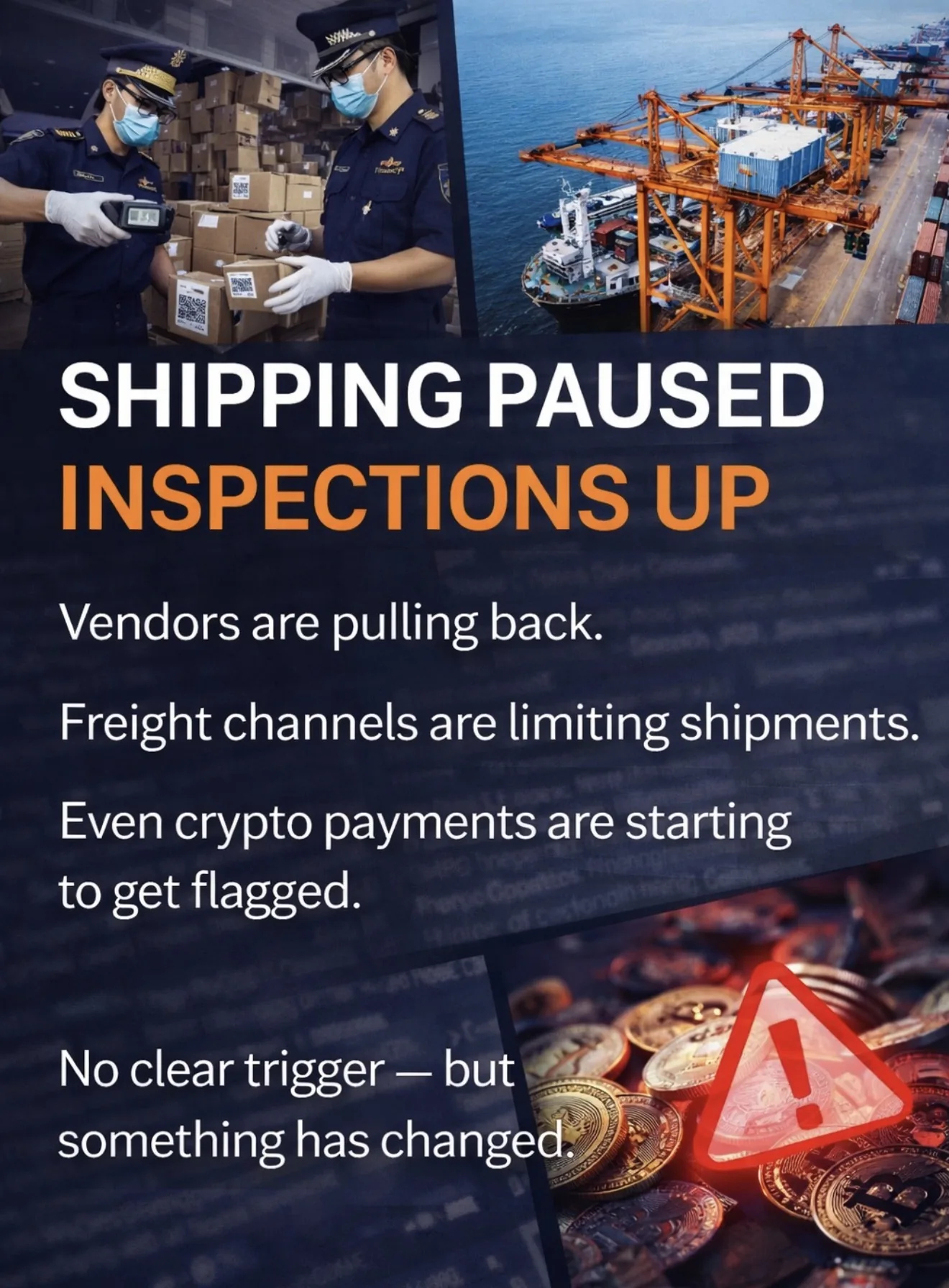
Something has shifted over the past few days. Vendors are issuing near-identical shipping suspension notices. Freight forwarders are limiting shipments. Delays are stacking up, with no clear timelines.
At the same time, there are early signs that pressure may not be limited to logistics. I’ve seen a report of a Binance.US warning tied to transaction activity, with wording that suggests they may be looking beyond a single wallet.
Nothing here is confirmed publicly yet. But the pattern is consistent and it’s showing up across multiple parts of the system at once.
What’s actually confirmed
When I checked with a FedEx-side contact, they said there’s been nothing notable from the US side. From their perspective, this looks like China tightening things at the source, not a sudden shift in US carrier behaviour.
They also pointed out that this isn’t unusual. These kinds of enforcement spikes happen periodically when China decides to crack down on exports. It’s disruptive, but not unprecedented.
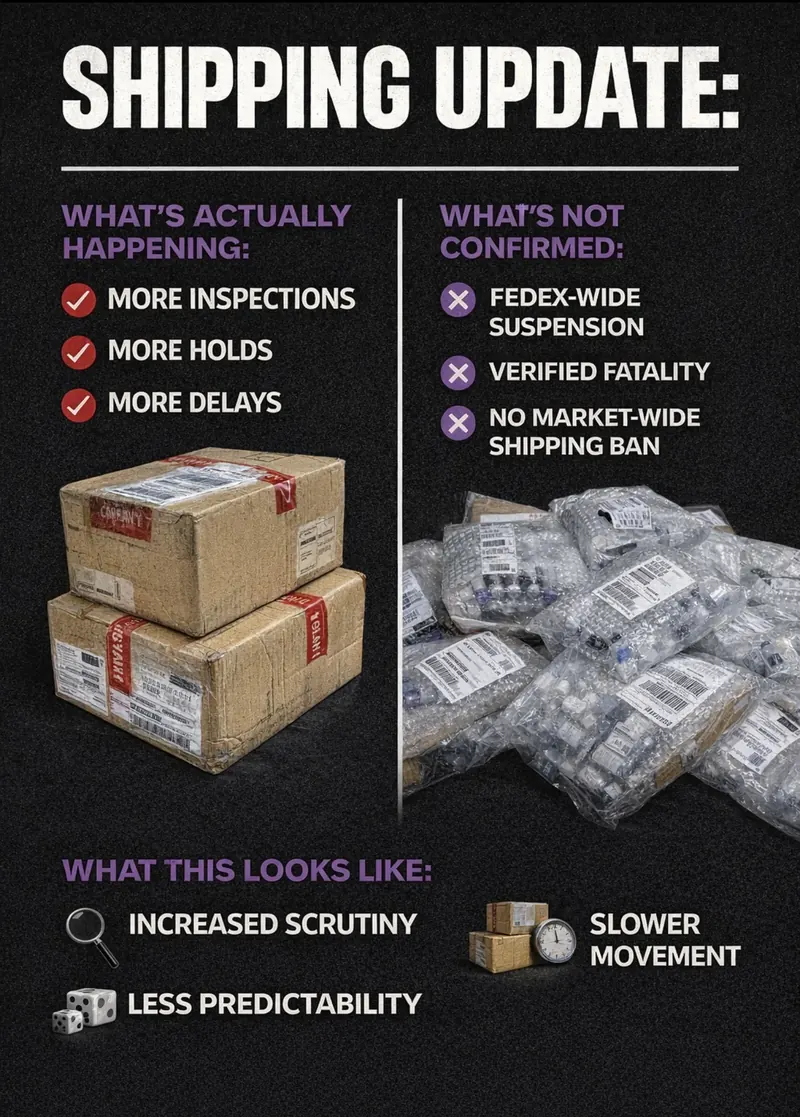
That lines up with what’s being reported, freight forwarders limiting shipments, vendors pausing orders, and delays or temporary refusals becoming more common. This part appears to be real.
What’s being claimed and what isn’t confirmed
Alongside that, there are circulating claims that certain freeze-dried powders were found to contain narcotic substances, triggering additional scrutiny.
There are also more serious claims being shared privately. One message says Chinese police are making arrests linked to freeze-dried powder shipments to the US, and that multiple logistics companies and individuals have already been affected. It also suggests some people in the supply chain are keeping a low profile and avoiding online activity while they wait to see how the situation develops.
So far, I haven’t found anything concrete to verify these claims.
Some are trying to link this to recent big pharma moves in China, including Lilly’s $3B manufacturing expansion. There’s no evidence for that, but it shows how quickly people are looking for a single explanation.
What matters more than the trigger
Even without a confirmed cause, the response is consistent, vendors are pulling back, freight forwarders are limiting shipments, shipments are slowing or stalling entirely. And the knock-on effects are already showing.
US warehouses are reportedly starting to run low on stock. Some are having to float significant amounts of capital with no clear timeline on when shipments will land. That creates a second layer of instability, even when product exists, access to it becomes unpredictable.
Why this keeps happening
To understand why this kind of disruption appears suddenly and why it’s so hard to pin to one clear cause you have to look at how this market actually operates.
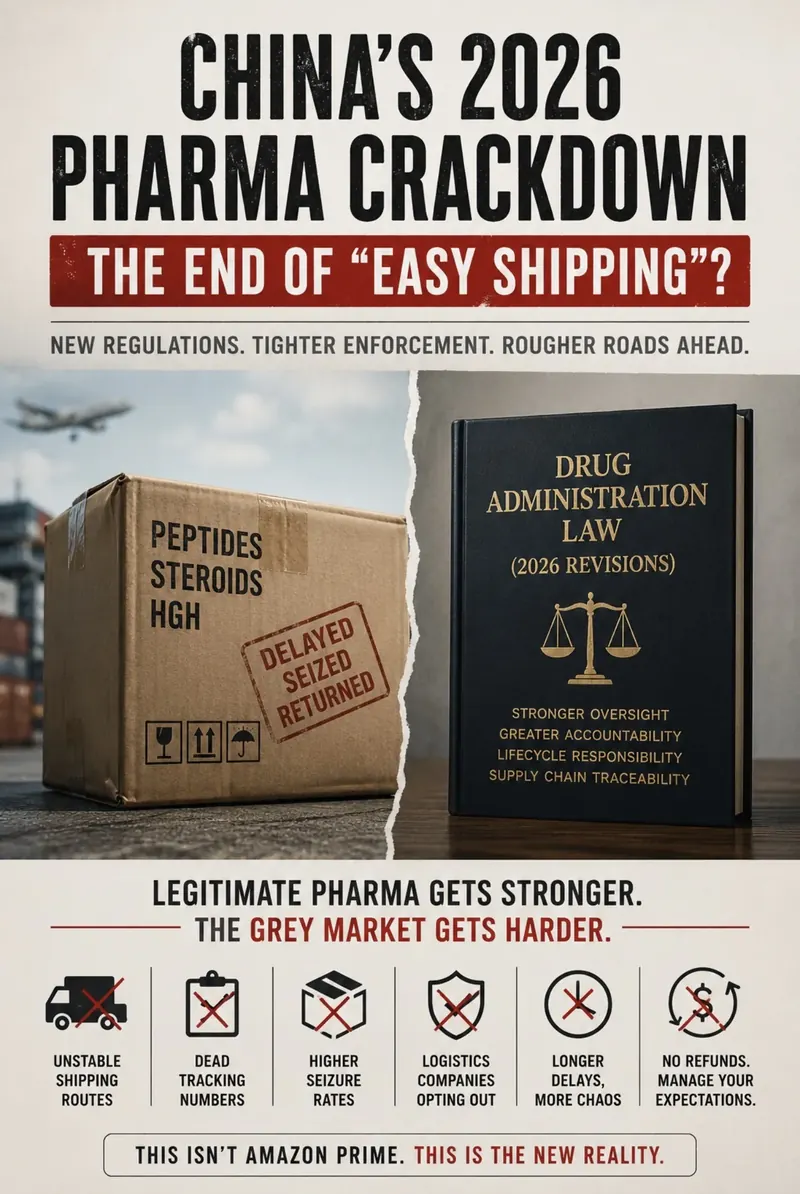
Under China’s Drug Administration Law (Article 41), APIs can be produced for export as long as they are not marketed domestically as drugs and are declared as chemicals or research compounds. That’s the foundation of the grey zone.
Producing peptide powder for export can sit inside that framework. Converting it into a finished injectable product, filling, vialing and packaging, is where it crosses into regulated territory requiring drug-specific GMP compliance.
That’s the line.
How the system works in practice
In reality, the system does not operate neatly within those boundaries. Supply chains are layered. Manufacturers often sell through trading companies, and listings frequently point to front-facing entities rather than the actual production site. API production may take place in legitimate facilities, but downstream stages such as vialing and packaging are not handled through licensed pharmaceutical manufacturing channels. Production can be fragmented, with one entity producing the powder, another handling distribution, and the fill / finish factories are often repurposed legitimate licensed cosmetic or other non-pharmaceutical facilities used out of hours, while other production is pushed into more hidden underground settings.
What also comes up in discussions is how some of the larger operators rely on local relationships and unofficial payments to stay under the radar. I cannot independently verify individual cases, but it’s come up enough times in conversations to make me think it’s true.
Most of this trade does not move through standard courier channels either. It relies on what are often called “special lines” managed routes run by freight forwarders. Orders are consolidated, repackaged, relabelled where needed, and routed through specific logistics pathways before entering normal courier networks at the final stage. As long as inspections remain stable, these routes can function relatively smoothly. But when enforcement tightens, forwarders pull back, routes pause, and shipments stall. That is why multiple vendors can be affected at the same time.
What’s changed
What changes is enforcement. China’s regulatory approach has shifted toward more dynamic inspections over time. Instead of static oversight, monitoring now happens across manufacturing, export and post-market stages. At the same time, customs technology has improved. Mislabelled or unusual shipments are easier to flag, especially when patterns repeat.
There have also been changes on the import side. The removal of de minimis treatment for certain shipments means smaller packages are no longer as invisible as they once were. When enforcement tightens, even temporarily, the effect isn’t gradual, shipments get held, forwarders pull back and vendors pause. Everything upstream reacts at once.
Now add a second pressure point
What’s new, or at least more visible, is pressure on the financial side. If exchanges are starting to flag not just individual wallets but “similar counterparties,” that suggests something broader than isolated enforcement. It points toward pattern-level monitoring. On its own, that doesn’t confirm a crackdown, but alongside what’s happening in logistics, it shows pressure building from more than one direction.
The bigger picture
This isn’t one clean story with a single cause. It’s what happens when a system built on regulatory gaps comes under pressure at multiple points at once, export enforcement tightening, logistics risk increasing, financial visibility improving. The exact trigger might be unclear, but the behaviour across the system isn’t.
Comments