
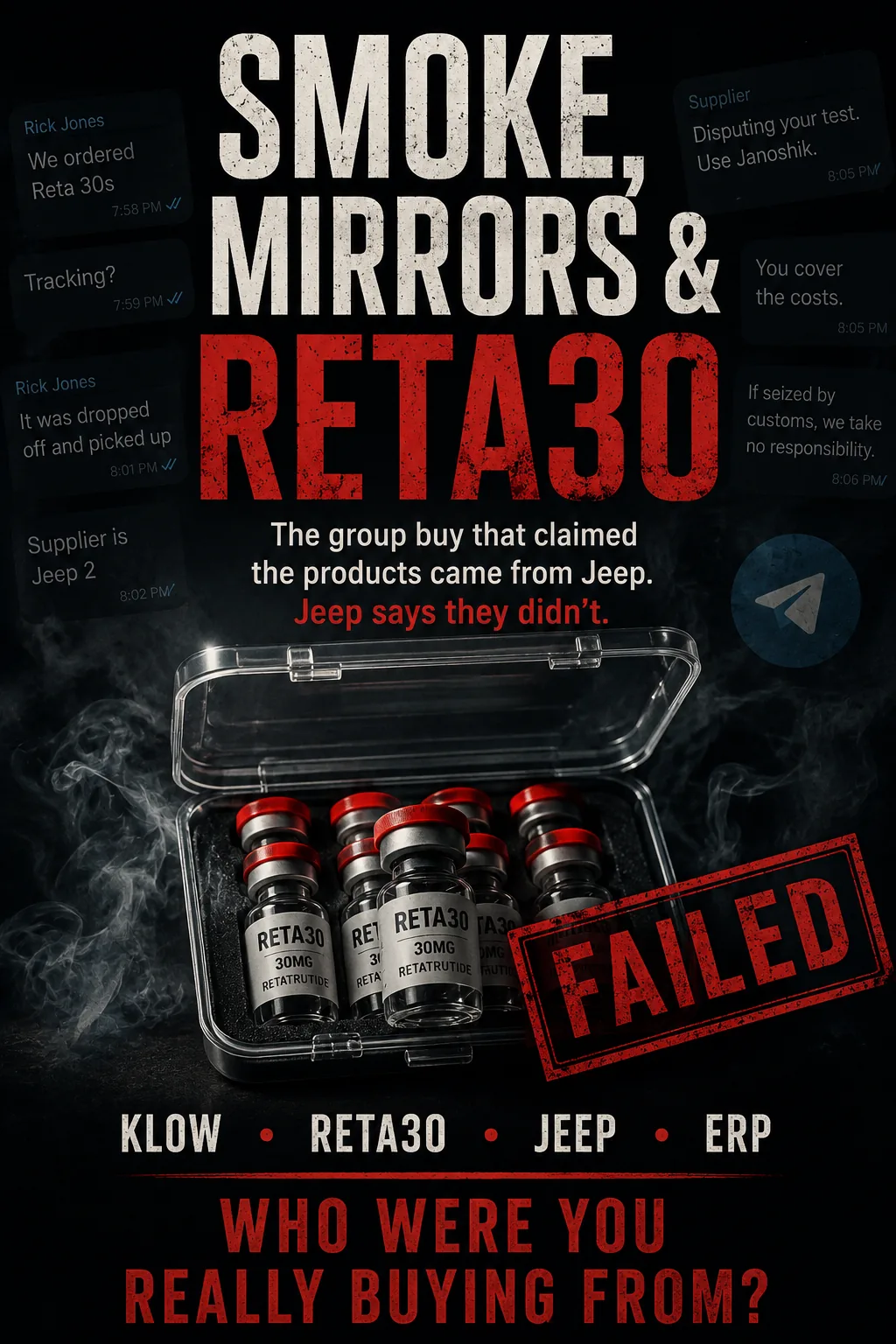
The Facebook Recruitment
The Peppers Group Buy didn’t operate solely through Telegram. One route in was through a Facebook group called Dad Swagg Community, where Rickey Lamb promoted the buy and invited interested buyers into the Telegram group. That matters because Rickey later described himself as “just the crypto guy,” but his role appears to have gone further than just payment handling. He was bringing people in, explaining how the buy worked and presenting Peppers as an established operation with regular suppliers, large orders and periodic testing. When discussing the operation, Rickey consistently used the word “we.”
Rickey described typical order sizes of between $20,000 and $30,000, explained how pricing worked and also presented the supplier relationship as long-standing and established, not as a one-off unknown source.
According to him, “We have been using them for almost 4 years.”
He then described the group’s testing practices in relation to that vendor, “We periodically do send out for testing” and “We do like the cross reference just to make sure their testing is legit and on point.”
Rickey also claimed that previous testing had generally been good, noting that some products occasionally tested slightly under or over their labelled amount but that purity and endotoxin testing had consistently been satisfactory.
In other words, Rickey wasn’t simply saying Peppers had bought from this vendor before. He was presenting the vendor as a familiar supplier whose own testing had supposedly been cross-checked by the group over time.
Those assurances would later be called into question when the Klow and Reta disputes emerged.
The Peppers Group Buy
Peppers Group Buy wasn’t presented as a one-man operation. Alongside Rickey Lamb, the core names attached to it were Isaac, Rick Jones and Melvin, with Rick Jones appearing to be the main organiser and public-facing contact. Buyers dealt with him when placing orders, chasing tracking and raising problems.
The wider circle was less clear.
Matt Wallace was later described as just another buyer, but his own comments suggested something closer to the operation. He referred to “our extras,” talked about what “we ordered,” and appeared familiar with the group’s supplier history, including the move from Quall to Jeep. He also explained the black-bag packaging and later tried to sell leftover Reta20, claiming it was from ERP.
So while Peppers may have looked like a simple group buy from the outside, the structure behind it was messier. Once the products started failing, that messy structure mattered. Everyone seemed close enough to explain the operation, but not close enough to take full ownership when things went wrong.
The First Failure: The Klow Buyer Exchange
On May 9, a buyer contacted Rick Jones to purchase four kits of Klow. Jones quoted $631.50 including shipping and customs. When asked whether he had ordered from the supplier before, Jones reassured him “We have been ordering from same people for close to 4 years.”
He added, “They have done us right for a long time, and so far so good.”
Payment was then made directly to Rickey Lamb through Cash App or Venmo, confirming Rickey’s role on the payment side.
The order itself wasn’t smooth either. After the buyer chased tracking, Jones said the package was running a day or two late. A tracking image later showed the package still sitting at “label created,” despite Jones saying it had been dropped off and picked up. When questioned, Jones said he had called the store and been told it had been collected but not scanned.
By June 2, the product had arrived, but another issue appeared. The Klow kits seemed to carry the same batch number while having different coloured caps.
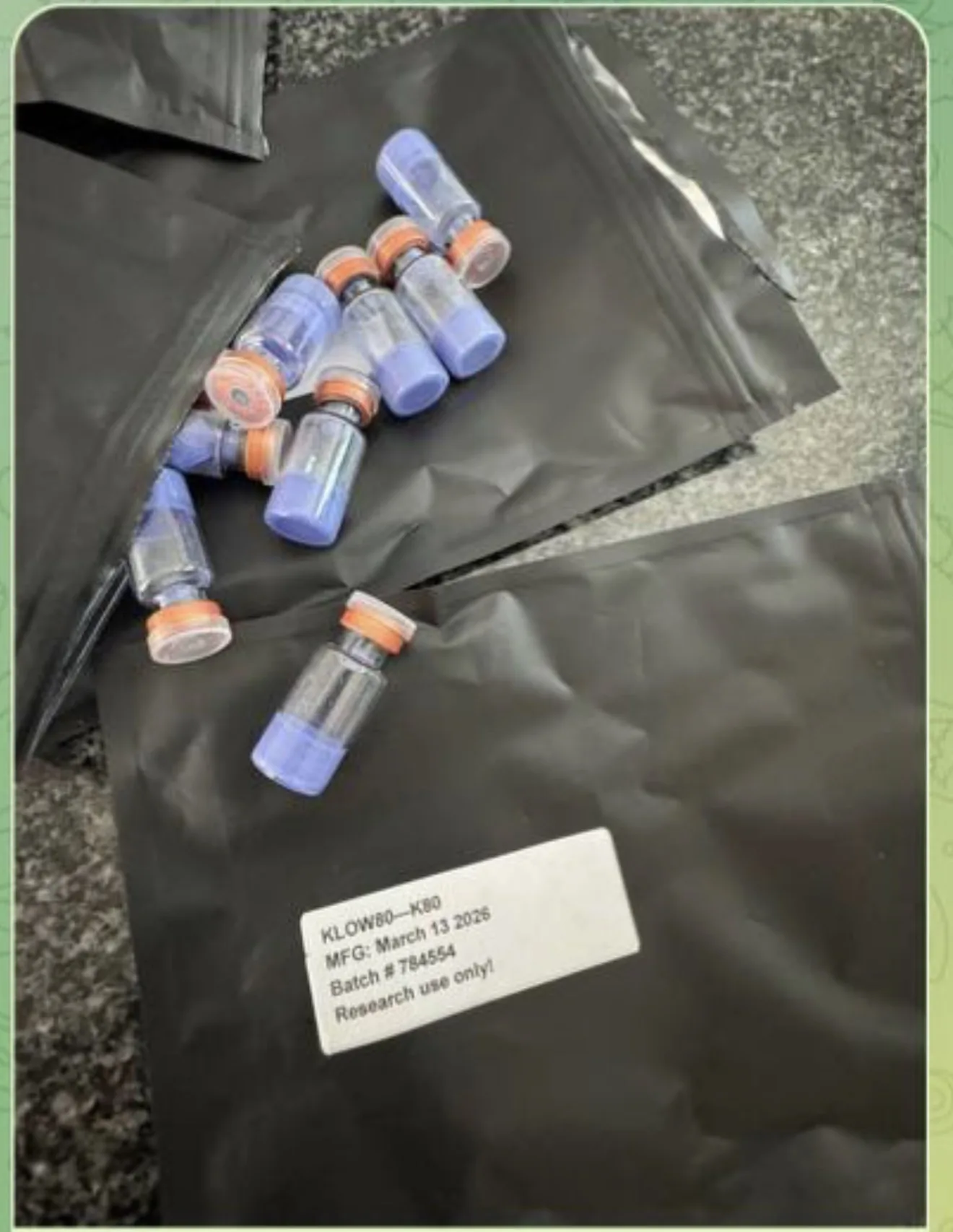
Jones explained, “I have been told the caps do change, but the product batch stays the same till that powder is gone.”
The buyer then sent the Klow to Freedom Diagnostics. A few days later, the result came back bad showing only AHKcu, 99.71% and 44.58mg
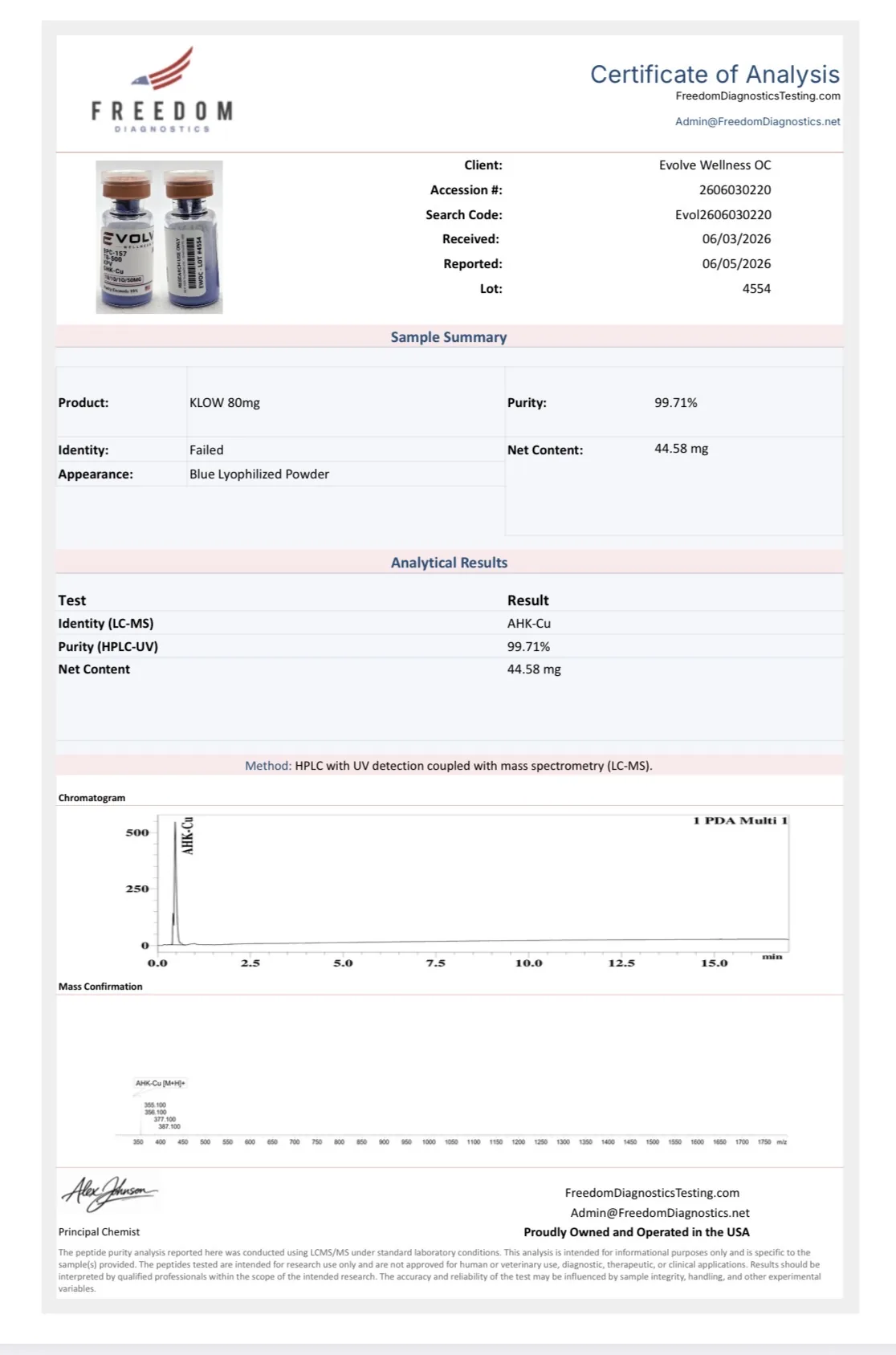
The buyer’s message was blunt, “These Klow 80’s were bullshit. Now what do we do?”
Jones asked for the report and said he would forward it to the vendor immediately. At first, his response was reassuring, “I will get it taken care of for you. They are always willing to help.”
He also said he and Isaac had 43 kits between them from the same special, suggesting they had their own exposure if the product was bad.
But by June 8, the tone had changed. When the buyer kept asking for updates, Jones pushed back.
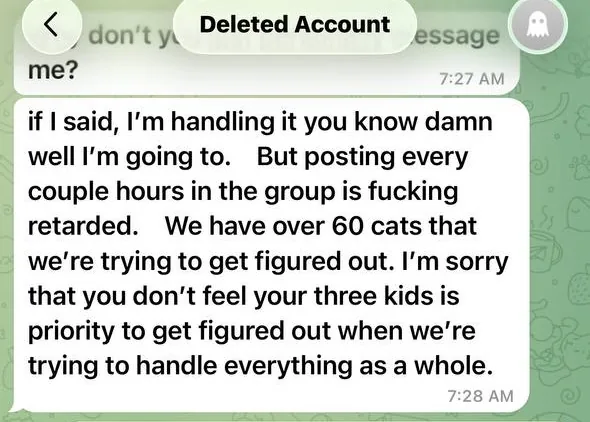
He complained about posts in the group and said they had “over 60 cats” to deal with. The buyer argued that if bad product had been sold, urgency and communication were not optional. The exchange quickly became hostile. Jones insisted he wasn’t making money from the sales and said he had joined the buy to avoid “400% markup.” He also claimed he had argued with the supplier to escalate the issue.
The supplier’s position, according to Jones, was that Freedom Diagnostics was not reliable and that Janoshik was the accepted standard.
By June 11, Jones told the buyer:
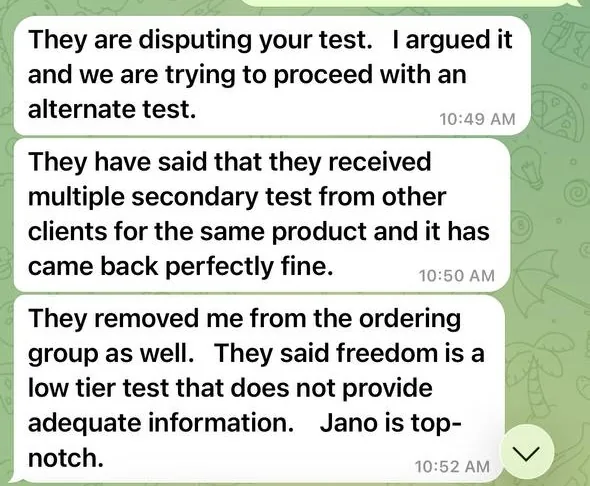
“They are disputing your test.”
He also claimed the supplier had received multiple secondary tests from other customers for the same product, and that those tests had come back fine. Jones then added another important detail, “They removed me from the ordering group as well.”
But when the buyer asked to see those reports, Jones refused:
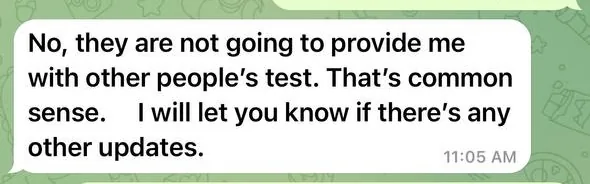
“No, they are not going to provide me with other people’s test. That’s common sense.”
That answer did nothing to calm the situation. If other passing tests existed, even redacted versions could have helped verify the claim. Instead, the buyer was asked to accept the existence of reports they weren’t allowed to see.
That is where the Klow issue stopped looking like a simple testing disagreement.
The buyer had a failed report in hand. Jones claimed there were other reports proving the opposite, but none were shown. The supplier was rejecting Freedom Diagnostics as “low tier.” And the person supposedly handling the problem had been removed from the very ordering group needed to resolve it.
The buyer’s final response summed up the growing distrust, “If they have them they should be able to click them right over. You guys are all scammers.”
By this stage, the Klow problem had already exposed the pattern that would later repeat with Reta30: a failed Freedom result, a disputed test, claims of unseen passing reports, pressure to use Janoshik, and a supplier relationship that became less clear the more questions were asked.
The Reta30 Problem
Shortly after the Klow dispute, a second buyer came forward. This time the product was Reta30. The buyer had purchased eight kits for approximately $2,000 through Peppers Group Buy. Samples were submitted to Freedom Diagnostics which came back as approximately 5.65mg of Tirzepatide rather than 30mg of Retatrutide.
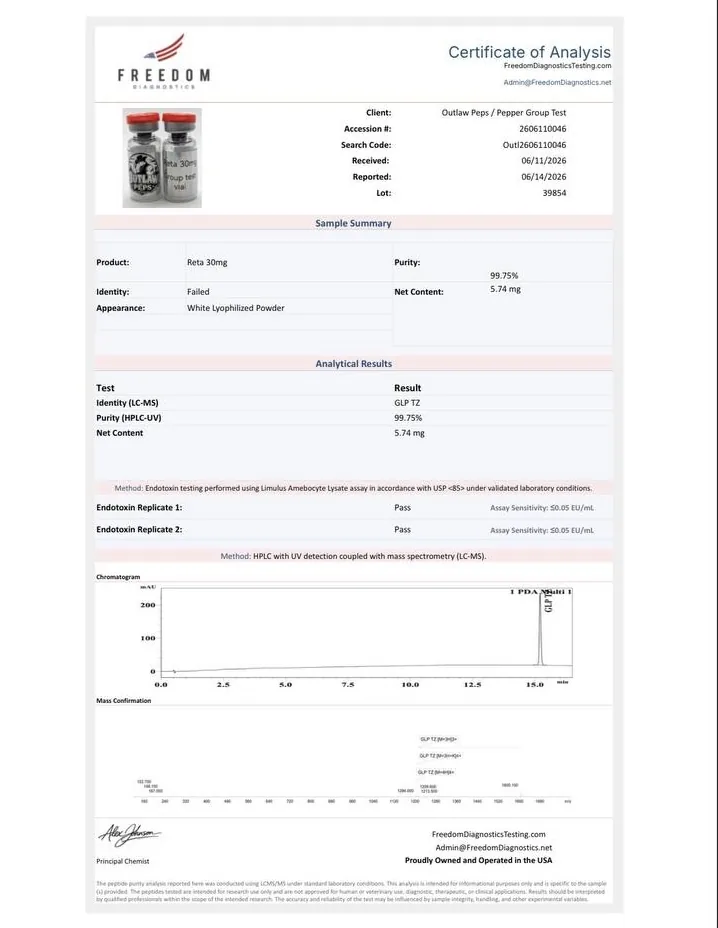
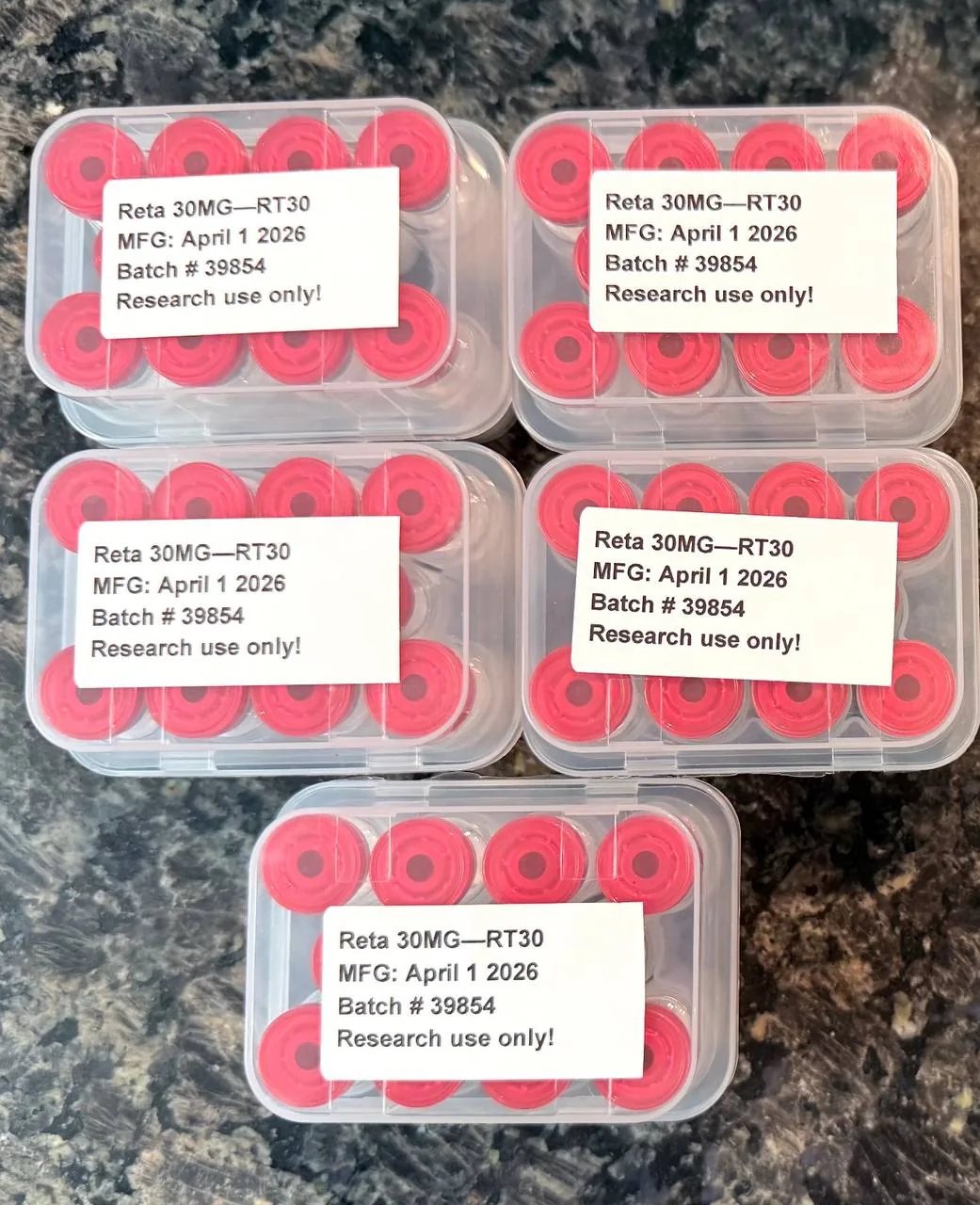
When the buyer asked Rickey Lamb who had supplied the product, the answer was simple, Jeep 2.
At first, that explanation seemed straightforward. Jeep was a known name, and the organisers appeared to be treating the failed result as a possible testing issue, mix-up or labelling error. But then the supplier’s response raised concerns.
According to what was relayed back through Rickey Lamb, the supplier refused to accept the Freedom Diagnostics result and insisted that any dispute would need to be verified through Janoshik. That alone isn’t unusual as many vendors only accept Janoshik for bad results. The concern was the proposed route to resolution.
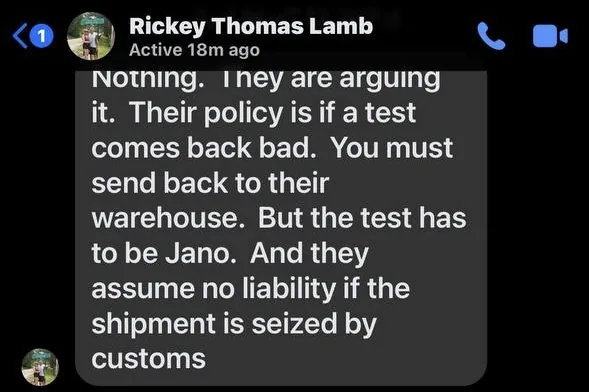
The buyer was told they would need to pay for additional Janoshik testing, return the rest of the product including the partial kits out of their own pocket to their warehouse, and accept that if the shipment was seized by customs, the supplier would take no responsibility.
For buyers who had already paid for product and independent testing, that was not reassuring. It also didn’t sound like the sort of customer service response many people associated with Jeep. Almost immediately questions began to surface about whether the product had really come from Jeep at all especially as the Reta 30 kits didn’t look like the kits Jeep usually sell which are known to have JP on them.
Then the supplier story started to unravel. In reality, the only people saying the products came from Jeep were the people involved in the group buy. The customers themselves hadn’t spoken to Jeep directly, weren’t in Jeep’s Telegram group, and had no independent way of confirming the supplier claim. They were relying entirely on what Peppers told them.
Rickey Lamb also told the customer that Peppers were removed from the vendor group because Ricky Jones was complaining about the under dosed Klow and now the vendor wasn’t replying to them either.
Enter Matt Wallace
Then another name entered the picture, Matt Wallace. Rickey Lamb described Matt as just another buyer, not part of the core operation. But Matt’s own comments made that difficult to accept at face value. When first contacted, Matt immediately denied being an admin or moderator, “I’m not admin or mod. I’m just selling off our extras.” Matt didn’t speak like someone completely outside the buy. He referred to what “we ordered,” said “we bought 12 total kits,” and appeared familiar with the group’s supplier history. According to him, the Reta20 he had was from February, when the group was still ordering from Quall. He explained, “They were the vendor before we went full-time to Jeep.”
A normal buyer might know what they personally bought, what arrived and who they paid. Matt was talking about supplier progression: Quall before, Jeep after. He also had an explanation for the black bags. When questioned about why some buyers received cases while others received loose vials in black bags, Matt said Jeep had two warehouses. According to him, one warehouse still shipped in cases while the other used the black bags. They became another odd detail in a story already full of inconsistencies
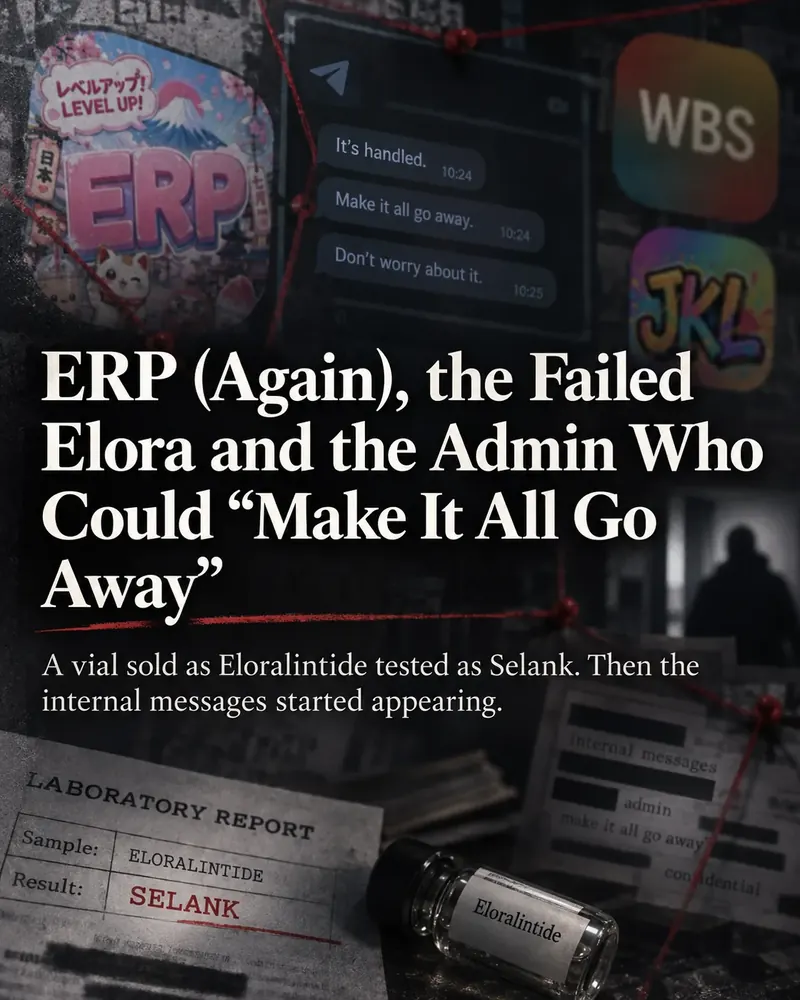
Then the supplier list expanded again. Matt later offered to sell seven kits of Reta20 and claimed they were from ERP, describing ERP as a good vendor. So Peppers now had Quall, Jeep, ERP, possible relabelling, black-bag packaging and disputed Freedom Diagnostics results all floating around the same story. This does make the “just a buyer” explanation feel incomplete.
Jeep Says No
The Peppers organisers had repeatedly stated that the products came from Jeep 2. Even after questions began to surface, the explanation remained broadly the same. The products were supposedly sourced from Jeep, relabelled, or shipped through different warehouses.
So photographs of the Reta30 kits were sent directly to Jeep representatives. One Jeep representative replied “No.” After being told that a group buy had claimed the products came from Jeep, she responded, “Lots of scammers pretend to be us. We don’t carry Reta with that cap color at all.”
A second Jeep representative was shown the same photographs and her response was equally direct “these isnt our products friend”
Neither representative suggested the products had been relabelled and neither suggested they came from an authorised distributor. That created a major problem for the explanation being given by the Peppers organisers.
Until that point, the dispute could still be explained away as a testing disagreement. The Klow failure might have been a laboratory error. The Reta30 result might have been a mix-up. The wrong labels might have been applied during packaging. But once the vendor itself denied recognising the products, the focus shifted. The question was no longer “Did the products fail testing?”
The question became “Where did these products actually come from?”
Later, when the buyer confronted Rickey Lamb, his explanation was, “The vendor sources from Jeep and ERP. Jeep is the manufacturer for them. They just get Cjztec label put on.”
By this point, Peppers was no longer dealing with one clean explanation. The supplier was Jeep. Then it was Jeep and ERP. Then the products were relabelled. Then the packaging differences were explained by warehouses. Meanwhile, the failed Freedom Diagnostics reports were being disputed, and customers were told there were other passing tests, but no supporting reports were shown.
The Peppers Group Buy began with a simple claim “The products came from Jeep 2.”
But by the end, that claim had turned into a much messier story involving failed tests, disputed results, relabelled products, changing explanations and unanswered questions about who was really supplying the bunk vials.

Comments