
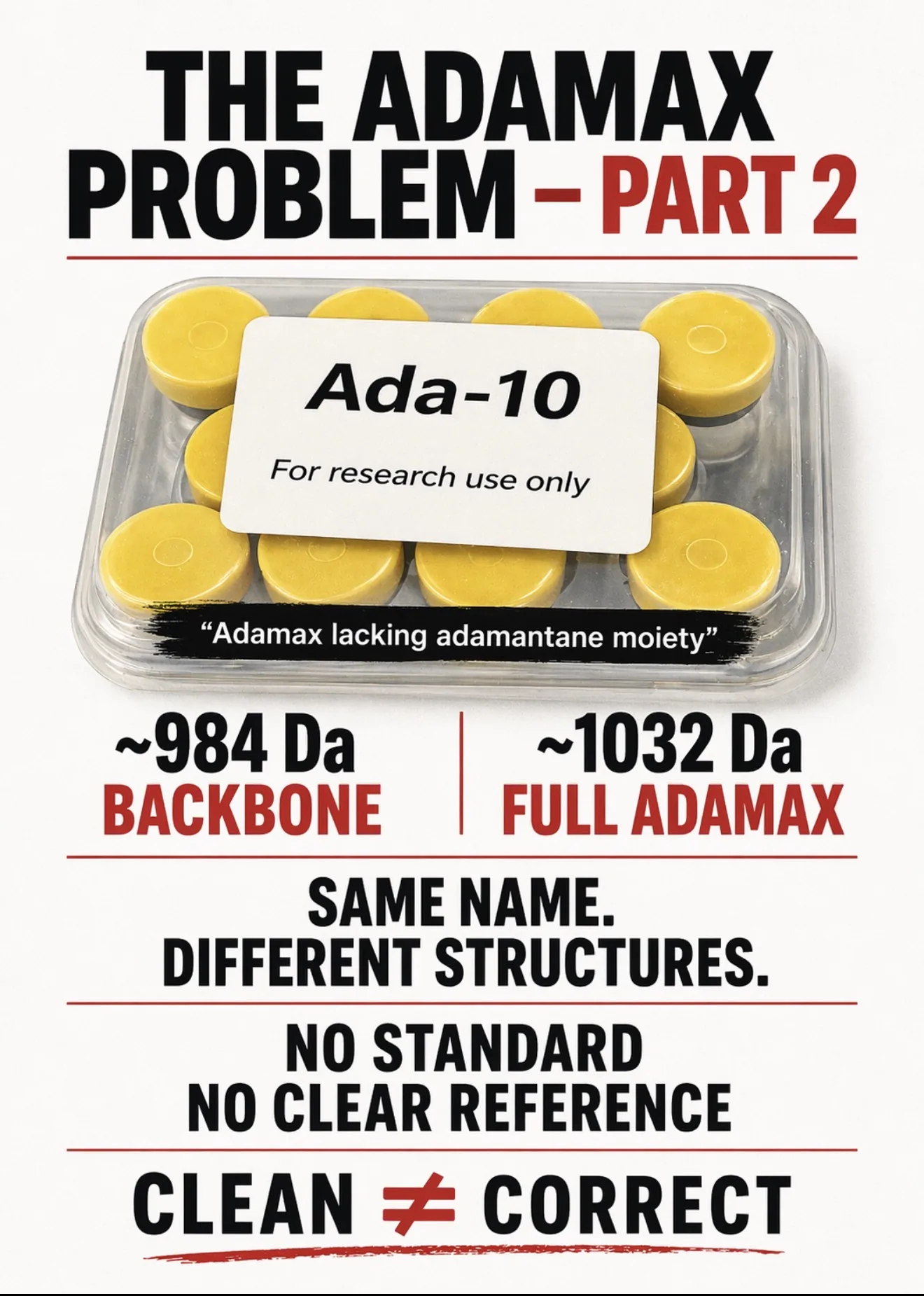
In the first article, I focused on the Janoshik result:
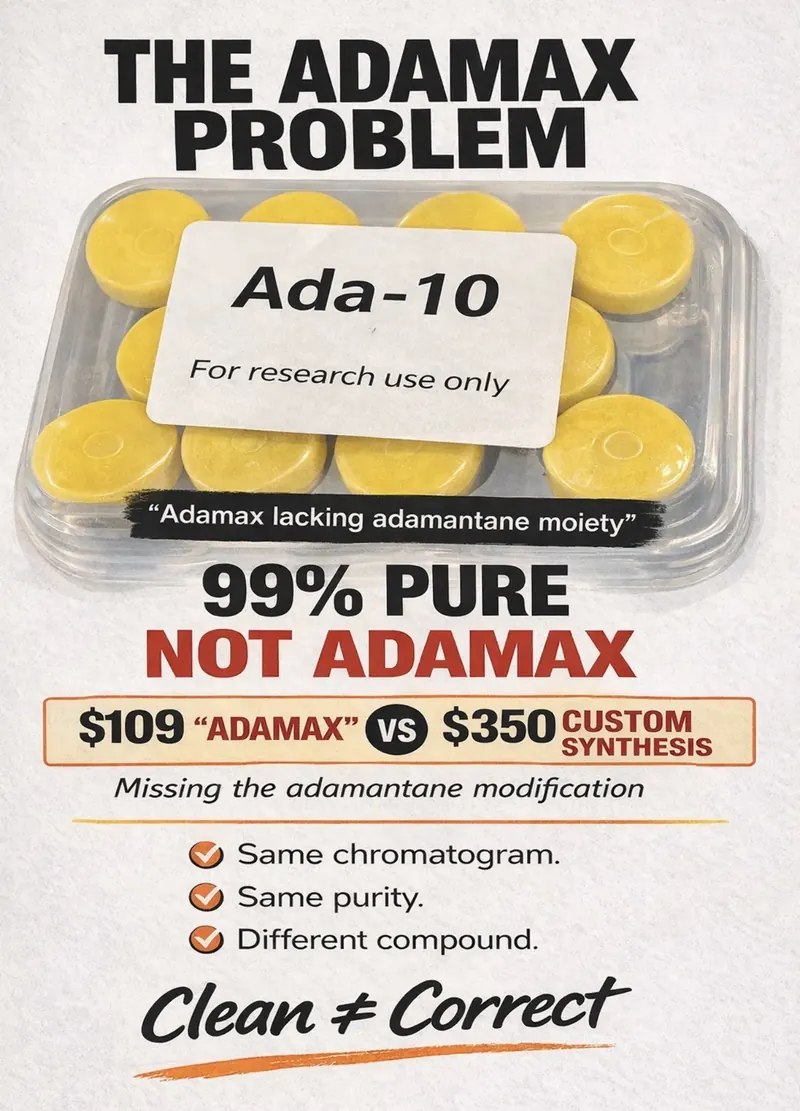
“Adamax lacking adamantane moiety”
That told me one important thing immediately, that what I had was not full Adamax. But once I started looking into it more closely, the situation turned out to be more complicated than a simple Adamax vs Semax split. What is being sold under the Adamax name may not fall into just two categories, rather, there appears to be an intermediate structure as well, what could be described as the Adamax backbone and what Vivian is obviously selling as “Adamax without Adamantine”. That matters, because it changes how the lab result should be interpreted.
The structural issue
The simplest version of the story is this:
Semax is the base heptapeptide (~813.9 Da)
NA Semax adds an N-acetyl group (~855.9 Da)
The Adamax backbone extends that structure further (~984.1 Da)
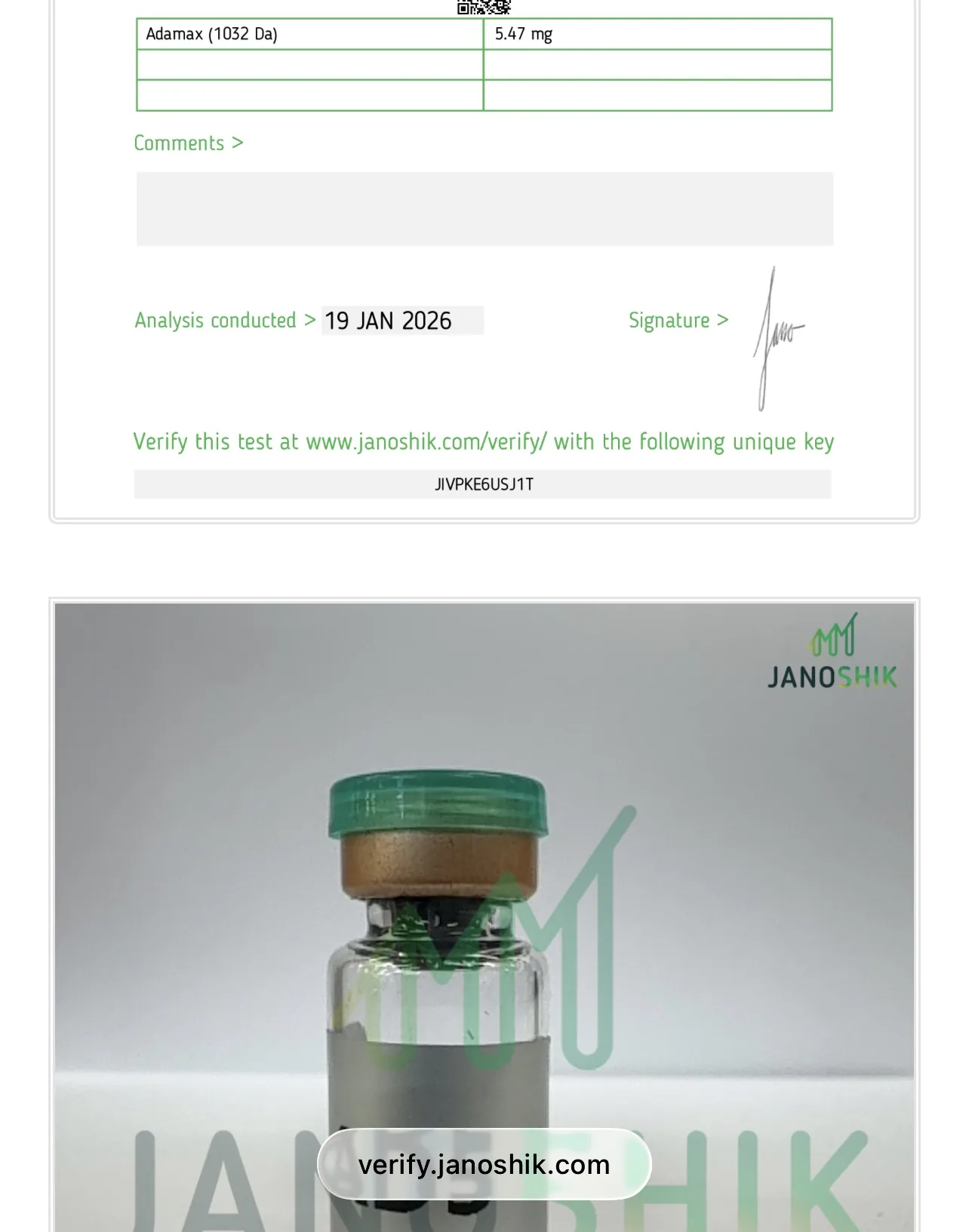
Full Adamax adds the adamantane-containing group on top (~1032 Da)
So rather than one clean jump from Semax to Adamax, there are stages.
This explains why a sample can come back around 984 Da, and why Janoshik called it:
“Adamax lacking adamantane moiety” instead of simply calling it Semax.
What the Adamax backbone appears to be
The Adamax backbone is essentially an extended, N-acetylated Semax-derived peptide with two additional amino acids at the C-terminus. In simple terms, more than NA Semax but less than full Adamax, because it does not include the adamantane moiety
So the progression looks like:
1. NA Semax (~856 Da)
Modified 7-amino-acid Semax
2. Adamax backbone (~984 Da)
Extended 9-amino-acid structure without adamantane
3. Full Adamax (~1032 Da)
Backbone + adamantane modification
Therefore ~984 Da material is not best described as full Adamax, but it is also more precise to call it an incomplete Adamax-type backbone rather than simply Semax.
Why the 984 Da result matters
This is where the wording on the report makes sense, “Adamax lacking adamantane moiety”. That suggests the lab recognised an Adamax-like backbone, but not the full completed structure. So instead of “this is just Semax”, it’s closer to “this is an extended Adamax-type backbone, but the defining modification is missing” Which explains why they didn’t just relabel it as Semax.
Why the market still calls both “Adamax”
Because the name has become looser than the structure and once that happens, “Adamax” starts being used to describe the full finished compound, the backbone version and anything within that supply chain. Structurally, those are not the same but commercially, they often carry the same label anyway.
How labs test this without a proper standard
This is where the second part of the problem begins. I spoke to a few labs, and Janoshik appears to be one of the only labs offering this testing, likely because there is no widely accepted standard to work from and proper validation becomes difficult when there is no trusted reference. For a well-defined compound, labs want a clear structure, a reference standard and a validated comparison point. But with Adamax, that’s not straightforward. As one lab contact put it bluntly “Running a testing lab off uncertain standards is like building a house on quicksand.”
If the standard is uncertain, the entire testing chain becomes uncertain.
What labs can still do
Even without a certified Adamax standard, labs can work from the expected structure, expected mass, the expected modifications, amino acid analysis, LC-MS / MS-MS and NMR comparison across batches. So even without fully confirming identity, they can still detect when a sample does not match the claimed structure.
What Janoshik likely did here
In this case, Janoshik most likely did not fully identify the sample against a certified Adamax reference standard. More likely, they compared the sample to the expected mass and expected structure of full Adamax. Since full Adamax should include the adamantane-containing modification and therefore sit at a higher molecular weight, a result around 984 Da would immediately show that the defining group was absent. That would allow them to conclude that the sample did not match full Adamax, even if they could not fully confirm the exact identity of what was present instead. That is why the report reads “Adamax lacking adamantane moiety”
This is best understood as a structural mismatch call, not a full identity confirmation.
Why deeper validation is expensive
Proper validation may require amino acid analysis, NMR, multiple lab comparisons and custom synthesis of a reference standard. If no standard exists, one may need to be created from scratch and that can cost thousands for a single compound. So this isn’t just difficult, it’s expensive and impractical for routine testing.
What this means in practice
This creates a gap at every level. On the supplier side there incomplete structural info, inconsistent naming and reliance on upstream assumptions, whereas on the Lab side it can detect missing features, may not fully confirm identity and is limited by lack of standard. So the problem isn’t just synthesis, it’s the gap between, what’s sold, what it actually is and what can be proven
Why this matters for the buyer
We don’t just need to know its purity, we also need to know if it’s the correct molecular weight, whether it’s the backbone or full compound, if the defining modification present, is the name being used loosely?
Pricing starts to make sense too
Once we understand the structure, ~984 Da backbone, ~1032 Da full Adamax, then the price differences make sense. The fully modified version should cost more, so if something is cheap, then you may not be getting the full compound and you may be getting just the backbone instead
Dosing
The difference is not just structural, it’s practical too. Semax and NA Semax are typically discussed in the 500 to 1000 mcg range, whereas Adamax is usually discussed around 200 to 300 mcg. So if someone thinks they have full Adamax, but actually has a backbone or Semax-type compound, they’re not just mislabelled, they may also be working from the wrong dosing assumptions.
Final takeaway
My first article showed, 99% + pure… and still not Adamax
This article explains why different structures are being sold under the same name while testing is trying to catch up without a clear standard.
That leaves the buyer guessing what they actually have.
My advice is to check with the vendor before buying what exactly they will be sending you. Vivian has confirmed now that she’s been selling just the Adamax backbone, but she’s been a great sport and given me a full refund for that.
Comments