
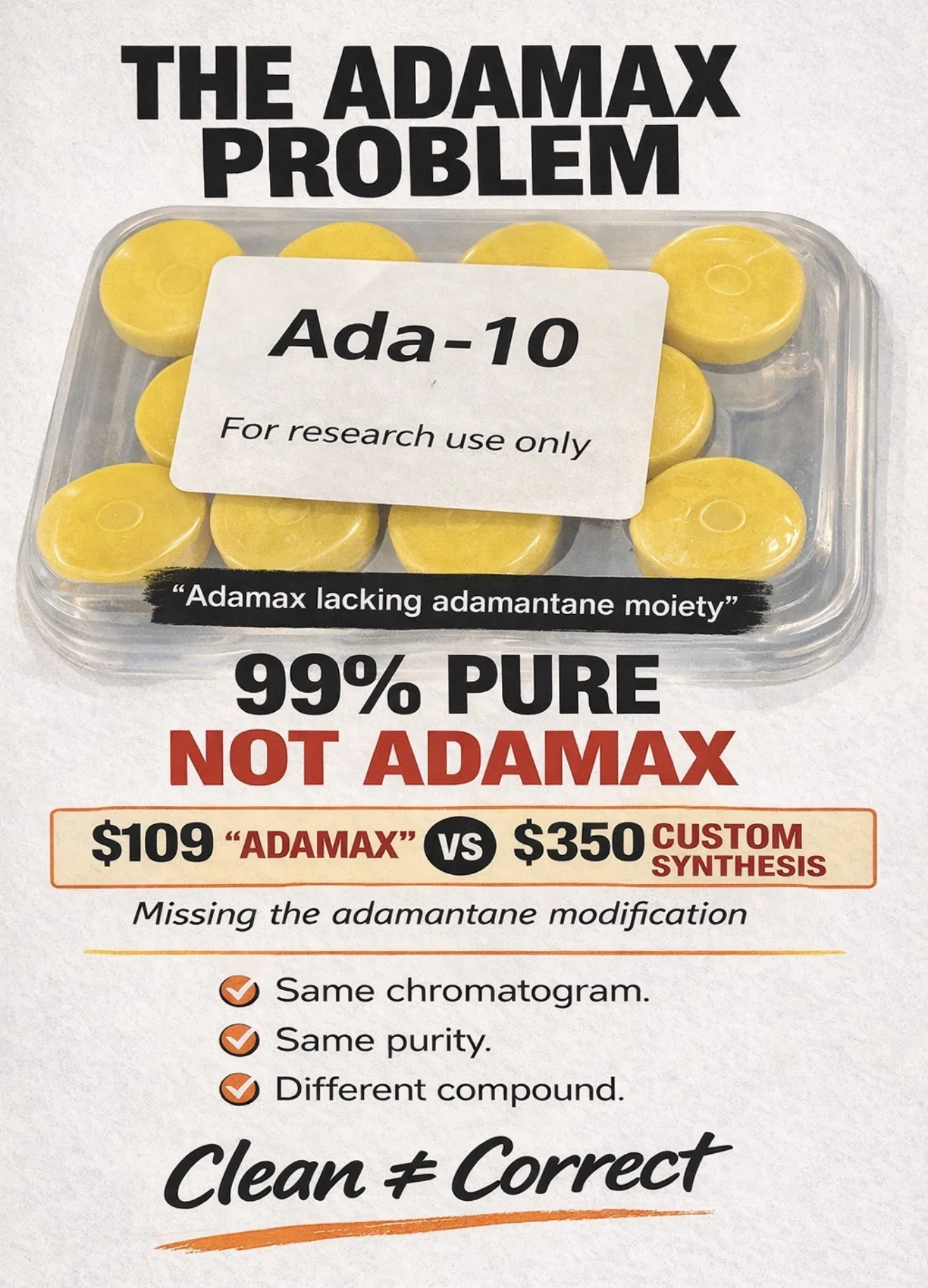
I’m reposting this COA because the first time I shared it, I missed the most important line:
“Adamax lacking adamantane moiety”
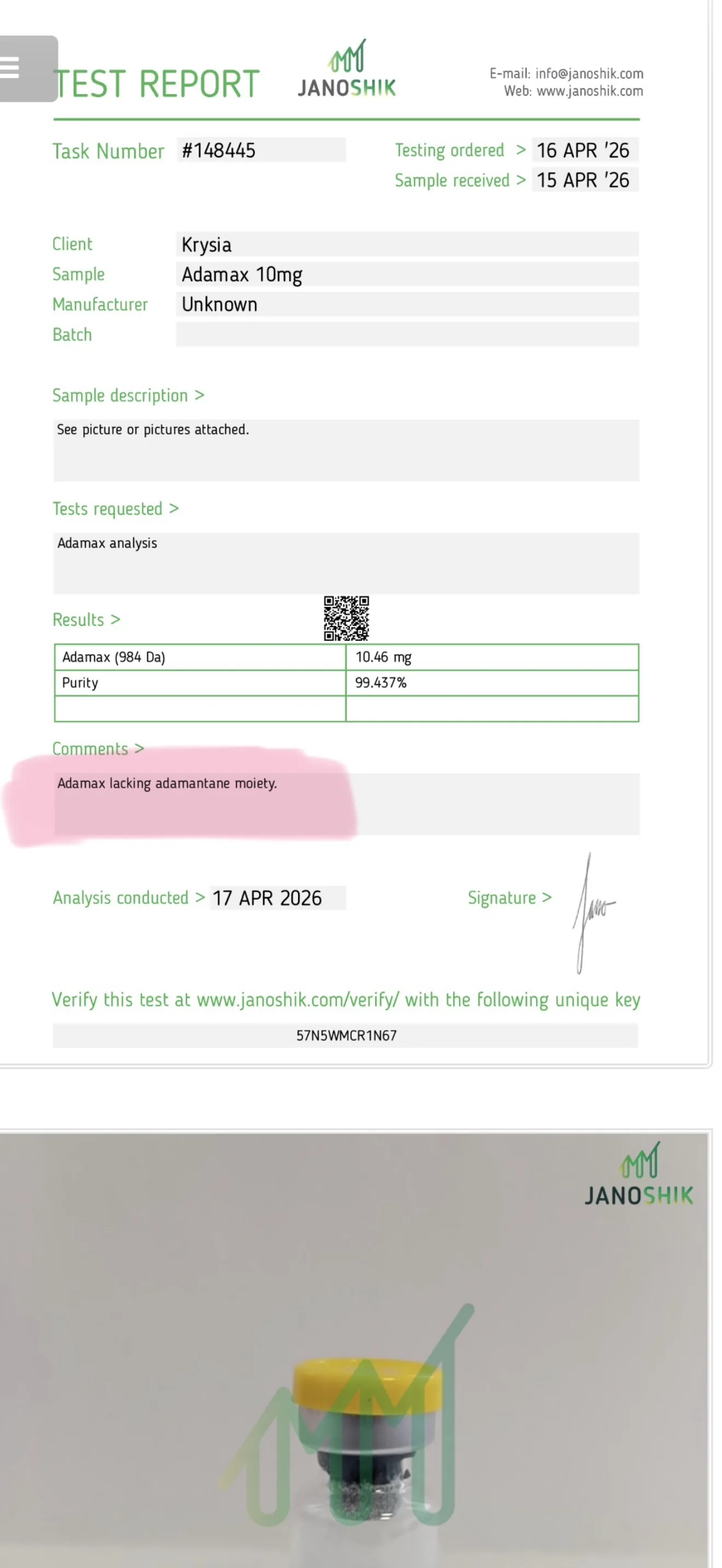
This makes this a very different result.
No adamantane = not Adamax
At this point, what I’m looking at is most likely a Semax-type peptide, or something very close to it. It most likely showed the same chromatogram, with a “99%+ purity”, but its a completely different compound.
Purity vs Identity; the core misunderstanding
This is where most people get it wrong. A result like 99.4% purity looks reassuring, but purity assumes the main peak is correct. If that assumption is wrong, the number doesn’t mean what people think it does. In this case, whatever is in my vial is “99.4% pure” by HPLC-UV, but it’s not Adamax. So this is when clean does not mean correct.
What Adamax is supposed to be
Adamax is described as a modified version of Semax with an adamantane group attached and that modification is the whole point, as it’s claimed to improve brain penetration, increase potency and extend duration. This is exactly why I chose to buy Adamax over Semax. Once that modification is removed, we are no longer dealing with Adamax.
How the lab reached that conclusion
The wording on the COA is very deliberate:
“Adamax lacking adamantane moiety”
This wasn’t a guess. The lab likely followed a standard analytical approach.
1. Expected mass vs observed mass
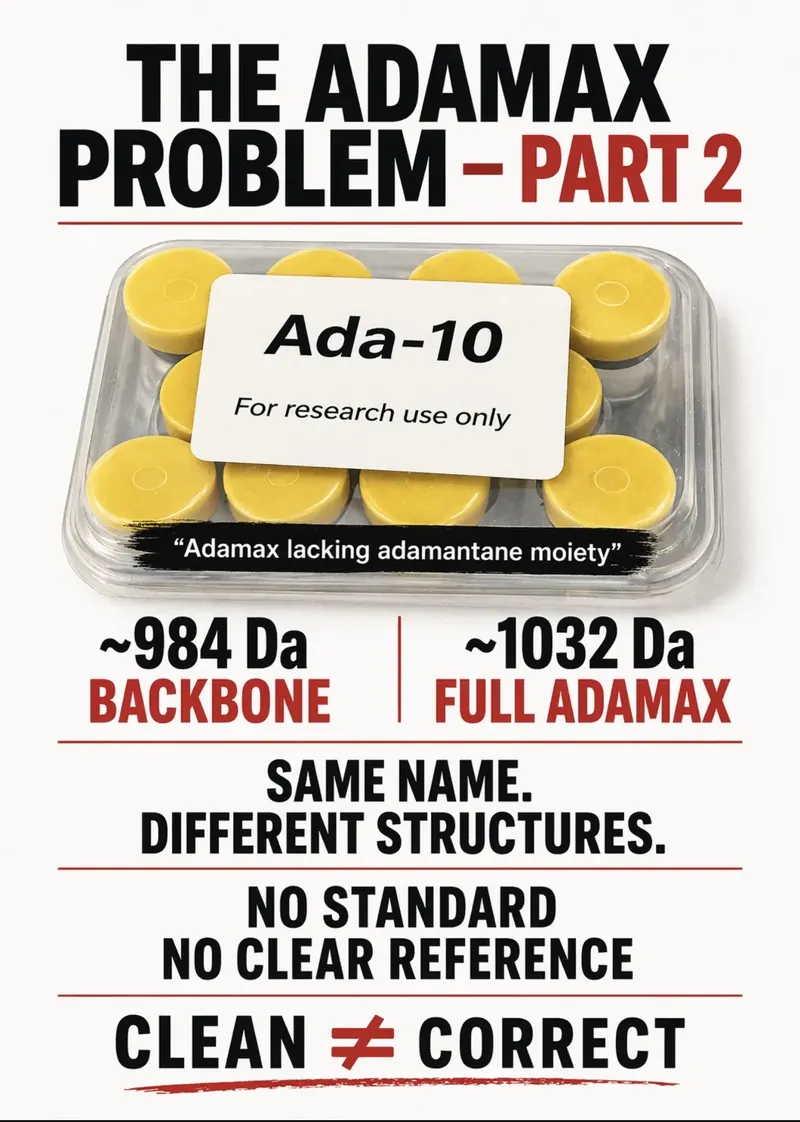
Adamax should have a higher molecular weight than Semax because of the added adamantane group. The observed mass appears to align with a Semax-range peptide (~984 Da), not the heavier modified structure. That immediately flags that the modification is missing.
2. Chromatographic behaviour
On HPLC, the sample shows a clean dominant peak, consistent with a single peptide, but it does not behave like a bulkier modified molecule. So visually, it looks “correct”, but only at the level of purity, not identity.
3. Structural inference
From that, the lab can say the peptide backbone is present and the defining modification is absent, but instead of over-claiming identity, they report it as Adamax lacking adamantane moiety, which is essentially the base peptide without the modification.
So why didn’t they just write “Semax”?
Even though everything points in that direction, labs avoid making that call without LC-MS/MS fragmentation and comparison to a reference standard. Small differences in sequence, terminal groups, or synthesis can still produce similar mass and chromatograms. So they report what they can prove, not what they can assume.
Is it Semax? Not fully confirmed
The obvious conclusion is that this is Semax and in practical terms, that is likely true, but analytically, Semax has a molecular weight of ~984 Da. That mass however, is not unique and similar peptides can share it. So without full structural confirmation, this remains a Semax-type peptide, not definitively Semax.
Why another lab might have called it Adamax
Different labs can give different answers on the same sample. A lab relying mainly on HPLC retention time and peak shape could easily have reported this as Adamax. If the sample produces a clean peak in the expected region, it may simply be assigned that identity and given a high purity figure. Retention time is useful, but it is not proof of structure. A modified peptide and an unmodified or differently modified analogue can behave similarly enough on HPLC to be misassigned, especially where no universal reference standard exists. This is exactly why retention time alone is not enough. MS or NMR is what actually confirms identity.
The deeper issue: designer peptides
Adamax falls into the category of a designer peptide. These are derived from known compounds, structurally modified and circulated commercially without formal standardisation. They often lack a CAS number, a universally agreed structure and certified reference standards.
Why this matters
Without a CAS number or standard labs work from expected structures and suppliers work from upstream assumptions. Identity then becomes inferred, not verified.
What this looks like in practice
Instead of one defined compound, you get multiple interpretations of “Adamax”, inconsistent synthesis and missing modifications. At that point Adamax becomes a label, not a structure.
Pricing as a signal
Looking back, the pricing already hinted at this.
Vivian (CGL): $80 (10x5mg), $109 (10x10mg)
Alisa: $172 (5mg)
Uther: $280 (10mg)
WWB: $120 (5mg, older listing)
TYP: $110 (10mg)
Other GB pricing:
~$200 per kit
~$350 for 10mg low MOQ custom synthesis
That spread reflects the difference between base peptide and true modified synthesis
Where this extends beyond Adamax
Adamax is an example of a broader issue. Custom Semax analogues are particularly vulnerable because the name can move faster than proper structural verification. P021 is more formally defined and has a registered identity, but even there, naming and product descriptions are not always used consistently. In the wild, “P21” is often used loosely, creating confusion between defined compounds and general naming. That means the same verification issue can still occur. This is reflected in pricing too:
Below is part of Alisa Peptides list
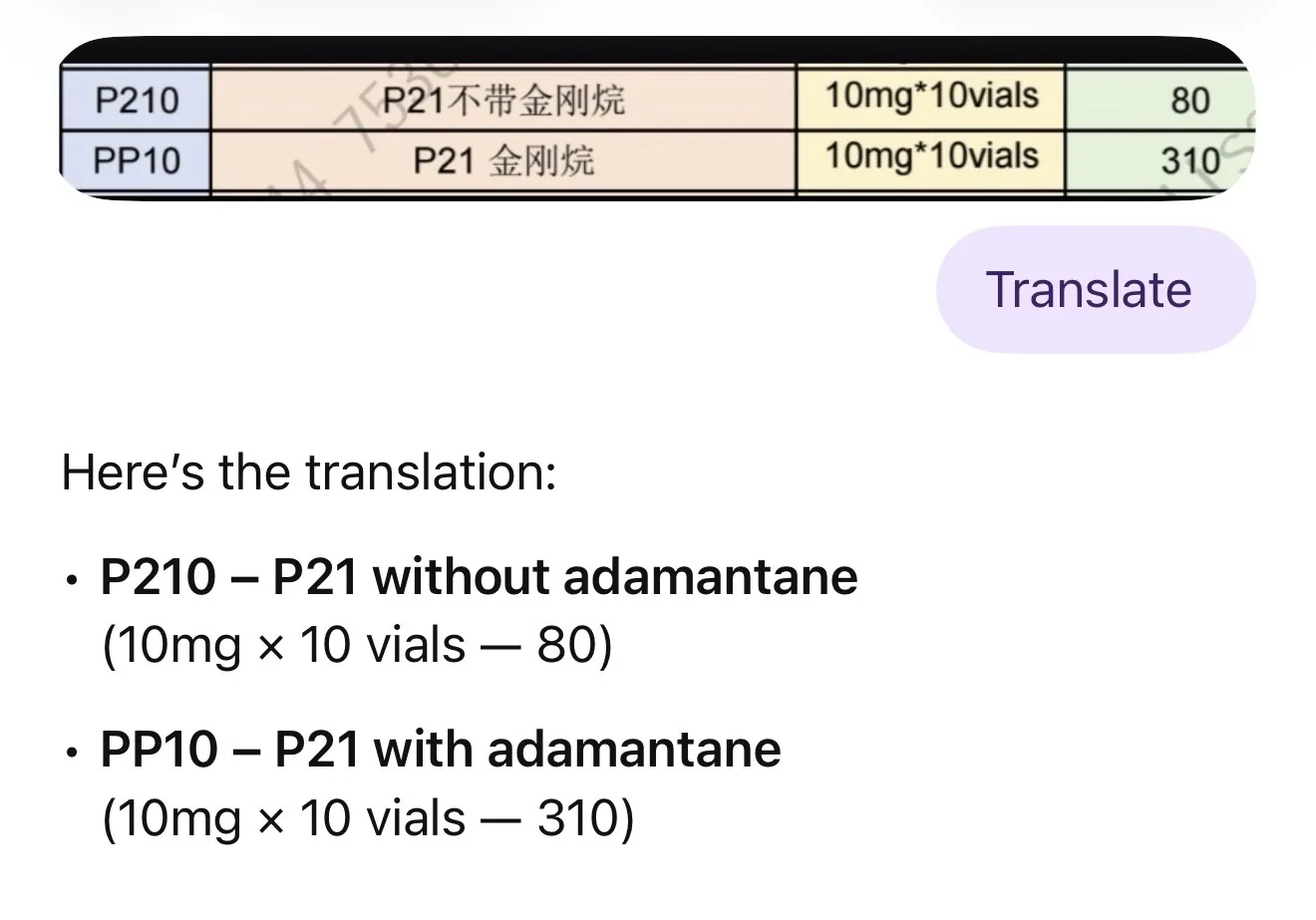
This is a clear illustration of the price difference.
Final takeaway
This isn’t just about one incorrectly named Adamax sample, rather it highlights a broader issue that purity can be mistaken for identity, structure can be assumed, not verified and labels cannot always be trusted. It also highlights the pricing problem. People want both the lowest price and confidence it was made properly. But with designer peptides, those rarely go together.
If it’s cheap, you may be getting whatever the supply chain calls that compound.
If it’s done properly by a quality synthesiser, it will usually cost more.
So when a designer peptide is priced unusually low, it should raise the question of whether the chemistry matches the label. In that environment a compound can be 99% pure and still be the wrong product
99% + pure… and still not Adamax.
As for this vial, I’ve already got some tested Semax that i haven’t used yet. I’m not comfortable using something where the identity isn’t fully clear and i don’t want to pay more for LC-MS just to confirm that its Semax.
Comments