
The KLOW controversy (April 2026)
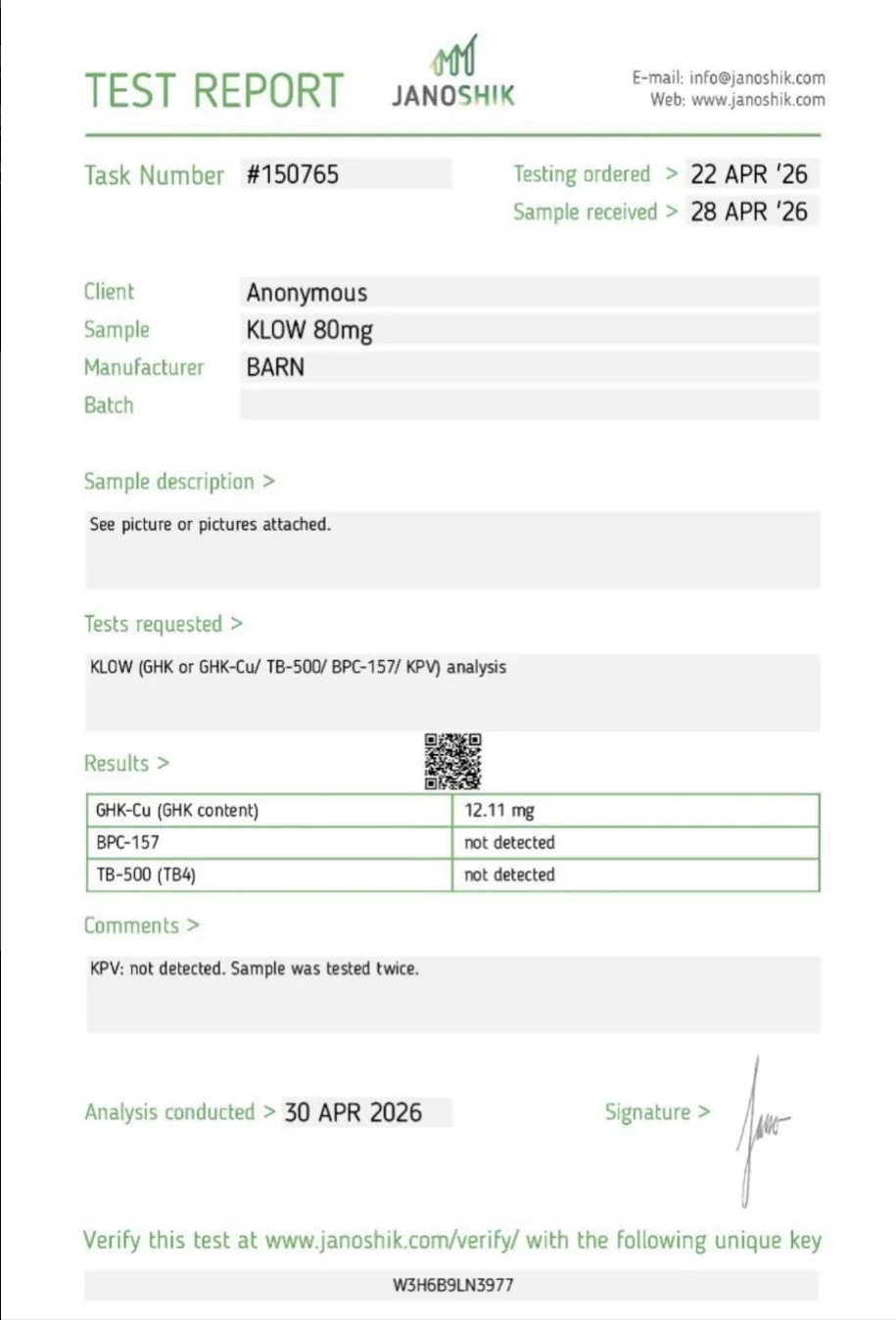
A Janoshik analysis of Barn’s KLOW 80 mg detected only 12.11 mg of GHK-Cu. BPC-157, TB-500 and KPV were not detected, with the report noting that the sample had been tested twice for KPV.
Barn didn’t challenge the COA, Instead, Alex publicly acknowledged that a limited batch from the China warehouse had been affected. She attributed the issue to a production mix-up at the laboratory, stated that only around ten boxes had been sold, confirmed that Barn had paid for the Janoshik testing, announced that the remaining China warehouse stock had been destroyed, and reassured customers that the US warehouse was not affected.
Customers who received the affected batch were offered full refunds after testing.
Barn’s response to KLOW was markedly different from its later response to RT10. In the KLOW case, the company accepted the laboratory findings, described the issue as a production error and moved directly to refunds and destruction of the remaining stock.
The KPV / Melanotan controversy ( June 2026)
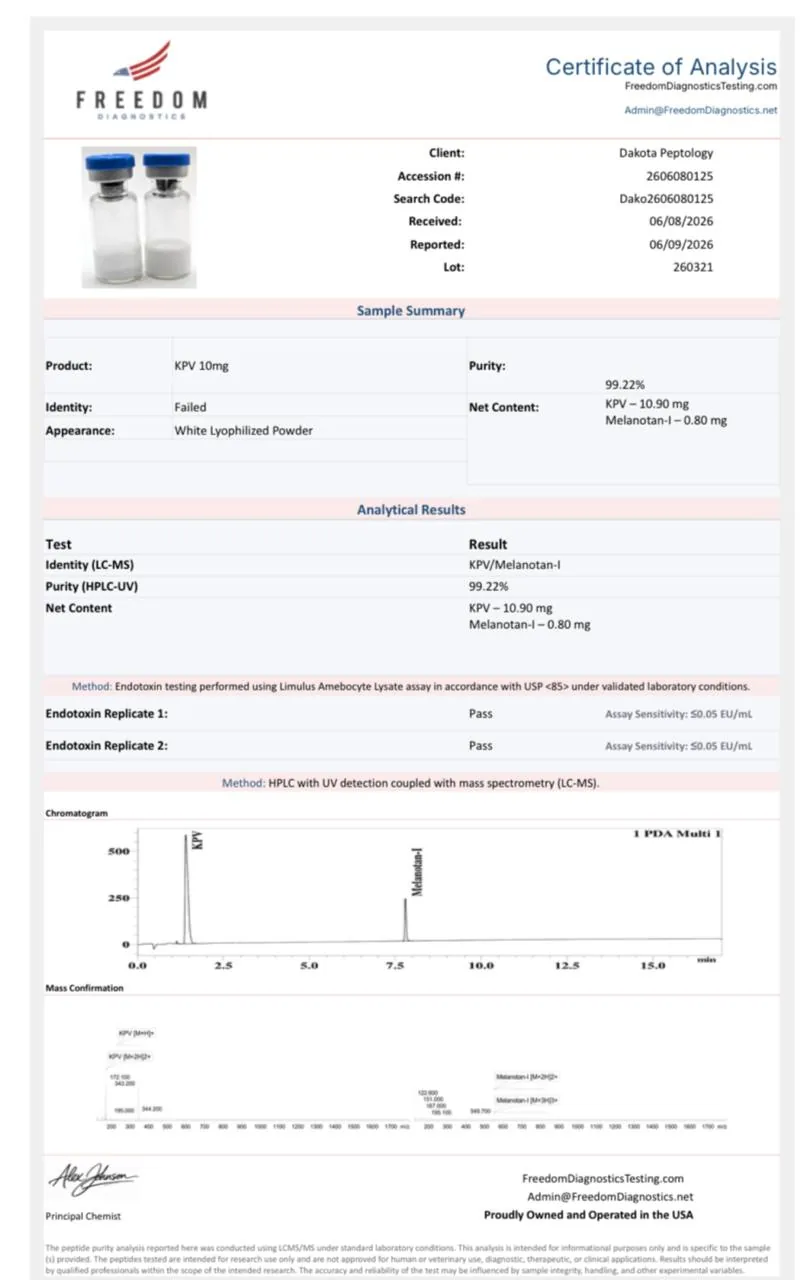
The controversy began when a KPV vial sold as a 10 mg product was submitted to Freedom Diagnostics for analysis. The laboratory reported that the sample failed identity testing. Rather than containing only KPV, it also detected approximately 0.80 mg of Melanotan-I, while the KPV content measured approximately 10.90 mg. The overall purity remained high at 99.22%, but the unexpected presence of Melanotan-I meant the sample no longer matched its stated identity.
Unlike a simple purity issue, this raised an entirely different concern. Customers purchasing KPV would not reasonably expect another peptide to be present, regardless of how small the amount.
As news of the report spread, discussion quickly moved beyond the laboratory findings. Community members claimed Barn was removing posts and banning people who raised questions about the result. Some users said they had been removed from Barn’s Telegram after mentioning the KPV report, while others alleged that Barn’s long-time administrator had also been removed after questioning the findings.
The discussion soon broadened further. Some participants argued that Barn was a reseller rather than a manufacturer and suggested that other vendors were experiencing similar problems with products using the same coloured caps. Others viewed the controversy as a reminder of the risks associated with group buys and the importance of independent testing. More speculative comments suggested Barn’s reputation had permanently changed or questioned the company’s future, although those remained personal opinions rather than established facts.
Whether the Melanotan-I originated from cross-contamination, a manufacturing error or another cause was never conclusively established by the evidence available to me. What is clear is that the report became another significant test of confidence. By this stage, the conversation was no longer only about laboratory results. It had become a debate about transparency, moderation, accountability and how vendors should respond when uncomfortable test results emerge.
R10; The Sample Selection War (June 2026)
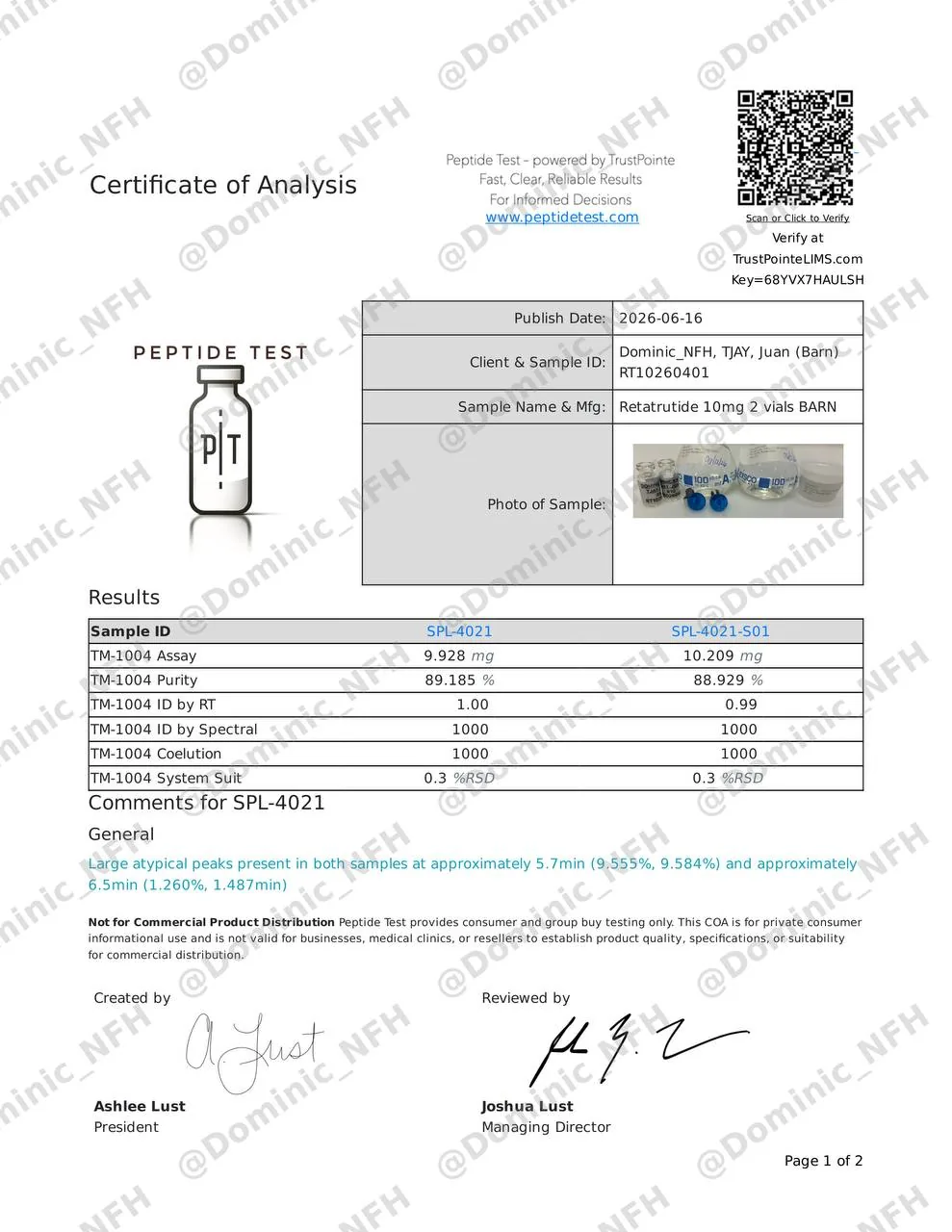
The RT10 dispute began with a Peptide Test report published on 16 June 2026. Two Barn RT10 vials from batch RT10260401 measured 89.185% and 88.929% purity. Barn wouldn’t accept the report because it wasn’t from Janoshik.
The customer group therefore decided to pay for Janoshik testing themselves. They had initially identified two suspect packaging variants, but after asking other Barn customers to check their products, they found five variants being sold under what customers had been told was the same batch and vendor COA. Some members even reported receiving two different variants in the same order.
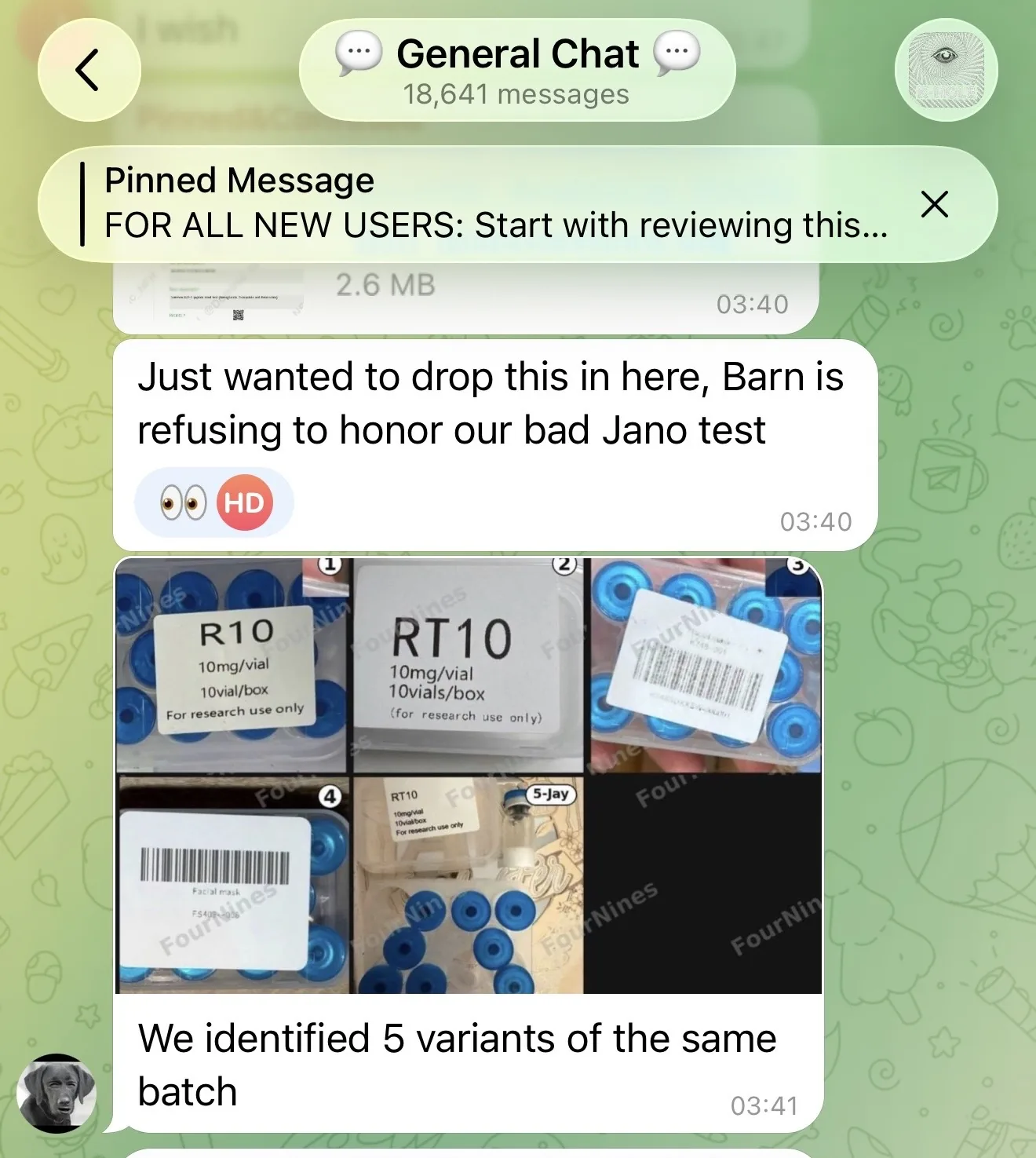
The customer-led Janoshik test was ordered on 18 June. The group planned to test all five identified variants rather than select random vials because its purpose was to establish whether the poor results were linked to particular versions of the product.
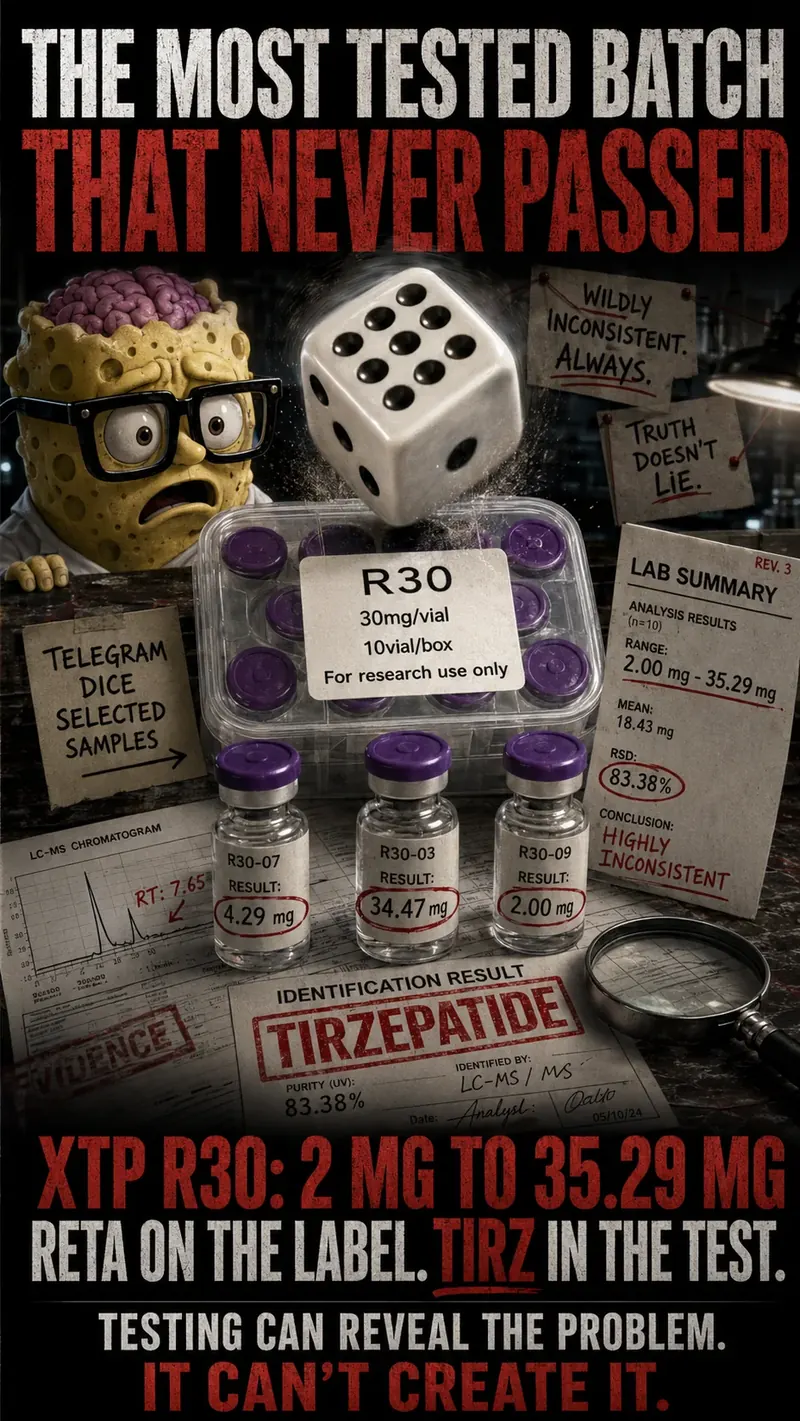
Barn also began arranging its own Janoshik submission on 18 June, but the two investigations used very different sampling methods. The customer group selected the five variants it had identified during its investigation. Barn chose three customers through a random bot draw and instructed them to send their vials directly to Janoshik.
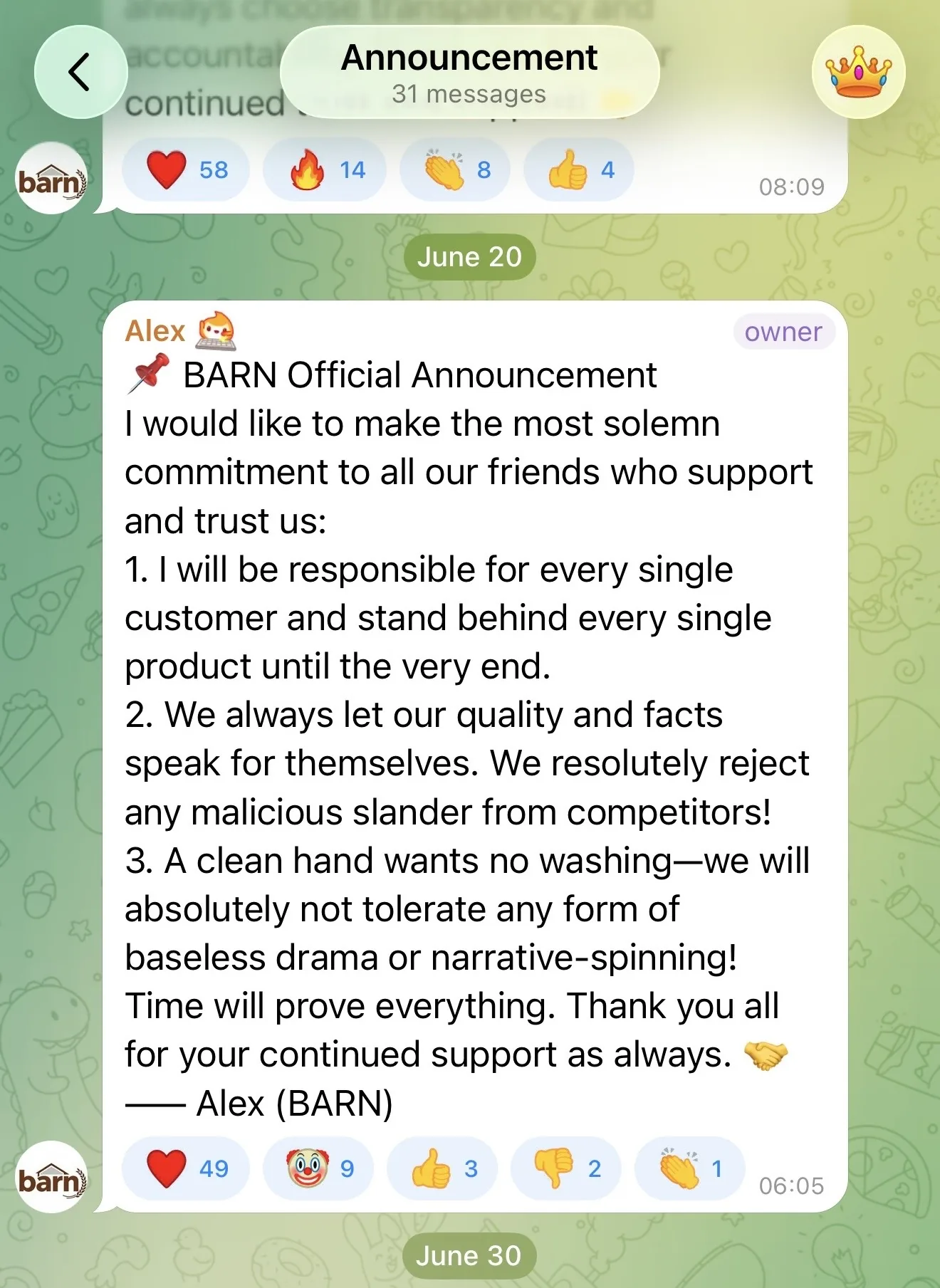
On 20 June, while both submissions were still being organised, Barn muted its public chat. Alex said there was no Janoshik report proving that the product had failed, questioned whether the customer group’s samples genuinely originated from Barn and promised to refund or reship if a verified Barn product later failed Janoshik testing. Barn also issued an announcement pledging to stand behind every customer while rejecting what it described as slander and narrative-spinning.
At the same time, Barn objected to the customer group controlling its own submission. Alex argued that the chain of custody was unclear and said there was no way to know whether the samples had been swapped or contaminated before reaching the laboratory. When the group insisted on independently selecting the known variants, Alex said Barn would not recognise the test and continued with its own public testing process.
Barn maintained that its method was transparent because the three selected customers sent their vials directly to Janoshik and the products never passed through Barn’s hands. The customer group disagreed, arguing that random sampling risked missing the specific variants already associated with the poor results.
The two Janoshik investigations were therefore running in parallel, but they were designed to answer different questions. Barn’s test examined three randomly selected customer vials to assess the broader quality of its inventory. The customer-led test examined all five identified variants to determine whether the low-purity results were connected to particular versions of the product.
Janoshik received the customer group’s samples on 2 July and Barn’s samples on 7 July. Both analyses were completed on 10 July.
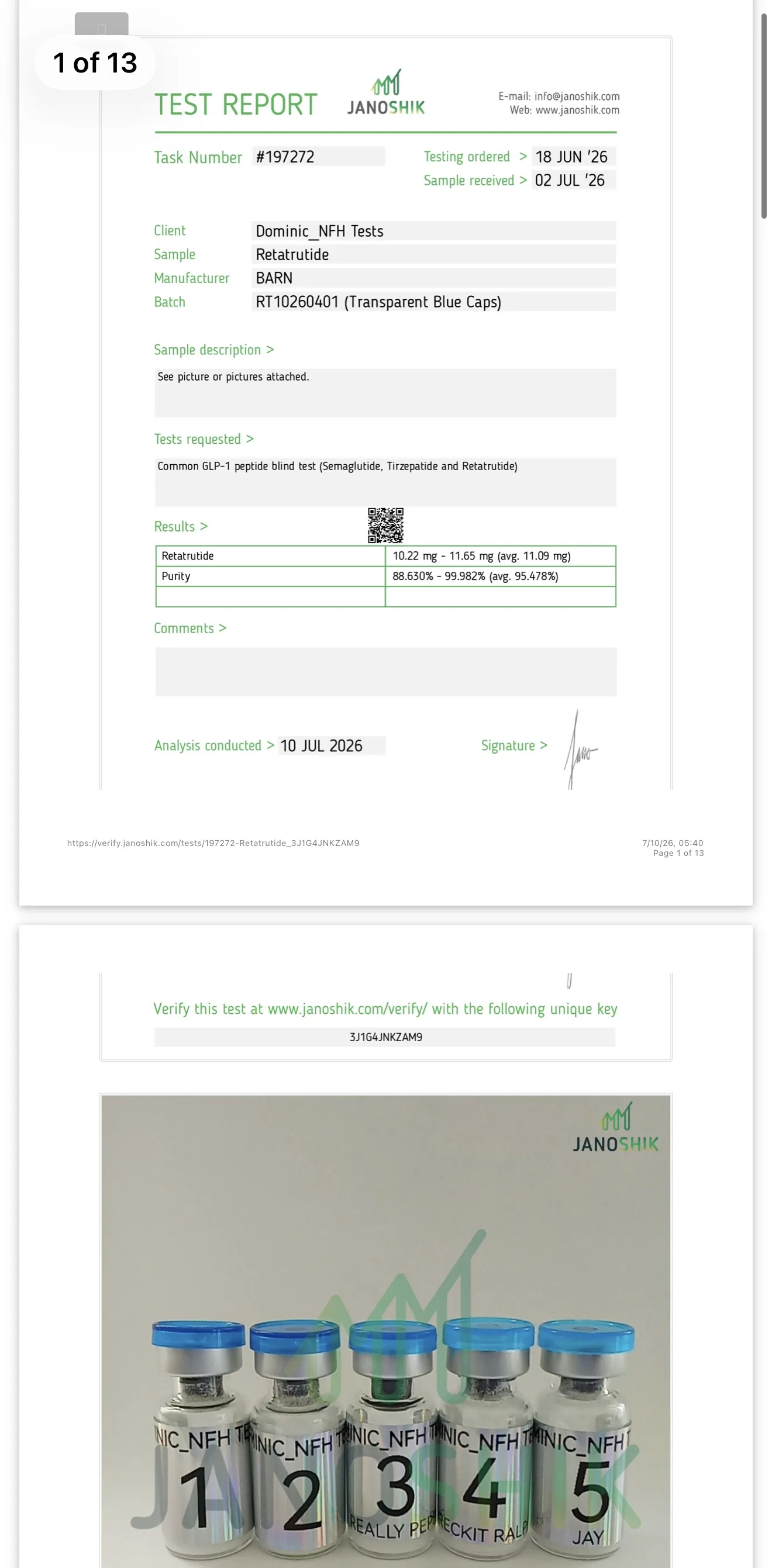
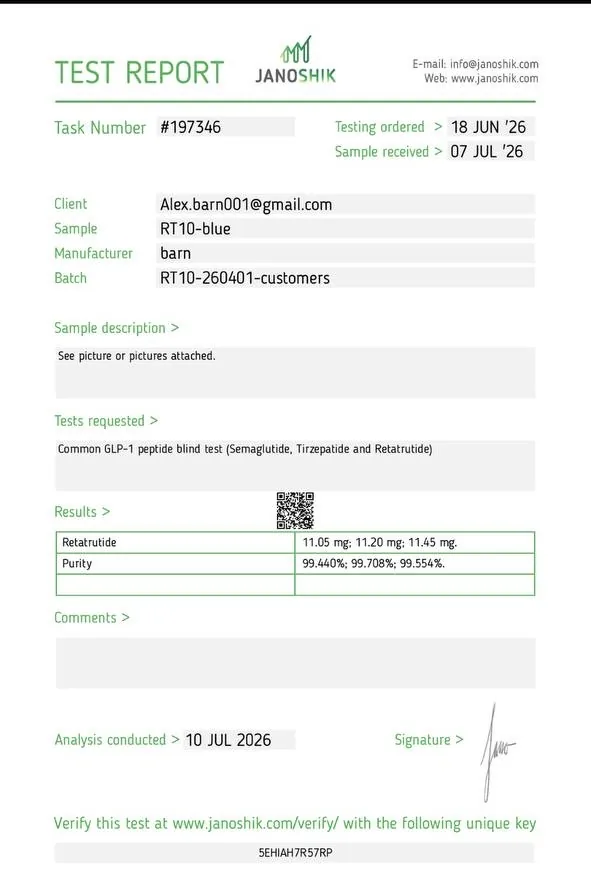
The customer-led report found a purity range of 88.630% to 99.982%, with two variants producing results around 88% and the remaining three testing satisfactorily. Barn’s three randomly selected vials all produced satisfactory results, with purity ranging from 99.440% to 99.708%.
Barn published its report as evidence that the quality of its inventory had been confirmed. The customer group argued that the two reports were not contradictory. In its view, Barn’s random selection had captured products comparable to the three satisfactory variants, while the targeted five-vial submission had also identified the two lower-purity variants.
Barn’s public chat was reopened on 10 July, the same day both Janoshik analyses were completed. By then, the argument was no longer about whether a Janoshik report existed. It was about which sampling method actually addressed the original complaint.
The Refund Controversy
Although by mid-July, the scientific dispute had largely been resolved. Yet the controversy still wasn’t over.
One customer contacted me after Barn instructed her to destroy her RT10 kit before processing a refund. She identified herself as a member of the transparent blue cap testing group, supplied her original payment hash, order information and proof of purchase, and complied with Barn’s request to destroy the product and provide photographs.
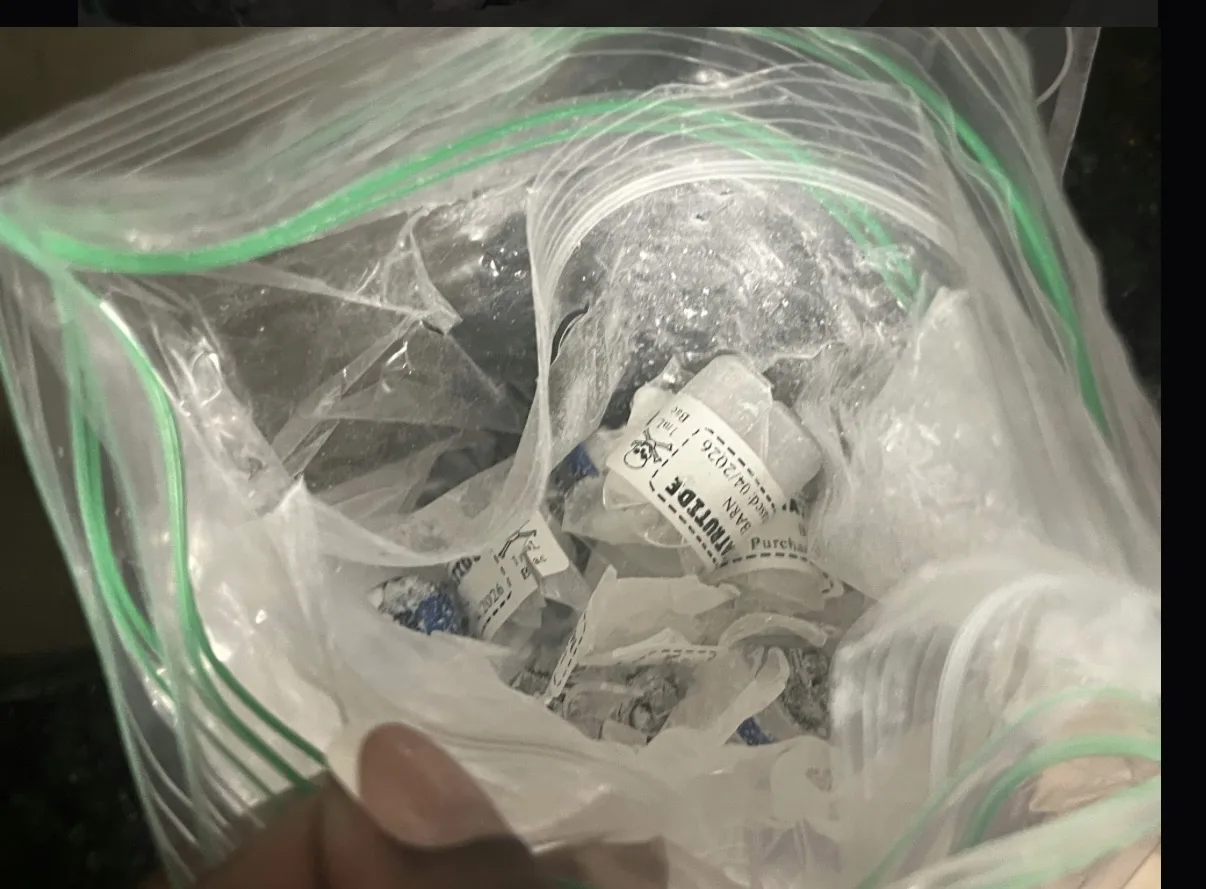
Only after doing so was she told that Barn’s records allegedly showed she had already received a previous refund.
The customer disputed that claim immediately. She requested the blockchain transaction hash for the alleged refund and pointed out that she had already supplied the payment hash proving her original purchase. Based on the screenshots I reviewed, no refund transaction hash was produced.
Another issue soon emerged.
Customers reported that refunds were being calculated on a per-vial basis rather than by kit. One customer who had purchased two ten-vial kits received a refund for only eighteen vials because two had been sacrificed for lab testing. Members argued those two vials had been voluntarily submitted to establish whether a defect existed and shouldn't reduce the refund for the remaining product.
The organiser of the testing group later stated that Barn eventually honoured most refund requests, although only after sustained pressure from customers, community organisers and public scrutiny. Some customers still described delays, disagreements over refund amounts and continued disputes before their claims were finally resolved.
Comments