
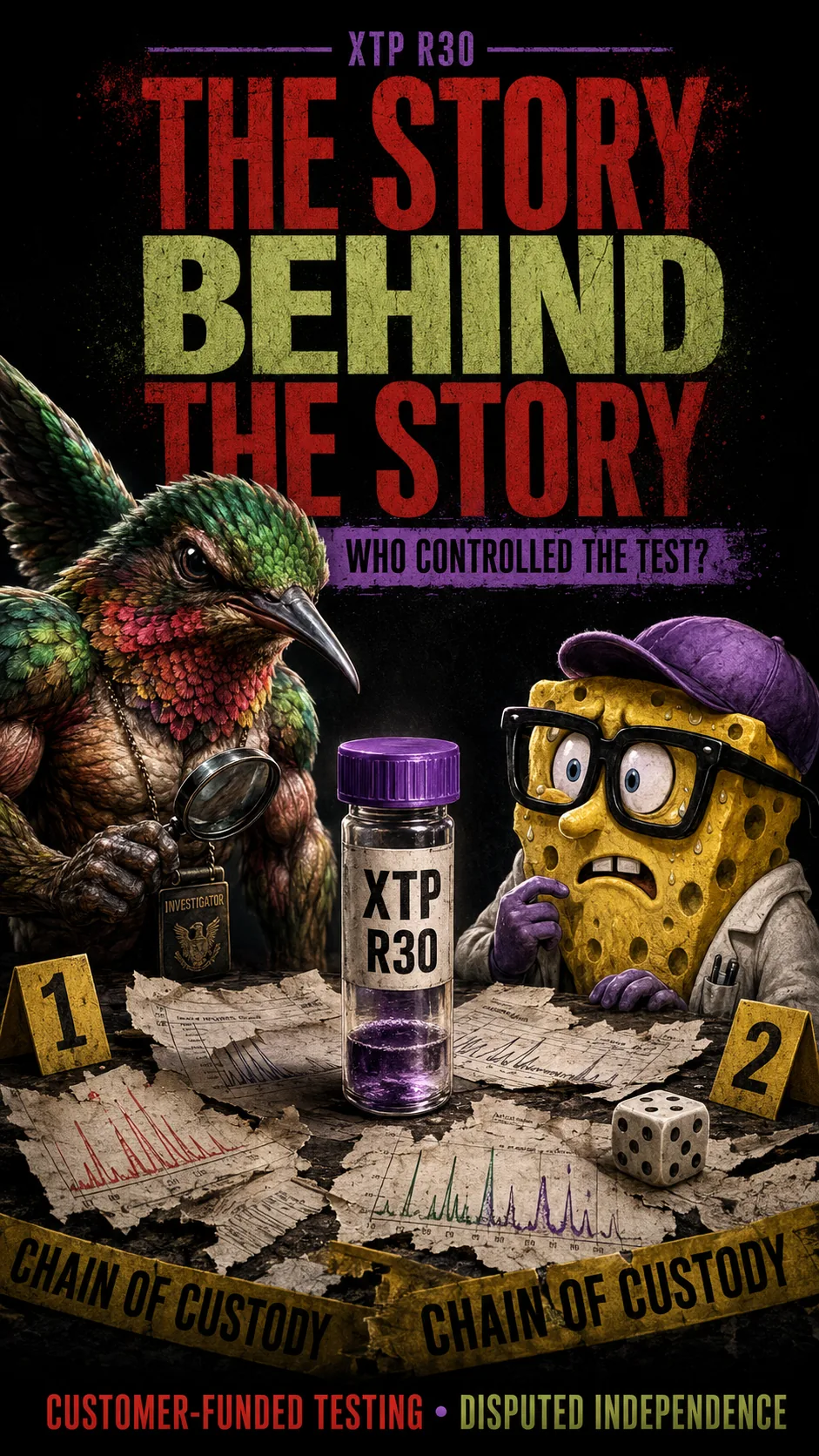
Since publishing my previous article about XTP’s R30, I’ve received additional information from Obvious Reel, the organiser connected to the original customer-funded Janoshik test. So now with the additional information, I’ve decided to cover in more detail the background to this whole testing saga, which explains why conflict already existed before the first failed result was published and how an independent customer effort was eventually followed by a separate retest organised under XTP’s supervision.
The customer testing began independently
The original R30 testing group was formed after several people reported that they were “not feeling anything” from their R30. Although that’s subjective and can’t establish a product’s identity or strength, enough customers were concerned that Obvious Reel offered to organise independent testing. This wasn’t not his first rodeo into group testing involving XTP products. By then, he says he was already coordinating tests for DSIP10, EPI10 and MOTS-C10 and he described himself as running more than seven testing groups involving XTP products. Importantly, he continued buying from XTP, while also preparing to test additional products, including R20, R30, R60 and MOTS-C40.
This doesn’t really support XTP’s later suggestion that the R30 testing was motivated by “malicious commercial competition.” The organiser wasn’t a rival vendor appearing after one failed result. He was a repeat customer coordinating multiple tests and continuing to place orders.
XTP’s own public group had acknowledged the independent R30 testing effort as early as 23 April, when members discussed a group testing the new purple-cap R30.
XTP had already published a passing result
Before the customer-funded failure, XTP had published its own Janoshik report for batch XTP-R30-003. That report was ordered on 18 May, received on 22 May and analysed on 1 June 2026. Three vials were tested at:
32.89 mg at 99.851% purity
34.59 mg at 99.873% purity
33.97 mg at 99.846% purity
Alongside that result, XTP advertised a guarantee stating that it only recognised independent Janoshik reports and would provide a refund or replacement if purity fell below 98.5% or fill quantity fell below 90% of specification. The only other test of this batch that was available at the time was from Freedom Diagnostics, reported as 31.76 mg and 93.77% purity. But XTP declined to honour its guarantee because the laboratory was not Janoshik. That made the independent Janoshik test especially important as it used the laboratory XTP said it would recognise.
The first customer-funded Janoshik result
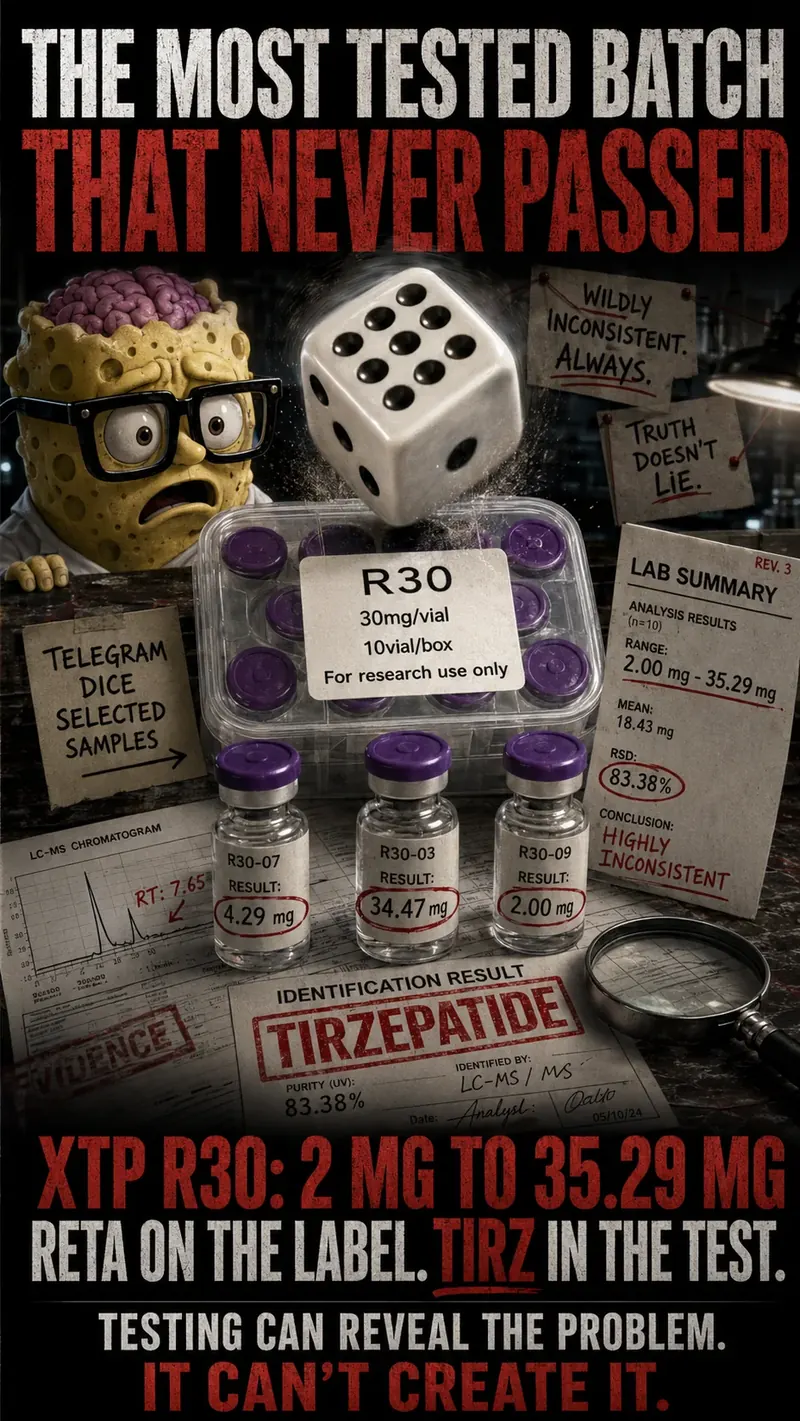
The original R30 group test organised by Obvious Reel, for the batch R30-003 was analysed on 15 June and the three reported quantities were, 4.48 mg, 4.29 mg, 34.47 mg. Their reported purities were, 99.254%, 99.489% and 99.901%
Two vials were therefore severely underfilled, while the third contained more than the labelled 30 mg. The report also states: “The samples were tested twice.” That means the published result wasn’t simply one unconfirmed measurement that nobody attempted to check. Janoshik repeated the testing before issuing the report.
XTP rejected the result; and questioned the organiser
XTP responded publicly on 17 June. They said its R30 “could not possibly exhibit such a basic error” and argued that previous disputes between XTP and the organiser raised concerns about the “objectivity, impartiality and credibility” of the group’s conclusions. XTP therefore refused to recognise the report despite it coming from Janoshik. XTP also said that the organiser had long been banned by XTP and that the company didn’t conduct business with him. At the same time, XTP referred to its own testing as independent and said its samples had been obtained through random selection without targeted screening or preparation.
Participants said the samples came from separate customers who’d purchased from XTP. Members offered to provide order records and photographs, and one participant stated that none of the submitted vials came from the organiser. They also said the organiser made no money from the process. According to members of the group, laboratory costs were handled through Janoshik’s split-payment system, while Obvious Reel facilitated discussions, created polls and coordinated the submission.
So even if XTP had an existing disagreement with the organiser, it doesn’t by itself establish that independently purchased customer samples were falsified, substituted or tampered with.
The conflict began before the R30 failure
The breakdown in trust didn’t begin with the R30 report. Obvious Reel says earlier disagreements concerned the administration of XTP-related testing spaces and control over privately funded results. One disputed policy reportedly required private testing groups to share their results with the XTP testing server within 14 days. He objected on the basis that customers who paid for the testing should decide whether, and when, their results were released.
Separate group discussions show that publication timing was already contentious. Some contributors wanted paying participants to see results before the wider public. One member suggested a 21-day delay, reasoning that contributors might want time to order more product before everyone else saw a favourable result. Another said they had rarely seen groups approve an embargo shorter than 60 days.
These conversations reveal a broader tension within customer-funded testing: the people paying for a result may want early access, while wider disclosure is necessary if testing is also being presented as a public-safety measure.
Questions about administrative independence
Obvious Reel also questioned whether the XTP testing group could fairly be described as independent when some administrators reportedly held roles in both the testing server and the main XTP group. He says he was removed from the XTP group after publicly raising those concerns. Other members also reported being removed, restricted from posting or having comments deleted after supporting him or questioning the administration of XTP testing groups. Some also alleged that portions of earlier discussions had disappeared.
Bella later announced to members that testing-group administrators would no longer simultaneously serve as administrators in XTP’s main group. She instructed customers and administrators to resolve testing disputes inside the testing group instead of posting what she called “panic remarks” in XTP’s group.
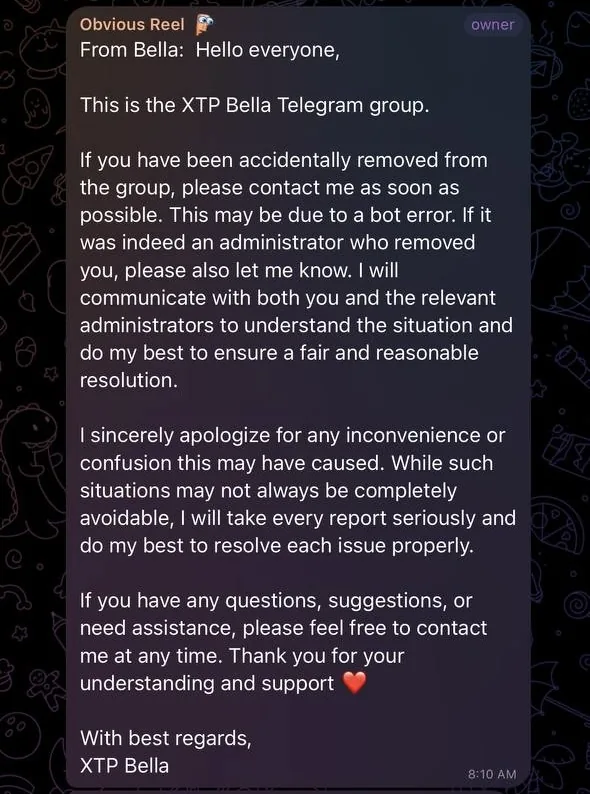
In an announcement Bella said anyone accidentally removed should contact her. She suggested that some removals might have resulted from a bot error, apologised for the confusion and said there should be no instances of administrators exercising excessive power. Whatever caused each removal, XTP’s response confirms that concerns about overlapping administrators and moderation had become serious enough to require changes and a public explanation.
The independent second round that never happened
Following the first failed result, Obvious Reel says he polled the original customer group about conducting another independent round. Opinions were mixed, but he was prepared to proceed. That plan changed when another participant received administrative privileges on an XTP platform and wanted to coordinate the retest directly with XTP. Obvious Reel objected because he believed direct vendor involvement defeated the purpose of an independent customer-funded test. As the disagreement became personal, he took himself out of the proposed retest. The dedicated R30 retest group that followed was separate from the original customer testing effort.
XTP was involved in the dedicated retest from the beginning
The dedicated retest group opened on 18 June with XTP already involved in its organisation. Bella appeared as the group owner. In the first discussion, she instructed members to wait for customers to enter before donors were randomly selected. An XTP/GTS administrator said the participants needed to be verified as XTP customers.
When members objected to vendor control, Bella stated that the group’s “organisational authority” needed to remain in XTP’s hands. Another administrator said they had to be the group leader. Customers immediately questioned how a vendor-organised process could be presented as independent third-party testing. Bella responded that XTP wouldn’t participate in selecting the samples and was “only responsible for organising.” Nevertheless, XTP:
Controlled the dedicated group
Verified which customers were eligible
Established the donor-selection procedure
Funded the laboratory testing
Set the packing and recording requirements
Determined the refund terms
Coordinated the submission process
The samples still came from customers, and donor selection was presented as random. But the surrounding retest procedure was organised inside a group controlled by the vendor whose product was being examined.
This is the crucial distinction: XTP didn’t create the original customer group or organise its failed test, but it was directly involved from the opening discussion of the dedicated retest created in response.
When the now infamous result was posted on 23 July showing 2.11 mg, 2.00 mg and 2.07 mg, with purities of 90.573%, 90.547% and 89.824% and containing Tirzepatide not Retatrutide, XTP later alleged that the result might reflect human interference or malicious competition. Janoshik, however, reportedly confirmed that it stood by the compound identification and said there was no indication that the samples had been mishandled inside its laboratory. The laboratory suggested examining manufacturing and filling procedures because the inconsistencies appeared to point toward an issue at that stage.
The dispute was about more than one result
The additional history doesn’t change the laboratory findings, but it does give more context to the history behind the R30 testing saga. The original R30 test was a customer-funded effort organised independently of XTP. Janoshik tested that submission twice before reporting two severely underfilled vials and one overfilled vial.
The proposed independent second round didn’t proceed under its original organiser. Instead, a separate dedicated group was established with XTP involved from its opening discussion. XTP controlled the group, funded the analysis and set the conditions, while maintaining that the customer-donated samples were selected randomly.
The disagreement was never only about whether one laboratory result was correct. It became a struggle over who controlled customer-funded testing, who administered supposedly independent spaces, how donors were selected, when private results could be released and whether the vendor being tested should organise the retest.
Most importantly, attacking the people involved doesn’t resolve the underlying product question.
Whatever the explanation, mixed production, mislabelling, filling failures, inconsistent supply or some other breakdown, those discrepancies require a manufacturing and distribution explanation. They can’t be resolved simply by calling the people who found them malicious.
Now 4 days after the XTP announcement, the team have still not returned to deal with their customers.


Comments