
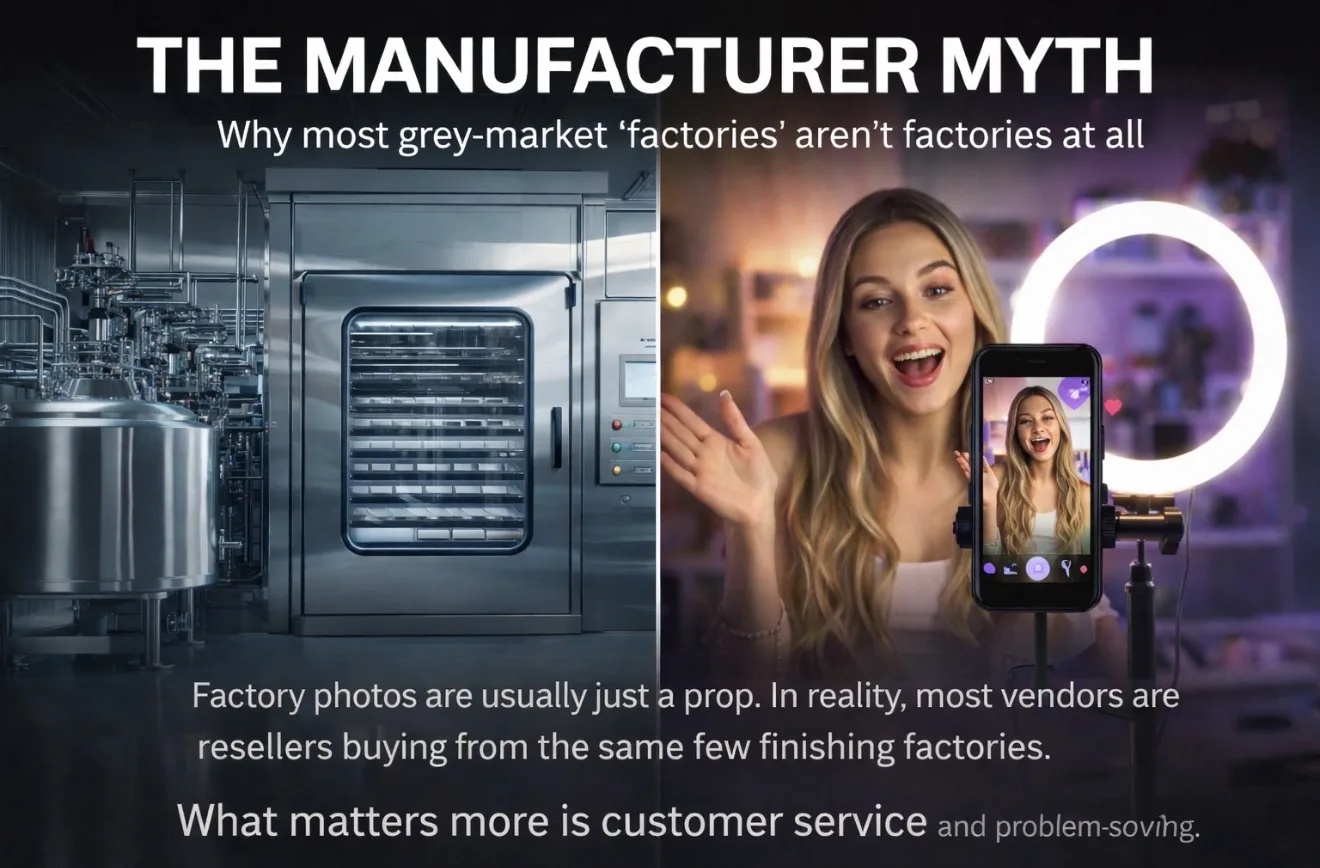
If you spend enough time in the grey peptide community, you’ll notice a pattern.
Almost everyone is a “manufacturer.”
TikTok vendors claim they manufacture.
Discord vendors claim they manufacture.
Telegram vendors claim they manufacture.
Some even claim they produce the raw APIs themselves.
And for newcomers, that sounds reassuring.
Factory = control.
Control = quality.
Quality = safety.
But once you understand how the grey market is actually structured, the “manufacturer” claim starts to fall apart.
The Actual Structure (Not the Marketing Version)
The grey peptide market is layered. Not emotionally. Logistically.
Level 1, API (Raw) Manufacturers
These are the actual peptide synthesis companies, mostly in China and India.
They produce raw peptide powder using SPPS (solid-phase peptide synthesis).
There are very few of them.
They do not advertise on TikTok.
They do not DM retail buyers.
They do not run Discord servers.
They sell in bulk, kilos at a time, usually to resellers, not to end consumers.
And many of them actively avoid being publicly associated with grey market sales.
Level 2, Raw Resellers
These companies purchase bulk powder and resell it to finishing labs or mid tier operators.
They may operate through shell entities.
They may obscure sourcing.
They may claim to be manufacturers themselves.
This is where opacity begins.
Level 3, Finishing Manufacturers (Lyophilisers)
These are the operations that turn raw powder into sterile vials.
They:
Resuspend
Mix with excipients
Sterile filter
Dispense into vials
Lyophilise
There are fewer of these than people think.
Larger scale finishers can produce tens of thousands of vials per day.
But they tend to prioritise discretion over visibility.
Why?
Because real manufacturing operations protect capacity, client relationships, and regulatory risk.
Visibility is liability.
Level 4, Finished Product Resellers
This is where most “vendors” live.
They:
Buy finished sterile vials
Rebrand them
Add markup
Provide customer facing logistics
Manage payment processing
Absorb small losses
Control narrative
Many of these vendors claim to be manufacturers.
Most are not.
Level 4B - Single Vial Sellers (Retail Rebrand Layer)
This is the layer many newcomers meet first: single-vial sellers.
They usually sell:
one vial at a time
polished branding
“pharma grade” language
a strong trust aesthetic
But structurally, many of them are simply: buying from the same small pool of finishers or larger resellers, rebranding, and reselling at a steep markup.
They often look “more legitimate” because the storefront is clean and the ordering process is simple, but that convenience is part of what you’re paying for.
And this layer is also where the “manufacturer” claim becomes most misleading: single vial sellers rarely manufacture raws or finish product, they retail it.
Level 5, Influencer / Marketing Layer
This is the loudest layer, and it often acts as the bridge between attention and checkout.
TikTok. Discount codes. “Exclusive sources”.“My vendor talk”. Testimonial marketing. Community positioning.
Most influencers don’t test or manufacture anything. The influencer layer doesn’t control production, it controls attention, directing buyers toward the sellers they are affiliated with and that frequently means single vial retail sellers with polished branding and easy purchasing.
This is also where trust gets engineered. The story becomes the product:
“factory direct” language
“pharma grade” aesthetics
“exclusive” narratives
social proof and reassurance loops
No additional quality control happens at this stage. It’s branding, distribution, and confidence, layered on top of whatever the upstream supply chain actually is.
The “Goldilocks Zone” vendor
A lot of newcomers are handed a simplified way to think about the market: a “Goldilocks” option that’s not the cheapest and not the most expensive, but feels “just right.”
The Goldilocks vendor is usually described in terms of convenience and perceived safety:
domestic shipping
easier payments
more documentation
sometimes multiple rounds of testing (vendor testing plus community testing)
To be clear: some of those features can genuinely reduce friction and sometimes reduce risk.
But here’s the catch: Goldilocks is a comfort category, not a supply chain position.
It tells you how safe something feels and how easy it is to buy, not who actually manufactured it upstream.
That’s why the “manufacturer” myth survives even in the Goldilocks lane, because comfort and legitimacy get blurred, and the harder questions get skipped:
Who made it?
Which layer is this seller in?
What happens when something goes wrong?
Affiliate codes and Pricing
This is where the influencer layer gets clever.
It doesn’t just promote a vendor. It hands newcomers a whole decision framework, usually framed as “options.”
Affiliate codes are presented as discounts. In reality, they’re usually commission.
They don’t make the peptides cheaper, they fund the promoter.
And once a promoter gets paid per sale, the narrative naturally shifts:
not toward accuracy
toward whatever converts best
The Chinese vendor
This gets positioned as the “cheaper but riskier” lane:
crypto payments
WhatsApp communication
one vendor provided COA ( if any)
extra effort required to independently verify
Again, some of that is true.
But what matters is how this framing quietly rewires what newcomers think “trust” is.
Instead of asking:
Who actually made this? What layer is this seller operating at? What’s the batch trail?
They start asking:
Does this feel easy? Does it feel safe? Do other people say it’s safe?
That’s not stupid, it’s human.
But it’s also exactly how marketing replaces verification.
Why the “Manufacturer” Claim Exists
Because being a reseller sounds weak.
Being a middleman sounds extractive.
Being a factory sounds powerful.
So the narrative shifts.
“Factory direct.”
“In house production.”
“We make our own raws.”
In reality, what often exists is:
A reseller with strong upstream relationships
A finisher providing technical access
Marketing layered on top of production
And a blurred line between liaison and manufacturer
Even photos of clean rooms mean very little. Finishers provide media assets to resellers. In some arrangements, finishers supply photos/videos that resellers use as marketing assets, or they just pull them from online
Belief replaces verification.
So Why Is TikTok a Tell?
Because as a general rule:
Real upstream manufacturers do not market to retail consumers.
They operate in B2B channels.
They minimise exposure.
They protect their supply chain.
TikTok is a retail funnel.
That doesn’t automatically mean a TikTok vendor is fake.
It means they are downstream.
And downstream operators are not inherently bad.
Some are excellent at customer handling, logistics, and problem resolution.
But they’re not API factories or finishers/lyophilisers.
The Outlier Problem
As with most rules, there are exceptions. There may be one or two operators who both run finishing operations and maintain a public facing social presence ( we can all easily think of one such vendor). But even then, their TikTok presence typically centres around:
COAs
Batch transparency
Testing documentation
Not influencer style marketing.
Exceptions don’t erase the pattern. They show how uncommon the exception is.
Why This Matters
Understanding structure changes how you assess risk.
If you believe you’re buying from a raw manufacturer, you may expect;
direct pricing
upstream control
transparent batch origin
factory level oversight
If you’re actually buying from a reseller, what matters more is:
how they handle problems
how they manage payment rails
how they respond under pressure
how they manage seizure risk
For how they price statistical losses
The biggest mistake in grey isn’t buying from a reseller.
It’s misunderstanding where you are in the chain, and what that means for price, accountability, and risk.
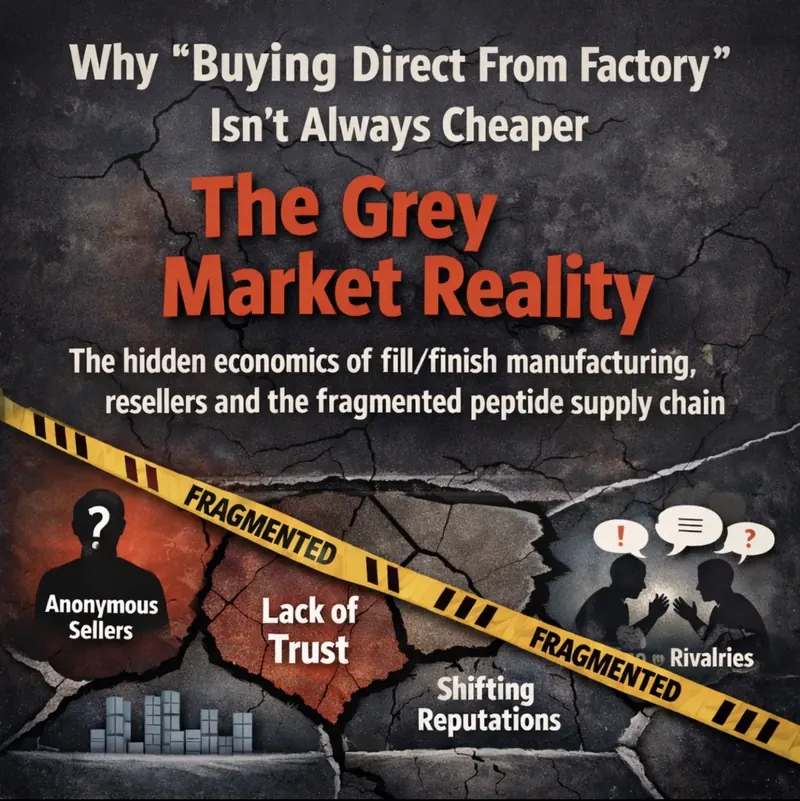
Because here’s the part that surprises newcomers: factory direct isn’t always cheaper. In many cases, the lowest prices come from resellers competing on volume, convenience, or marketing, not from the upstream manufacturer.
And “upstream” doesn’t automatically mean “better,” either. Being closer to the source doesn’t guarantee superior finishing, handling, sterility, storage, or problem resolution. In the grey market, quality is a chain, and the weakest link still counts.
The Hard Truth
At the end of the day, you’re usually better off assuming:
Most vendors are resellers.
The good ones are those who manage logistics well.
The ones to be cautious with are sellers who lean on “manufacturer” claims without verifiable batch documentation
Because in this market:
The story you’re sold
is often more polished
than the supply chain behind it.
Clarification (after feedback):
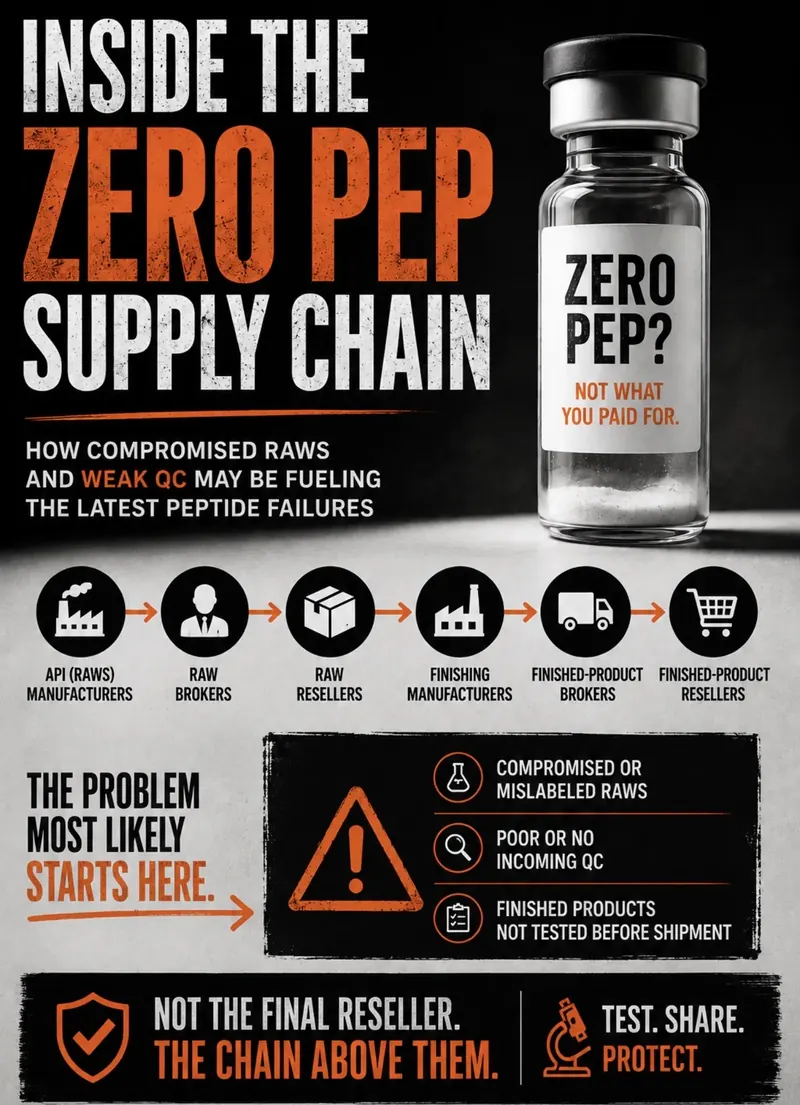
I simplified the structure in the main piece. There’s an additional layer worth noting, the brokers. Raw brokers move the API between the raw manufacturer and the raw reseller and finished product brokers aggregate finished vials from the finishing factories and often operate the long 200-SKU lists that sell a huge variety of products, however, they may also sell direct to consumers. Currently there are 3 raw synthesisers and 7 legit fill/ finishers and a few UGL finishers.
Comments