
The new peptide policy has barely landed, and the argument has already moved from access to money. Telehealth companies see an opportunity to sell prescription peptides alongside blood testing and clinical support. Existing research-market buyers see familiar compounds advertised at prices they would never pay. Supporters say the extra money buys oversight and accountability. Critics say those benefits need to be demonstrated, not just assumed because a pharmacy is involved.
Both sides are talking about peptides, but they aren’t necessarily talking about the same customers. Someone already comfortable sourcing products, checking COAS and arranging independent testing may see little reason to switch. Someone curious about peptides but unwilling to buy a vial labelled “not for human consumption” may welcome a prescription service.
That’s the commercial opportunity: not necessarily replacing the grey market, but bringing in customers it has never reached.
Superpower was ready
Superpower, the venture-backed blood-testing and health platform, is taking paid preorders for three peptides:
BPC-157: $149/month
TB-500: $149/month
MOTS-c: $199/month
The package includes a blood panel covering more than 40 biomarkers, clinician review, messaging and continuing guidance. Epitalon, oral BPC-157 and Semax are on the waitlist. Shipment is targeted for late November, subject to clinician approval. Customers pay upfront and receive a refund if they’re not approved for a prescription.
This is an established platform adding another product category. Superpower already had customers, clinical services, pharmacy relationships, software and venture funding. It announced a $30 million Series A in 2025, and Entrepreneur reported in July 2026 that it was valued at more than $500 million. The infrastructure was already there. The policy created the opening.
What does the extra money buy?
Superpower bundles its peptides with medical review, bloodwork, monitoring and pharmacy fulfilment. Research-market suppliers generally sell the product alone, sometimes with independent testing and refund policies. Wanting clinical supervision and being able to afford it are different things.
The public launch page didn’t clearly disclose the milligrams supplied each month, preventing a reliable price-per-milligram comparison. Buyers are comparing vial prices; Superpower is selling a treatment package.
The value depends on what that service delivers. A clinician who checks medications, identifies contraindications and follows up properly provides something different from an online questionnaire followed by automated approval. Calling both “medical oversight” doesn’t make them equivalent.
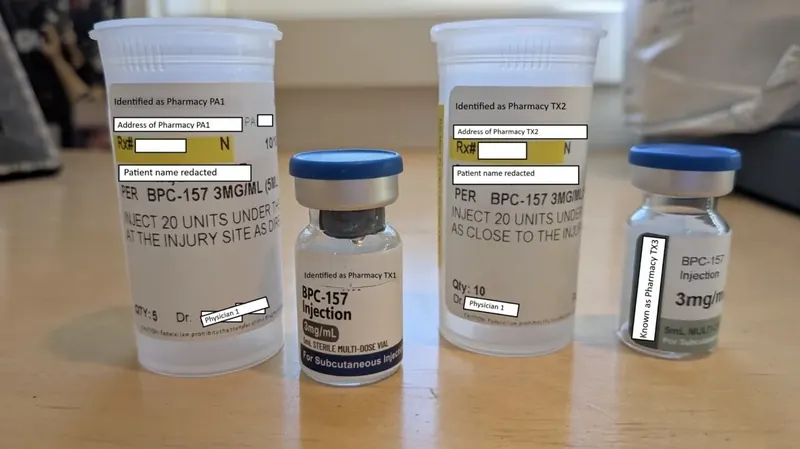
Product quality needs separate scrutiny: who manufactured the ingredient, which batch was tested, what the tests covered and how the finished product was released. A refund policy isn’t clinical supervision, and a pharmacy licence doesn’t guarantee a correctly made product.
The premium needs to buy something measurable, not just a more reassuring website.
“Produced in the USA”
Superpower advertises American production using active ingredients from FDA-registered facilities. FDA registration isn’t approval and doesn’t establish where an ingredient was synthesized. An American pharmacy can compound a product using imported API. The public launch page doesn’t identify each product’s original API manufacturer, country of synthesis, dispensing pharmacy or testing laboratory. Superpower’s general materials name pharmacy partners, but don’t specify which will supply each peptide.
The HHS policy requires compounders to document and report manufacturer information. Its absence from the sales page doesn’t mean the pharmacy lacks it. It just means the customer can’t currently inspect that part of the supply chain and if traceability is part of the sales pitch, publishing it would be a useful start.
Different customers, different needs
Prescription platforms don’t need every existing research-market buyer to switch. Their larger opportunity is people who want a clinician involved, particularly those taking other medications or managing conditions such as heart, kidney or metabolic disease.
For those patients, reviewing medical history, checking for interactions and monitoring treatment may justify part of the premium. That doesn’t make the peptide proven or suitable. In fact, limited safety and interaction data make prescribing inadequately studied compounds to medically complicated patients more, not less, demanding.
Established buyers may continue using existing suppliers because they value price and control. Others will pay for an identifiable clinician and pharmacy. The two markets can coexist because they’re selling different propositions: one primarily sells the vial; the other sells the vial with a clinical service around it.
Whether that service is worth the premium depends on its quality. A careful medical assessment is valuable. A questionnaire and automatic approval dressed up as “oversight” isn’t.
Jay Campbell and Jeff Cohen: access for whom?
Jay Campbell, co-founder of BioLongevity Labs, called the policy potentially good news for people seeking prescription access but potentially bad news for existing direct-to-consumer buyers. He warned that prices could rise if research-market access is restricted, while pharmacy requirements for registered manufacturers and extensive quality testing would add costs that are ultimately passed to patients. He predicted that people accustomed to research-market pricing should expect “a very different bill at the pharmacy counter.”
Jeff Cohen, co-founder of the American Peptide Association, described the policy as overdue clarity and “a bold step” beyond the usual pharmaceutical approval pathway. He said it serves consumers who want clinician-led access, while leaving the route for those who don’t want medical supervision unresolved. He also warned that products obtained from non-pharmacy manufacturers may come from a market where safety and quality controls are inconsistent.
Both have commercial interests in the peptide industry. Their comments nevertheless identify the unresolved issue: another route to purchase isn’t automatically an affordable route. Some people will pay for supervision. Others may want it but be unable to afford it. Treating everyone outside the prescription market as reckless ignores that distinction.
The lawyer’s warning
Speaking on Hunter Williams’s podcast, peptide lawyer Rick Collins warned that writing “research use only” or “not for human use” on a product doesn’t determine its legal status. Regulators look at the seller’s actual intent, including its advertising, customer communications, order sizes, buyers and whether products such as bacteriostatic water are sold alongside it.
His comparison is speeding: plenty of drivers escape a ticket, but that doesn’t make their driving lawful. For suppliers, the consequences can include criminal charges and asset forfeiture. He said he’d never seen an individual buyer prosecuted solely for purchasing an injectable peptide without evidence of resale. That reflects his experience, not legal immunity.
The interview appears to have been recorded before HHS released the new policy. His broader warning still applies: federal enforcement discretion is conditional and does not override state pharmacy or medical-board rules.
What actually changed
HHS announced a draft, nonbinding interim enforcement policy covering specified forms of BPC-157, TB-500, MOTS-c, KPV, Semax and Epitalon under 503A. It sets conditions involving patient-specific prescriptions, API sourcing, testing, reporting and single-API products. It doesn’t cover 503B outsourcing facilities or authorise direct-to-consumer research sales. The six peptides haven’t been added to Category 1 or the final 503A Bulks List, and they remain unapproved.
HHS says updated manufacturing and testing records, documented use and limited human data support its decision.
Blood testing may detect some adverse changes, but it can’t establish effectiveness or rule out long-term risks. Clinical supervision can’t fill gaps in the evidence, or stop someone deciding that twice the prescribed dose must work twice as well.
The real test comes after the launch
Superpower has shown that it can advertise a prescription peptide package and take preorders. The next questions concern what customers receive: how much medication, who made it, what testing supports it, how useful the clinical care is and how problems are handled.
Existing research buyers may stay where they are. New customers may decide the prescription package is worth paying for. Neither outcome requires pretending that one market is flawless and the other has nothing to offer.
The grey market already knows how to sell a vial. The prescription market is asking customers to pay for everything around it. Now it needs to show what that extra money buys.

Comments