
In the world of peptides and research chemicals, a heated debate rages over products labeled “Research Use Only” (RUO). Critics claim the RUO label is a scam employed by hucksters to push fraudulent, unsafe products. Others argue the label began as a compliance posture: a way to signal non-human “intended use” in a market where demand arrived faster than clear, peptide specific regulatory pathways.
One key correction upfront: “RUO” is an FDA concept. but it was built for lab and diagnostic products (IVDs/devices), not for drugs or peptides. In the peptide market, sellers often copy RUO-style wording (“for research only,” “not for human use”) as a disclaimer. But FDA doesn’t decide based on the disclaimer alone, it looks at the full context to determine whether the product is really being sold for human therapeutic use.
What Does “Research Use Only” Mean?
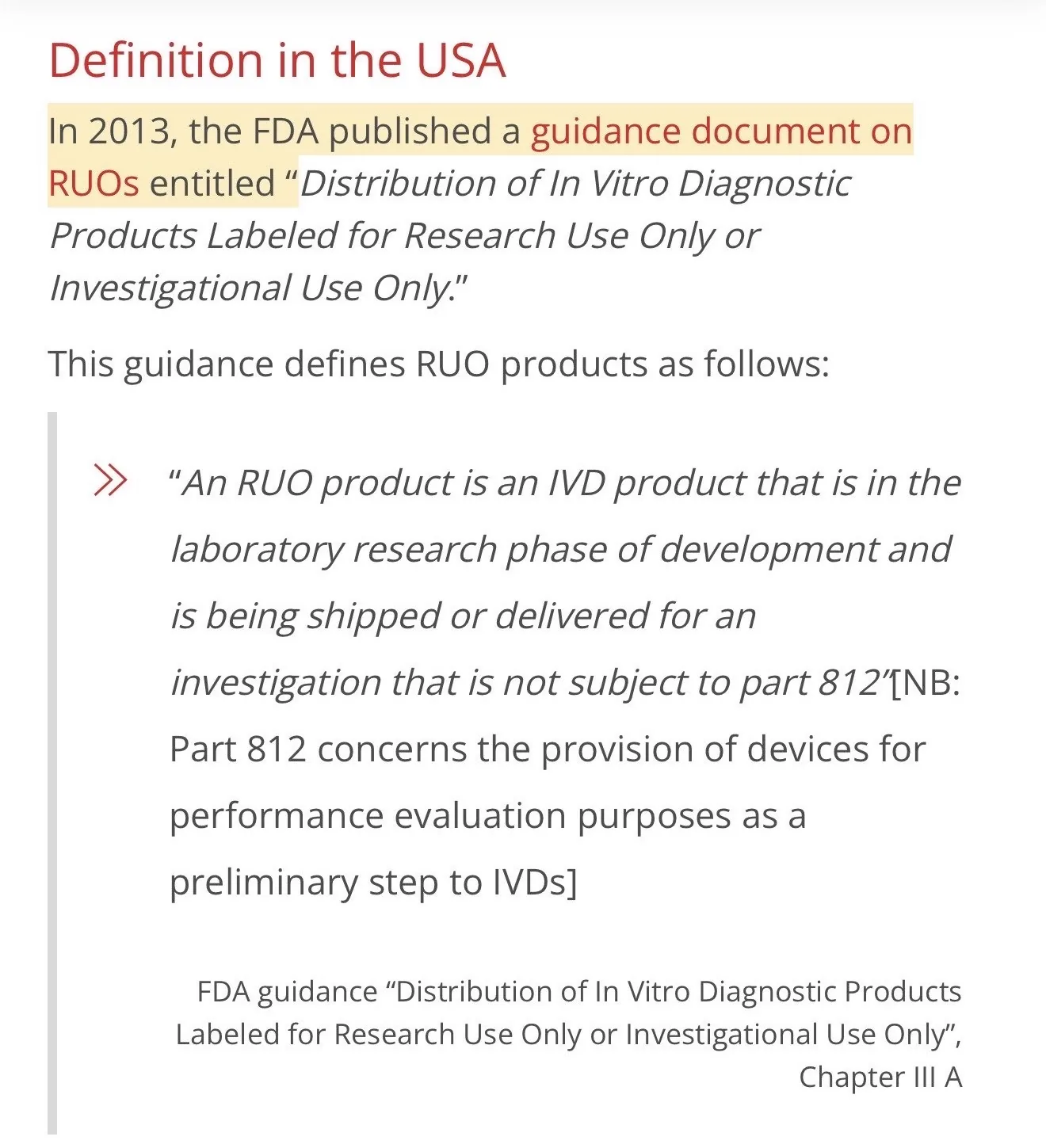
In FDA’s formal system, RUO labelling applies to certain IVD/device products that are still in the laboratory research phase. Under 21 CFR 809.10(c)(2)(i) those products can carry the RUO statement: “For Research Use Only. Not for use in diagnostic procedures.”
FDA later clarified how RUO and IUO labels should be used for IVD products in guidance finalised in 2013.
For peptides sold online as ‘research chemicals,’ the key legal issue is usually intended use. Under FDA’s intended-use rule (21 CFR 201.128), FDA can look at the seller’s labelling, advertising, instructions, and surrounding context. to decide whether a product is being presented as a drug for humans.
If the overall marketing points to human use, an RUO disclaimer doesn’t override that.
How RUO Labelling Emerged in the Peptide Market
So if RUO is a device/IVD concept, why is RUO everywhere in peptides?
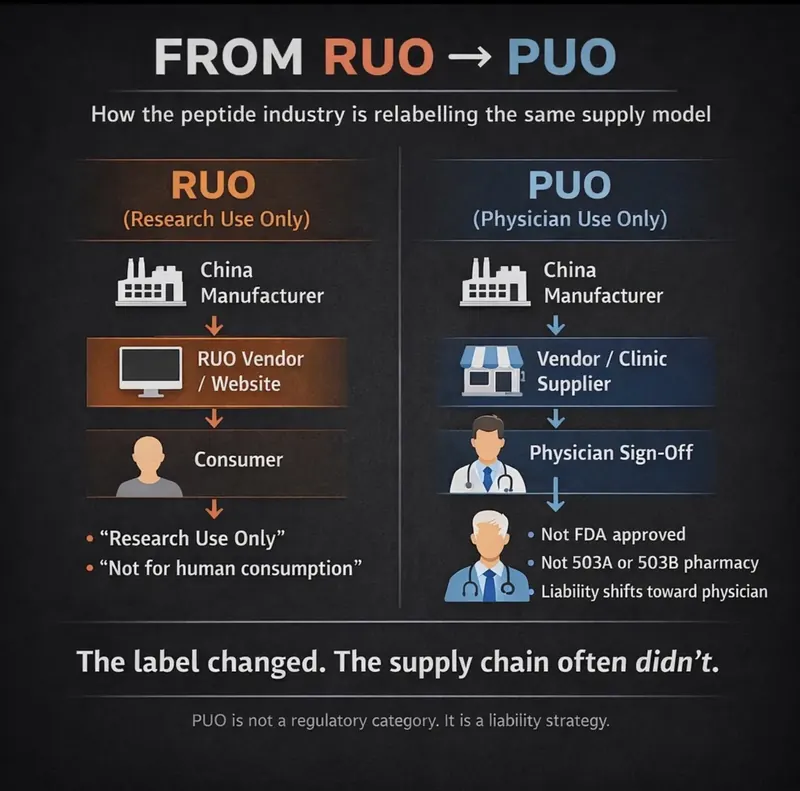
Because in practice, the peptide market adopted RUO-style disclaimers to signal ”this is not being sold for human use.” That became a common risk management pattern in online sales, especially when sellers wanted to avoid explicit therapeutic claims while still selling compounds that consumers were actively self-administering.
At the same time, enforcement and policy activity increasingly focused on (a) compounding rules for peptides, and (b) online sellers marketing GLP-1/weight-loss actives “for research only” while also targeting human outcomes.
RUO Origins and Peptide Market Enforcement: A Verified Timeline
RUO as a formal concept (device/IVD lane)
Pre-2011; (baseline rule). RUO labelling language is codified in the IVD/device labelling regulation at 21 CFR 809.10(c)(2)(i).
2011-06-01; FDA announces availability of a draft RUO/IUO IVD guidance in the Federal Register.
2013-11-25; FDA announces availability of the final RUO/IUO IVD guidance in the Federal Register; the guidance itself is dated Nov 2013 and posted by FDA.
“Intended use” doctrine (drug/peptide lane)
2021-08-02; FDA publishes the final rule “Regulations Regarding ‘Intended Uses’,” amending the intended use regulations (including 21 CFR 201.128) and describing evidence FDA may consider to determine intended use.
Peptides in compounding/sterility enforcement
2017-10-17; FDA warning letter to a compounding pharmacy references a sermorelin/GHRP-6 injection recall due to sterility failure and cites sterile production deficiencies.
2020-04-01 (posted 2020-05-05). FDA warning letter to Tailor Made Compounding states the firm compounded using numerous peptide bulk substances (including GHRP-2, GHRP-6, BPC-157, CJC-1295, ipamorelin, etc.) and that these products did not meet 503A conditions for exemptions.
Online “research-only” storefront crackdown (GLP-1 lane)
2024-10; (review period in letters), FDA reviews multiple websites/social media pages selling GLP-1-related actives (e.g., semaglutide, tirzepatide, retatrutide) as “peptides.”
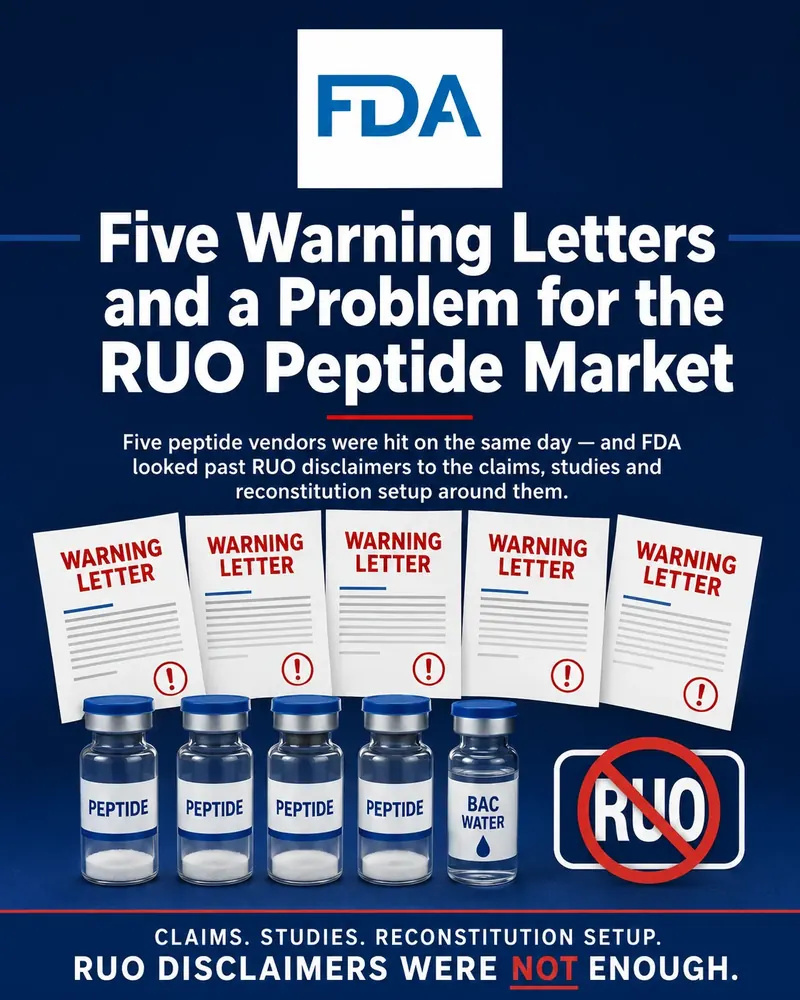
2024-12-10; FDA warning letters to Prime Peptides, Summit Research Peptides, and Swisschems, state that “research use only / not for human consumption” language does not control when website evidence establishes the products are intended to be drugs for human use.
2024-12-17; Reuters reports FDA issued warning letters to multiple online vendors for selling unapproved versions of GLP-1 drugs despite “research use only” positioning.
Pharma/public messaging and state pressure
2024-06-20; Eli Lilly publishes an open letter expressing concern about promotion of tirzepatide labeled “research purposes only” / “not for human consumption.”
2025-02-19; A bipartisan coalition of 38 states and territories urges FDA action against illegal GLP-1 sales; the coalition letter explicitly notes retailers claiming ingredients are ”for research purposes only” / “not for human consumption.”
Market visibility (platform lane)
2020-09-17 The Markup reports peptides were being sold on Amazon with “research” positioning, while reviews indicated human use.
The Rumour vs. The Reality
Because of how RUO style disclaimers function in peptides, misconceptions have grown. Let’s separate the myths from reality:
Misconception 1: “RUO peptides are just low-grade junk peddled by scammers.”
Reality; The RUO label (or RUO-style language) doesn’t automatically indicate chemical quality. It is often used as a marketing/compliance posture. Quality depends on synthesis, handling, identity testing, and (if relevant) sterile processing, none of which are guaranteed by a disclaimer. Enforcement history shows regulators care about both quality systems (sterility/compounding controls) and intended use/marketing.
Misconception 2: “RUO is a shady loophole to trick consumers.”
Reality : In many cases it’s an explicit disclaimer. The core legal problem isn’t the presence of a disclaimer, it’s the mismatch between the disclaimer and the surrounding marketing. FDA’s intended-use framework and recent warning letters are explicit that “research only” language won’t prevent a product being treated as a drug if the broader presentation indicates human therapeutic intent.
Misconception 3: “RUO labelling completely protects sellers from the FDA.”
Reality: It doesn’t. The 2024 warning letters are direct: the sites used “research use only / not for human use” language, but FDA still found evidence of intent for human use based on the total content and promotion.
Misconception 4: “All RUO peptides are illegal to buy or possess.”
Reality: Consumer purchase/possession sits in a grey zone, but regulators generally focus on distribution and marketing of unapproved drugs and misbranding. The intended use doctrine is central: when the product is intended for human therapeutic use, FDA treats it as a drug regardless of “research” disclaimers.
Regulators, Pharma, and the Backlash Against RUO
For years, enforcement against “research chemical” peptide sellers was inconsistent, while compounding and sterile processing issues periodically triggered sharper action. A visible inflection point was FDA’s 2020 warning letter to Tailor Made Compounding, listing many peptides and stating the products did not meet 503A conditions.
From 2024 onward; FDA escalated direct action against online sellers marketing GLP-1 actives and related compounds under research disclaimers while presenting them as human use drugs.
State officials and pharma messaging also increased pressure. In February 2025, a coalition of 38 states and territories urged FDA action and explicitly referenced “research purposes only / not for human consumption” claims used by retailers.
Separately, Eli Lilly publicly criticized the promotion of tirzepatide labeled “research purposes only.”
The Ultimate Irony and Where Do We Go From Here
The core irony is structural: RUO is a real regulatory term in one lane (IVDs/devices) but peptides use RUO-style language in a different lane (drugs), where “intended use” governs. The label alone doesn’t decide status; the surrounding marketing does
If policymakers want to reduce unsafe use, the current dynamic matters: platform visibility (e.g., major marketplaces), inconsistent quality controls, and downstream incentives all shape behavior. The enforcement record suggests the trendline is toward treating “research-only” storefronts as drug sellers when they target human outcomes, especially in the GLP-1 arena
Conclusion
RUO is not “made up,” and it isn’t inherently a scam label. But in peptides, “RUO” is typically a disclaimer strategy, not a regulatory safe harbor. The verifiable history shows: RUO is formally rooted in IVD/device labelling rules and guidance, while the peptide market is policed through intended use doctrine, compounding rules, and targeted enforcement when sellers present “research” products as human therapeutics.
There is a lot of misinformation being published about grey market peptides, by people who actually know nothing about them and have never used them themselves. As part of my substack, I’ll be dispelling these myths and giving readers a clearer picture of what’s actually true, what’s misunderstood, and what the real risks and unknowns are. Most mainstream pieces act like researchers are just ordering random powder and hoping for the best. That’s not the reality inside responsible communities, where the emphasis is the opposite: proper lab testing funded independently or through group testing.
Comments