
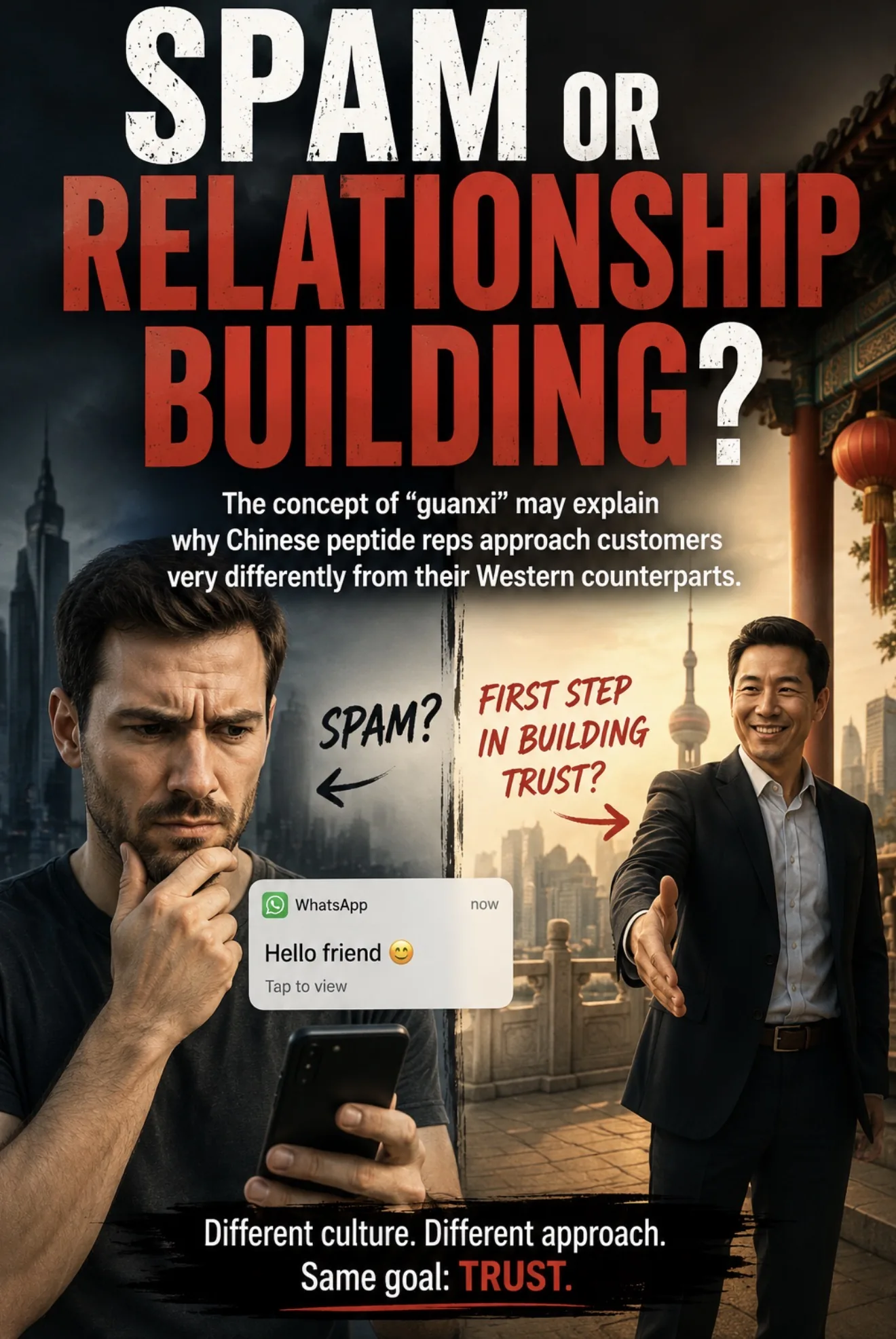
For as long as I can remember, it’s been an established rule within the peptide community that any Chinese rep who contacts you out of the blue is probably a scammer.
More recently, however, I’ve discovered that the reality is not quite so simple. Through my various interviews and conversations with Chinese suppliers, I’ve found that not all unsolicited outreach is necessarily a red flag and I’ve documented a successful purchase that started off as a cold outreach which you can read here.
So after coming across a post by Peptide Mom, I decided to investigate whether there might be a cultural explanation for this behaviour.
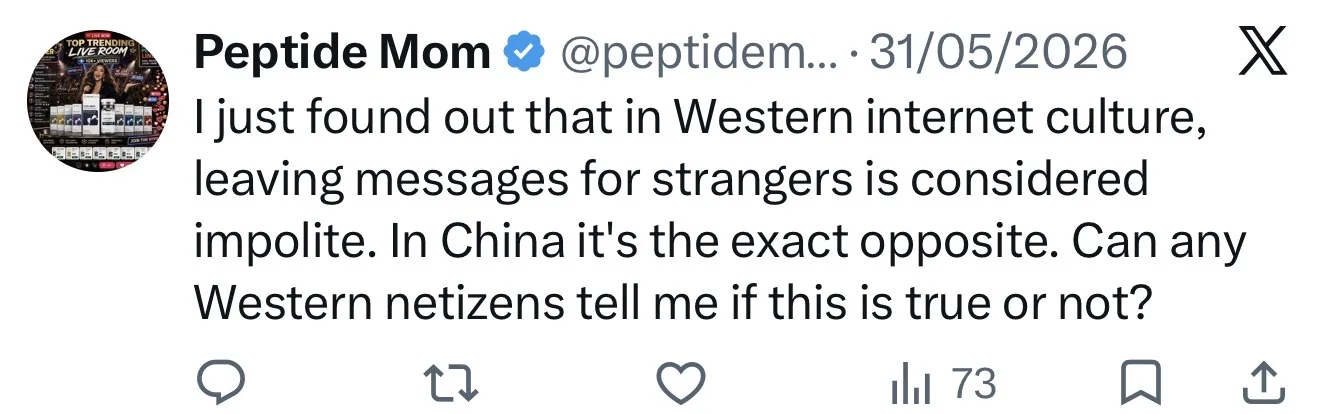
And as it turns out, there may be. The answer appears to centre around a concept known as guanxi.
In Western business culture, an unexpected WhatsApp message from a stranger is often viewed as intrusive, suspicious, or simply spam. In China, researchers describe a very different approach. The concept of guanxi places significant value on building personal relationships, trust, and long-term connections before business is conducted.
Several studies suggest that Chinese businesses often prioritise relationship-building first and commercial transactions second. Rather than waiting for a customer to make contact, outreach itself may be viewed as the first step in establishing trust.
This doesn’t mean every unsolicited message is legitimate, nor does it mean scammers don’t exist. But it may explain why so many Chinese peptide reps seem perfectly comfortable contacting complete strangers, following up regularly, and maintaining communication long after a sale has been completed. So what many Western buyers interpret as spam, may sometimes be something else entirely, an attempt to build a relationship.
What Is Guanxi?
The Harvard Program on Negotiation describes guanxi as:
“The cultivation of personal relationships with people who can be expected to exchange favours, loyalty and support over time.”
Researchers have long identified guanxi as one of the defining characteristics of Chinese business culture. In simple terms, it refers to the network of relationships, trust, obligations and mutual support that develops between people over time. One of the most striking observations made by researchers is that in China:
“Who you know, and how well you know them, often matters as much as what’s written in a contract.”
To many Western readers that may sound surprising. We tend to think of contracts, certifications, regulations and company credentials as the primary basis for trust. But in much of China, relationships themselves are often viewed as a business asset.
Relationships First, Business Second
One of the recurring themes throughout the literature is that Chinese businesses frequently seek to establish trust before pursuing business. Researchers describe how parties often strive to build a trusting relationship first and only then consider the possibility of commercial cooperation. Viewed through that lens, many of the behaviours peptide buyers encounter suddenly make more sense.
The rep who sends a WhatsApp message out of the blue.
The rep who checks in every few weeks despite no active order.
The rep who remembers details from previous conversations.
The rep who sends photos of their family, office, warehouse, or daily life.
These actions may not always be random attempts to make a sale, they may be part of a broader effort to establish familiarity and trust.
Digital Guanxi
What I found particularly interesting was that researchers now describe a modern evolution of this concept called digital guanxi or swift guanxi. Historically, guanxi was built through face-to-face meetings, introductions, gifts and long-term personal interaction. Today, much of that process happens online. Researchers found that trust can be developed through, regular messaging, quick responses, personalised communication, customer support, discounts and special offers and ongoing interaction before and after a purchase. The goal remains the same, turning a stranger into a trusted relationship. In fact, one paper describes swift guanxi as an important driver of modern Chinese online commerce.
So now the behaviour of many peptide reps starts to look much less unusual.
Why Western Buyers Sometimes Misinterpret It
The problem is that Western buyers and Chinese sales representatives are often working from entirely different assumptions. A Western buyer may receive an unsolicited WhatsApp message and think, “Why is this stranger contacting me?” while the Chinese sales representative may be thinking, “This is how relationships begin”
Neither side necessarily understands the assumptions of the other and what one side sees as networking, the other may see as spam. What one side sees as relationship-building, the other may interpret as a sales tactic. The result is frequent misunderstanding.
Does This Mean Every Rep Is Genuine?
Of course not. The existence of guanxi doesn’t magically transform every unsolicited message into a legitimate business opportunity. Scammers exist. Fake vendors exist. Fake laboratories exist and plenty of people exploit trust for personal gain. But what the research suggests is simply that unsolicited outreach alone shouldn’t automatically be treated as evidence of fraud. The behaviour itself may be culturally normal, even if the individual behind it still requires proper due diligence.
Guanxi’s Partner: Mianzi
Closely linked to guanxi is another important Chinese cultural concept known as mianzi, often translated as “face.” Researchers describe face as a person’s social standing, reputation, prestige, and the respect they receive from others. Maintaining face, protecting face, and helping others save face play a significant role in Chinese social and business interactions. This can sometimes lead to behaviour that Western buyers find confusing.
For example, direct criticism may be avoided, mistakes may be handled indirectly, and considerable effort may be invested in presenting a professional and successful image. Researchers have also noted that modern Chinese business communications often involve strategies designed to “add face” through reputation-building, status signals, endorsements, and demonstrations of success.
That doesn’t mean misleading claims should be accepted without scrutiny. Due diligence remains essential. However, understanding the role of mianzi may help explain why Chinese businesses often place such importance on image, reputation, relationships, and social standing alongside more traditional business credentials.
In many ways, guanxi explains why the relationship matters, while mianzi helps explain why reputation matters.
What About Vendors Spamming Our Servers?
Another common assumption in the peptide community is that any vendor who joins a server and immediately starts spamming the server with promotions must be a scammer. Again, in many cases now that’s true, but after booting legit vendors for doing this, its definitely not always the case.
An example of this is Peptide Pole Hong Kong. I had to add a filter to prevent them spamming my Pepchat servers and most people have assumed they're scammers, however, today a customer confirmed that after receiving a zero kit from them, they’ve refunded the customer the price of the kit as well as the testing fee and he’s made numerous purchases from them before.
So after reading the research on guanxi and modern Chinese business culture, I wonder whether we occasionally misinterpret what we’re seeing. Viewed through a Western POV, a rep posting repeatedly in multiple servers may look aggressive, desperate, or suspicious. Viewed through the lens of guanxi, the same behaviour may be seen as networking, visibility, and relationship-building. In other words, the rep may not be thinking, “How can I spam as many people as possible?” Instead, they may be thinking, “How can I introduce myself, build connections, and become known within this community?”
Again, this doesn’t mean every vendor who floods channels with advertisements is trustworthy, some absolutely are not. Nor does it mean communities should tolerate excessive advertising or poor behaviour. But what it does suggest is that unsolicited outreach, server promotion, and constant visibility may not always be intended as red flags. In some cases, they may reflect a different set of cultural assumptions about how business relationships are formed.
The challenge for buyers is learning to distinguish between genuine relationship-building and simple spam as those two things can sometimes look remarkably similar.
Final Thoughts
After reading the research, this whole exercise has largely confirmed my suspicion that at least some of the behaviour Western buyers often view as suspicious may simply be the result of cultural differences.
The concepts of guanxi and digital guanxi suggest that many of these behaviours are not only normal in China but are actively encouraged as part of doing business.
That said, a line still has to be drawn somewhere. While cultural differences may explain certain communication styles and business practices, they don’t explain everything. The use of fake laboratories, fabricated testing credentials, misleading COAs, or other forms of deception can’t simply be dismissed as cultural differences. Those issues raise legitimate questions regardless of where a company is based.
In the case of Peptide Mom, the verdict is still very much out. My instinct is that we may be looking at a mixture of both. I have a feeling the vendor is legit but using unscrupulous sales tactics.
So for now, I still remain open-minded.
Disclaimer: This article is intended for educational and informational purposes only. It explores cultural and academic research relating to Chinese business practices and does not constitute an endorsement of any vendor, company, representative, product, or service. Readers should always conduct their own due diligence when evaluating suppliers, testing claims, certifications, or business credentials.
References
Harvard Program on Negotiation.
The Importance of Relationship Building in China. Harvard Law School.
Discusses the role of guanxi in Chinese business culture and the importance of long-term relationship-building in commercial interactions.
Gao, H., Knight, J.G., & Ballantyne, D. (2012).
Guanxi as a Gateway in Chinese-Western Business Relationships. Journal of Business & Industrial Marketing, 27(6), 456 to 467.
Examines how guanxi functions as a bridge between Chinese and Western business cultures and explores the importance of personal relationships in Chinese commerce.
Skalnaya, O. (2024).
“Guanxi Management” and “Facework” in Modern Chinese Business Culture.
Explores the concepts of guanxi, mianzi (face), digital relationship-building, WeChat business communication, and the emergence of “swift guanxi” in online commerce.

Comments